


Acquisition of habitual visual attention and transfer to related tasks
- PMID: 28698989
- PMCID: PMC5764836
- DOI: 10.3758/s13423-017-1341-5
Acquisition of habitual visual attention and transfer to related tasks
Abstract
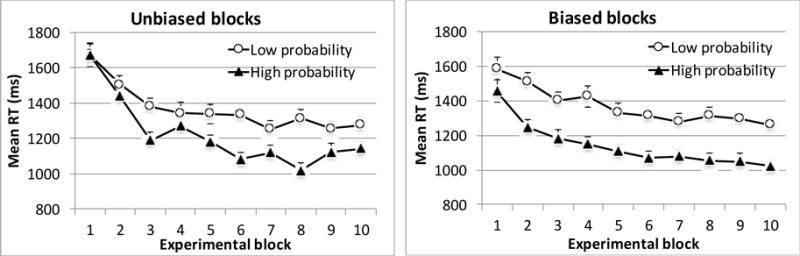
Extensive research has shown that statistical learning affects perception, attention, and action control; however, few studies have directly linked statistical learning with the formation of habits. Evidence that learning can induce a search habit has come from location probability learning, in which people prioritize locations frequently attended to in the past. Here, using an alternating training-testing procedure, we demonstrated that the initial attentional bias arises from short-term intertrial priming, whereas probability learning takes longer to emerge, first reaching significance in covert orienting (measured by reaction times) after about 48 training trials, and in overt orienting (measured by eye movements) after about 96 training trials. We further showed that location probability learning is persistent after training is discontinued, by transferring from a letter search task to a scene search task-emulating another characteristic feature of habits. By identifying the onset of probability learning and investigating its task specificity, this study provides evidence that probability cuing can induce habitual spatial attention.
Keywords: Eyetracking; Habitual attention; Probability cuing; Statistical learning; Visual search.
Figures




References
-
- Bayley PJ, Frascino JC, Squire LR. Robust habit learning in the absence of awareness and independent of the medial temporal lobe. Nature. 2005;436(7050):550–553. https://doi.org/10.1038/nature03857. - DOI - PMC - PubMed
-
- Brainard DH. The Psychophysics Toolbox. Spatial Vision. 1997;10(4):433–436. - PubMed
-
- Chun MM, Jiang Y. Contextual cueing: implicit learning and memory of visual context guides spatial attention. Cognitive Psychology. 1998;36(1):28–71. https://doi.org/10.1006/cogp.1998.0681. - DOI - PubMed
-
- Druker M, Anderson B. Spatial probability aids visual stimulus discrimination. Frontiers in Human Neuroscience. 2010:4. https://doi.org/10.3389/fnhum.2010.00063. - DOI - PMC - PubMed
-
- Geng JJ, Behrmann M. Probability cuing of target location facilitates visual search implicitly in normal participants and patients with hemispatial neglect. Psychological Science. 2002;13(6):520–525. - PubMed
Publication types
MeSH terms
Grants and funding
LinkOut - more resources
Full Text Sources
Other Literature Sources
Miscellaneous
