


Quantitative CrAssphage PCR Assays for Human Fecal Pollution Measurement
- PMID: 28700235
- PMCID: PMC7350147
- DOI: 10.1021/acs.est.7b02703
Quantitative CrAssphage PCR Assays for Human Fecal Pollution Measurement
Abstract
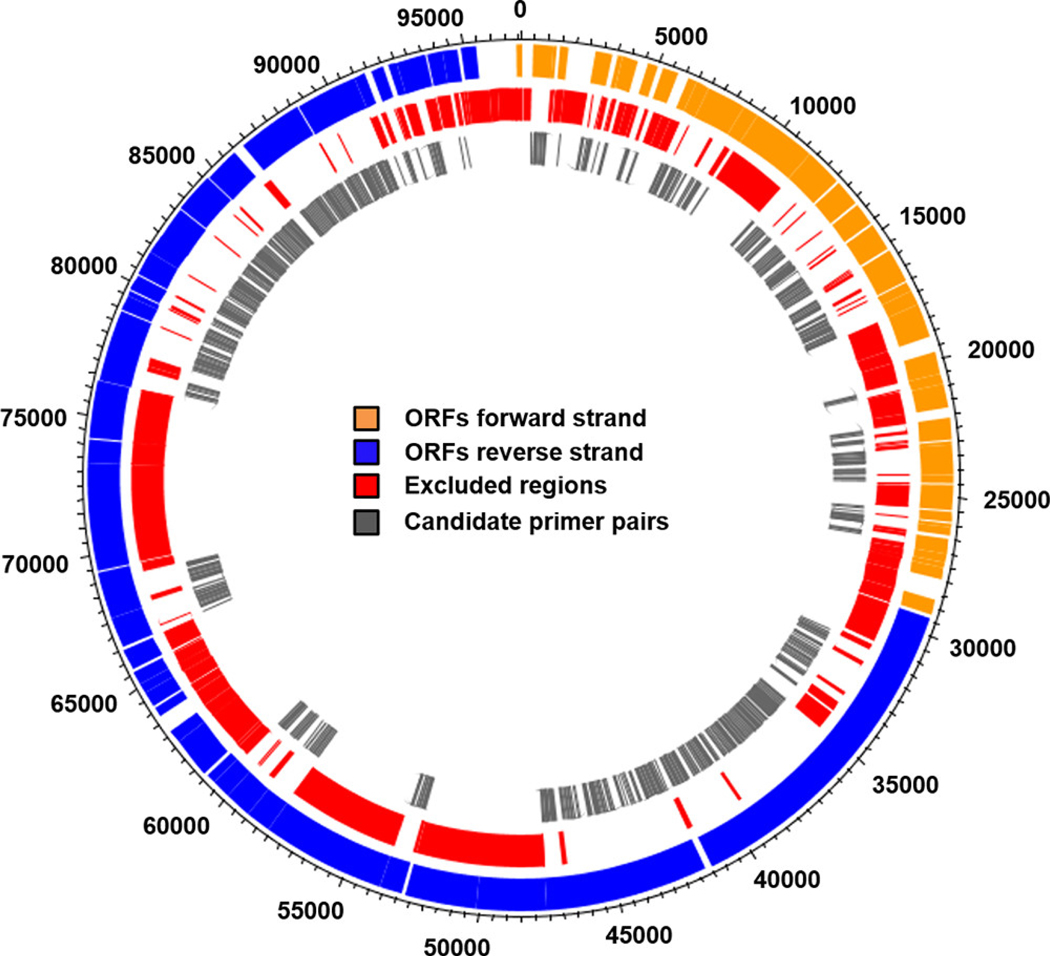
Environmental waters are monitored for fecal pollution to protect public health and water resources. Traditionally, general fecal-indicator bacteria are used; however, they cannot distinguish human fecal waste from other animal pollution sources. Recently, a novel bacteriophage, crAssphage, was discovered by metagenomic data mining and reported to be abundant in and closely associated with human fecal waste. To confirm bioinformatic predictions, 384 primer sets were designed along the length of the crAssphage genome. Based on initial screening, two novel crAssphage qPCR assays (CPQ_056 and CPQ_064) were designed and evaluated in reference fecal samples and water matrices. The assays exhibited high specificities (98.6%) when tested against an animal fecal reference library, and crAssphage genetic markers were highly abundant in raw sewage and sewage-impacted water samples. In addition, CPQ_056 and CPQ_064 performance was compared to HF183/BacR287 and HumM2 assays in paired experiments. Findings confirm that viral crAssphage qPCR assays perform at a similar level to well-established bacterial human-associated fecal-source-identification approaches. These new viral-based assays could become important water quality management and research tools.
Figures

References
-
- Boehm A; Soller J, Risks associated with recreational waters: pathogens and fecal indicators Encyclopedia of Sustainability Science and Technology; Springer Publishing: New York, 2011.
-
- Green HC; Haugland RA; Varma M; Millen HT; Borchardt MA; Field KG; Walters WA;Knight R; Sivaganesan M; Kelty CA Improved HF183 quantitative real-time PCR assay for characterization of human fecal pollution in ambient surface water samples Appl. Environ. Microbiol 2014,80 (10) 3086–3094 DOI: 10.1128/AEM.04137-13 - DOI - PMC - PubMed
MeSH terms
Substances
Grants and funding
LinkOut - more resources
Full Text Sources
Other Literature Sources
Medical
Miscellaneous
