Years of life lost due to traumatic brain injury in Europe: A cross-sectional analysis of 16 countries
- PMID: 28700588
- PMCID: PMC5507416
- DOI: 10.1371/journal.pmed.1002331
Years of life lost due to traumatic brain injury in Europe: A cross-sectional analysis of 16 countries
Abstract
Introduction: Traumatic brain injuries (TBIs) are a major public health, medical, and societal challenge globally. They present a substantial burden to victims, their families, and the society as a whole. Although indicators such as incidence or death rates provide insight into the occurrence and outcome of TBIs in various populations, they fail to quantify the full extent of their public health and societal impact. Measures such as years of life lost (YLLs), which quantifies the number of years of life lost because the person dies prematurely due to a disease or injury, should be employed to better quantify the population impact. The aim of this study was to provide an in-depth analysis of the burden of deaths due to TBI by calculating TBI-specific YLLs in 16 European countries, analyzing their main causes and demographic patterns, using data extracted from death certificates under unified guidelines and collected in a standardized manner.
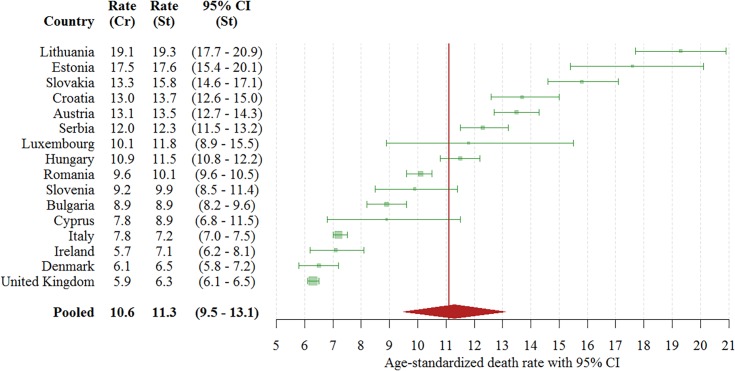
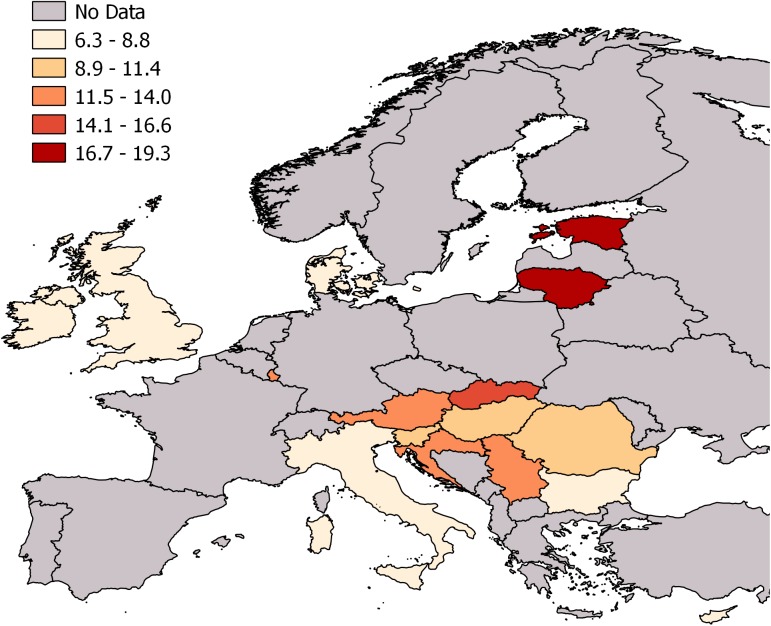
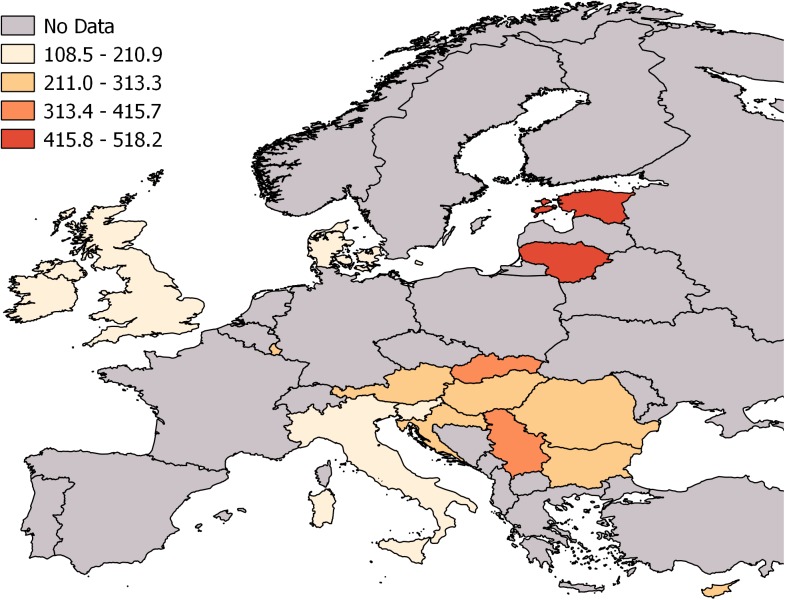
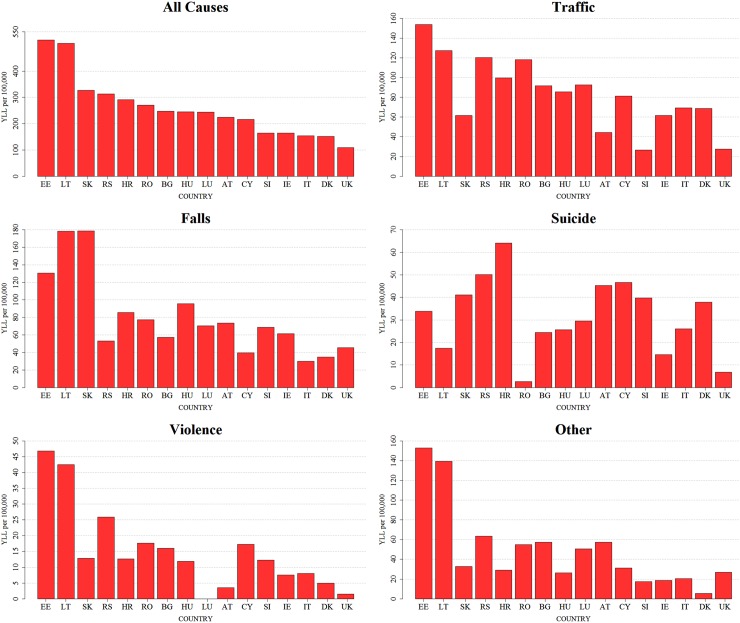
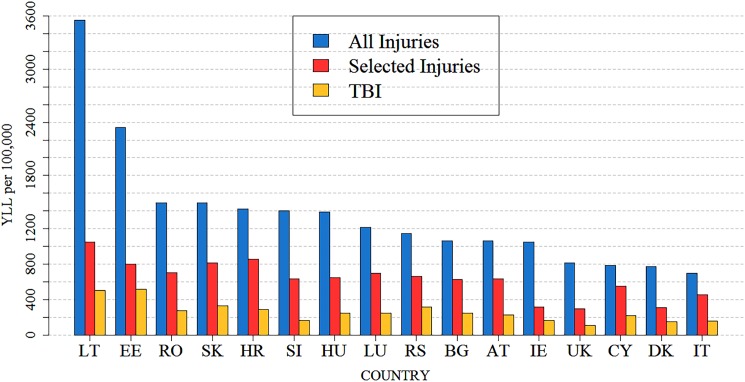
Methods and findings: A population-wide, cross-sectional epidemiological study was conducted in 16 European countries to estimate TBI YLLs for the year 2013. The data used for all analyses in this study were acquired from the statistical office of the European Union (Eurostat). A specifically tailored dataset of micro-level data was provided that listed the external cause of death (International Classification of Diseases-10th Revision [ICD-10] codes V01-Y98), the specific nature of injury (ICD-10 codes S00-T98), the age at death, and sex for each death. Overall number of TBI YLLs, crude and age-standardized TBI YLL rates, and TBI YLLs per case were calculated stratified for country, sex, and age. Pooled analyses were performed in order to estimate summary age-standardized rates of TBI YLLs. In order to evaluate the relative importance of TBI in the context of all injuries, proportions of TBI YLLs out of overall injury YLLs were calculated. The total number of TBI YLLs was estimated by extrapolating the pooled crude rate of TBI YLLs in the 16 analyzed countries to the total population of the 28 member states of the EU (EU-28). We found that a total of 17,049 TBI deaths occurred in 2013 in the 16 analyzed countries. These translated into a total of 374,636 YLLs. The pooled age-standardized rate of YLLs per 100,000 people per year was 259.1 (95% CI: 205.8 to 312.3) overall, 427.5 (95% CI: 290.0 to 564.9) in males, and 105.4 (95% CI: 89.1 to 121.6) in females. Males contributed substantially more to TBI YLLs than females (282,870 YLLs, 76% of all TBI YLLs), which translated into a rate ratio of 3.24 (95% CI: 3.22 to 3.27). Each TBI death was on average associated with 24.3 (95% CI: 22.0 to 26.6) YLLs overall, 25.6 (95% CI: 23.4 to 27.8) in males and 20.9 (17.9 to 24.0) in females. Falls and traffic crashes were the most common external causes of TBI YLLs. TBI contributed on average 41% (44% in males and 34% in females) to overall injury YLLs. Extrapolating our findings, about 1.3 million YLLs were attributable to TBI in the EU-28 in 2013 overall, 1.1 million in males and 271,000 in females. This study is based on administratively collected data from 16 countries, and despite the efforts to harmonize them to the greatest possible extent, there may be differences in coding practices or reporting between countries. If present, these would be inherited into our findings without our ability to control for them. The extrapolation of the pooled rates from the 16 countries to the EU-28 should be interpreted with caution.
Conclusions: Our study showed that TBI-related deaths and YLLs have a substantial impact at the individual and population level in Europe and present an important societal and economic burden that must not be overlooked. We provide information valuable for policy-makers, enabling them to evaluate and plan preventive activities and resource allocation, and to formulate and implement strategic decisions. In addition, our results can serve as a basis for analyzing the overall burden of TBI in the population.
Conflict of interest statement
MM, AM, MR and AB received funding during the writing of this Article within the project Collaborative European Neurotrauma Effectiveness Research in Traumatic Brain Injury (CENTER-TBI) supported by the European Union Seventh Framework Programme (FP7/2007–2013) under grant agreement number 602150.
Figures
References
-
- Hyder AA, Wunderlich CA, Puvanachandra P, Gururaj G, Kobusingye OC. The impact of traumatic brain injuries: a global perspective. NeuroRehabilitation. 2007;22(5):341–53. - PubMed
-
- Maas AI, Stocchetti N, Bullock R. Moderate and severe traumatic brain injury in adults. Lancet Neurol. 2008;7(8):728–41. doi: 10.1016/S1474-4422(08)70164-9 - DOI - PubMed
-
- Reilly P. The impact of neurotrauma on society: an international perspective. Prog Brain Res. 2007;161:3–9. doi: 10.1016/S0079-6123(06)61001-7 - DOI - PubMed
-
- Rubiano AM, Carney N, Chesnut R, Puyana JC. Global neurotrauma research challenges and opportunities. Nature. 2015;527(7578):S193–7. doi: 10.1038/nature16035 - DOI - PubMed
-
- Majdan M, Plancikova D, Brazinova A, Rusnak M, Nieboer D, Feigin V, et al. Epidemiology of traumatic brain injuries in Europe: a cross-sectional analysis. Lancet Public Health. 2016;1(2):e76–83. doi: 10.1016/S2468-2667(16)30017-2 - DOI - PubMed
MeSH terms
LinkOut - more resources
Full Text Sources
Other Literature Sources
Medical