


Age dependent differences in the kinetics of γδ T cells after influenza vaccination
- PMID: 28700738
- PMCID: PMC5507438
- DOI: 10.1371/journal.pone.0181161
Age dependent differences in the kinetics of γδ T cells after influenza vaccination
Abstract
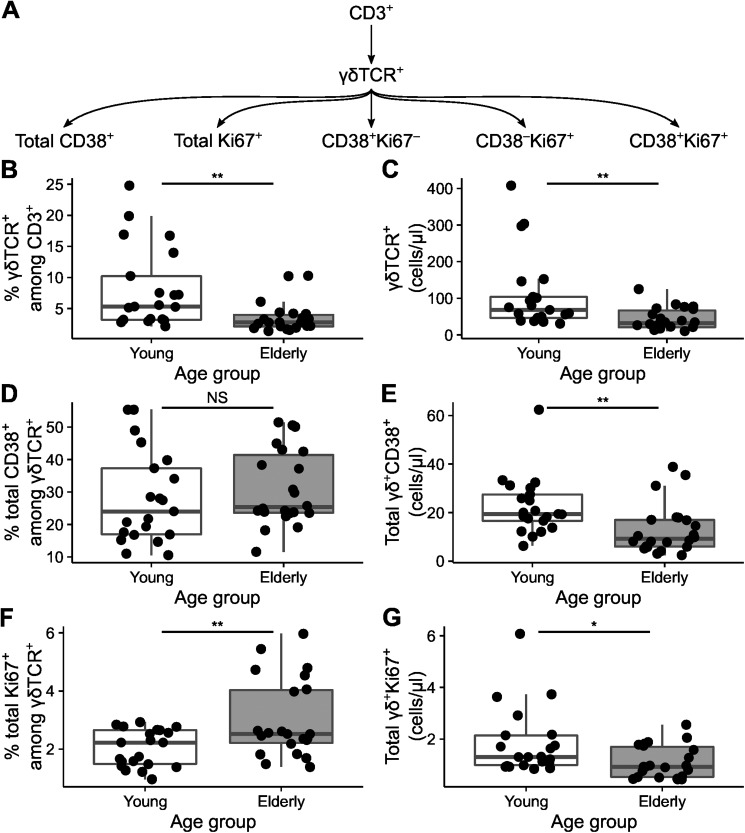
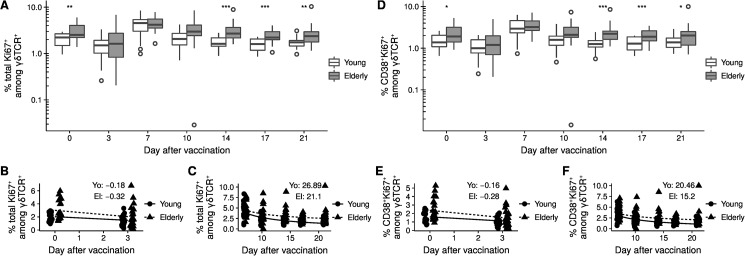
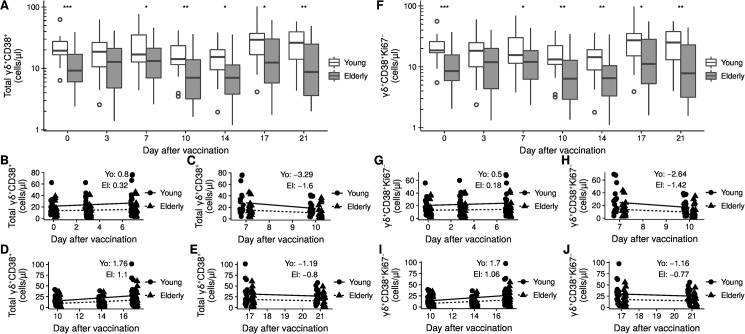
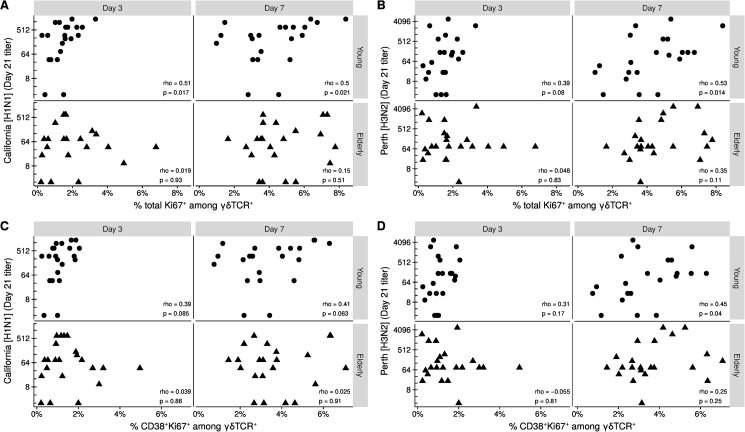
Immunosenescence is a hallmark of the aging immune system and is considered the main cause of a reduced vaccine efficacy in the elderly. Although γδ T cells can become activated by recombinant influenza hemagglutinin, their age-related immunocompetence during a virus-induced immune response has so far not been investigated. In this study we evaluate the kinetics of γδ T cells after vaccination with the trivalent 2011/2012 northern hemisphere seasonal influenza vaccine. We applied multi-parametric flow cytometry to a cohort of 21 young (19-30 years) and 23 elderly (53-67 years) healthy individuals. Activated and proliferating γδ T cells, as identified by CD38 and Ki67 expression, were quantified on the days 0, 3, 7, 10, 14, 17, and 21. We observed a significantly lower number of activated and proliferating γδ T cells at baseline and following vaccination in elderly as compared to young individuals. The kinetics changes of activated γδ T cells were much stronger in the young, while corresponding changes in the elderly occurred slower. In addition, we observed an association between day 21 HAI titers of influenza A and the frequencies of Ki67+ γδ T cells at day 7 in the young. In conclusion, aging induces alterations of the γδ T cell response that might have negative implications for vaccination efficacy.
Conflict of interest statement
Figures
References
-
- Preaud E, Durand L, Macabeo B, Farkas N, Sloesen B, Palache A, et al. Annual public health and economic benefits of seasonal influenza vaccination: a European estimate. BMC Public Health. 2014;14: 813 doi: 10.1186/1471-2458-14-813 - DOI - PMC - PubMed
-
- Osterholm MT, Kelley NS, Sommer A, Belongia EA. Efficacy and effectiveness of influenza vaccines: a systematic review and meta-analysis. Lancet Infect Dis. 2012;12: 36–44. doi: 10.1016/S1473-3099(11)70295-X - DOI - PubMed
-
- Holtmeier W, Kabelitz D. gammadelta T cells link innate and adaptive immune responses. Chem Immunol Allergy. 2005;86: 151–183. doi: 10.1159/000086659 - DOI - PubMed
-
- Chien Y, Meyer C, Bonneville M. γδ T cells: first line of defense and beyond. Annu Rev Immunol. 2014;32: 121–155. doi: 10.1146/annurev-immunol-032713-120216 - DOI - PubMed
-
- Wu Y-L, Ding Y-P, Tanaka Y, Shen L-W, Wei C-H, Minato N, et al. γδ T cells and their potential for immunotherapy. Int J Biol Sci. 2014;10: 119–135. doi: 10.7150/ijbs.7823 - DOI - PMC - PubMed
MeSH terms
Substances
LinkOut - more resources
Full Text Sources
Other Literature Sources
Medical
Research Materials
