


Population-Based Assessment of a Biomarker-Based Screening Pathway to Aid Diagnosis of Monogenic Diabetes in Young-Onset Patients
- PMID: 28701371
- PMCID: PMC5570522
- DOI: 10.2337/dc17-0224
Population-Based Assessment of a Biomarker-Based Screening Pathway to Aid Diagnosis of Monogenic Diabetes in Young-Onset Patients
Abstract
Objective: Monogenic diabetes, a young-onset form of diabetes, is often misdiagnosed as type 1 diabetes, resulting in unnecessary treatment with insulin. A screening approach for monogenic diabetes is needed to accurately select suitable patients for expensive diagnostic genetic testing. We used C-peptide and islet autoantibodies, highly sensitive and specific biomarkers for discriminating type 1 from non-type 1 diabetes, in a biomarker screening pathway for monogenic diabetes.
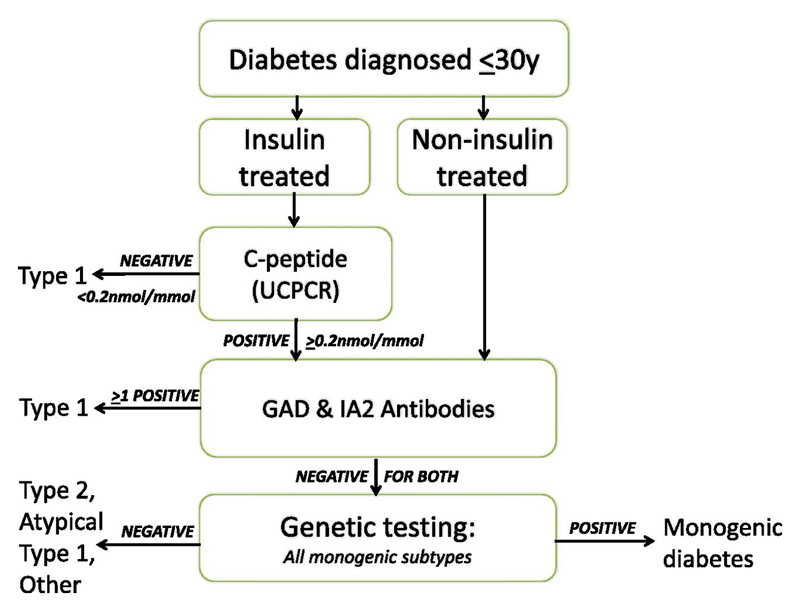
Research design and methods: We studied patients diagnosed at age 30 years or younger, currently younger than 50 years, in two U.K. regions with existing high detection of monogenic diabetes. The biomarker screening pathway comprised three stages: 1) assessment of endogenous insulin secretion using urinary C-peptide/creatinine ratio (UCPCR); 2) if UCPCR was ≥0.2 nmol/mmol, measurement of GAD and IA2 islet autoantibodies; and 3) if negative for both autoantibodies, molecular genetic diagnostic testing for 35 monogenic diabetes subtypes.
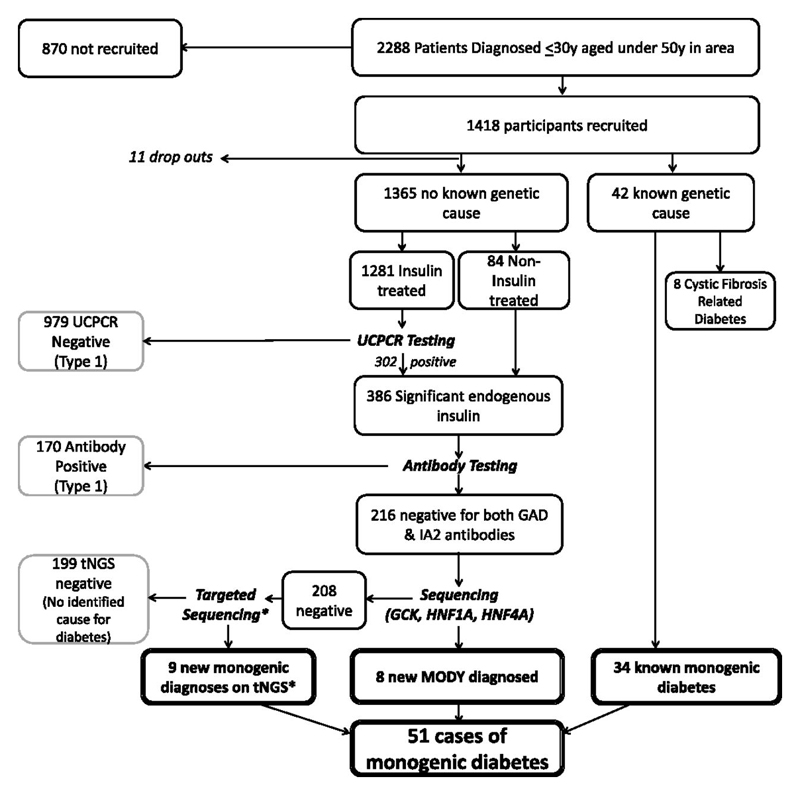
Results: A total of 1,407 patients participated (1,365 with no known genetic cause, 34 with monogenic diabetes, and 8 with cystic fibrosis-related diabetes). A total of 386 out of 1,365 (28%) patients had a UCPCR ≥0.2 nmol/mmol, and 216 out of 386 (56%) were negative for GAD and IA2 and underwent molecular genetic testing. Seventeen new cases of monogenic diabetes were diagnosed (8 common Maturity Onset Diabetes of the Young [Sanger sequencing] and 9 rarer causes [next-generation sequencing]) in addition to the 34 known cases (estimated prevalence of 3.6% [51/1,407] [95% CI 2.7-4.7%]). The positive predictive value was 20%, suggesting a 1-in-5 detection rate for the pathway. The negative predictive value was 99.9%.
Conclusions: The biomarker screening pathway for monogenic diabetes is an effective, cheap, and easily implemented approach to systematically screening all young-onset patients. The minimum prevalence of monogenic diabetes is 3.6% of patients diagnosed at age 30 years or younger.
Trial registration: ClinicalTrials.gov NCT01238380.
© 2017 by the American Diabetes Association.
Conflict of interest statement
BS had full access to all the data in the study and had final responsibility for the decision to submit for publication
Figures
References
-
- Diabetes UK. Diabetes in the UK 2012: Key statistics on diabetes. 2012
-
- Scottish Diabetes Survey Monitoring Group NS. Scottish Diabetes Survey 2014. 2014
-
- Shields BM, Hicks S, Shepherd MH, Colclough K, Hattersley AT, Ellard S. Maturity-onset diabetes of the young (MODY): how many cases are we missing? Diabetologia. 2010;53:2504–2508. - PubMed
-
- Rubio-Cabezas O, Hattersley AT, Njolstad PR, Mlynarski W, Ellard S, White N, Chi DV, Craig ME, International Society for P, Adolescent D ISPAD Clinical Practice Consensus Guidelines 2014. The diagnosis and management of monogenic diabetes in children and adolescents. Pediatric diabetes. 2014;15(Suppl 20):47–64. - PubMed
-
- Zeitler P, Fu J, Tandon N, Nadeau K, Urakami T, Barrett T, Maahs D, International Society for P, Adolescent D ISPAD Clinical Practice Consensus Guidelines 2014. Type 2 diabetes in the child and adolescent. Pediatric diabetes. 2014;15(Suppl 20):26–46. - PubMed
MeSH terms
Substances
Associated data
Grants and funding
LinkOut - more resources
Full Text Sources
Other Literature Sources
Medical
