. 2017 Sep 1;118(3):1739-1748.
doi: 10.1152/jn.00844.2016. Epub 2017 Jul 12.

Aging does not affect the intralimb coordination elicited by slip-like perturbation of different intensities

Affiliations

Aging does not affect the intralimb coordination elicited by slip-like perturbation of different intensities

Federica Aprigliano et al. J Neurophysiol. .

Abstract

This study was aimed at verifying whether aging modifies intralimb coordination strategy during corrective responses elicited by unexpected slip-like perturbations delivered during steady walking on a treadmill. To this end, 10 young and 10 elderly subjects were asked to manage unexpected slippages of different intensities. We analyzed the planar covariation law of the lower limb segments, using the principal component analysis, to verify whether elevation angles of older subjects covaried along a plan before and after the perturbation. Results showed that segments related to the perturbed limbs of both younger and older people do not covary after all perturbations. Conversely, the planar covariation law of the unperturbed limb was systematically held for younger and older subjects. These results occurred despite differences in spatio-temporal and kinematic parameters being observed among groups and perturbation intensities. Overall, our analysis revealed that aging does not affect intralimb coordination during corrective responses induced by slip-like perturbation, suggesting that both younger and older subjects adopt this control strategy while managing sudden and unexpected postural transitions of increasing intensities. Accordingly, results corroborate the hypothesis that balance control emerges from a governing set of biomechanical invariants, that is, suitable control schemes (e.g., planar covariation law) shared across voluntary and corrective motor behaviors, and across different sensory contexts due to different perturbation intensities, in both younger and older subjects. In this respect, our findings provide further support to investigate the effects of specific task training programs to counteract the risk of fall.NEW & NOTEWORTHY This study was aimed at investigating how aging affects the intralimb coordination of lower limb segments, described by the planar covariation law, during unexpected slip-like perturbations of increasing intensity. Results revealed that neither the aging nor the perturbation intensity affects this coordination strategy. Accordingly, we proposed that the balance control emerges from an invariant set of control schemes shared across different sensory motor contexts and despite age-related neuromuscular adaptations.

Keywords: aging; corrective response; intralimb coordination; motor control; unexpected slip-like perturbations.


Figures

Fig. 1.
Fig. 1.
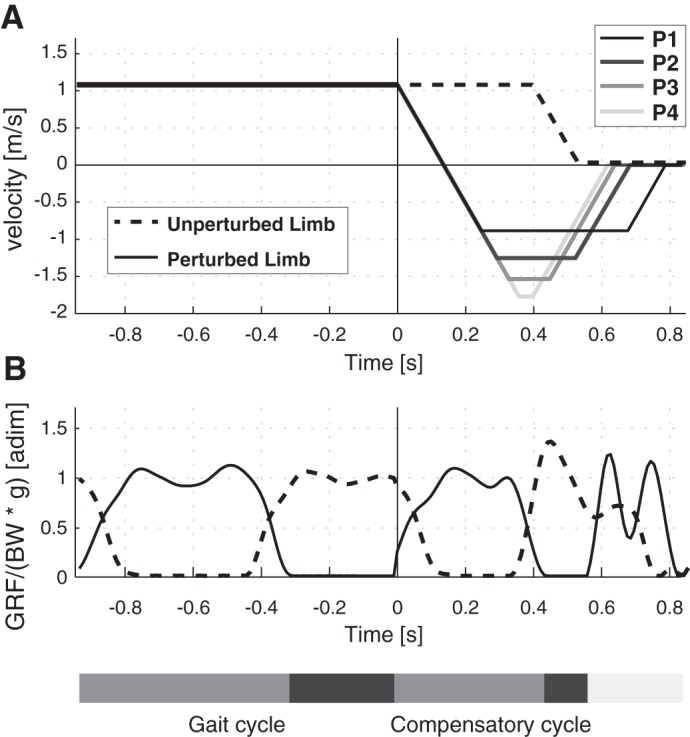
Belt velocity profiles (A) and vertical component (B) of the ground reaction force (GRF), normalized to subjects’ body weight (BW) and gravitational acceleration (g), referred to the perturbed and unperturbed limbs (solid and dashed lines, respectively). The time course (in s) of the gait and compensatory cycles is represented along the horizontal axes; 0 s corresponds to the onset of the perturbation. Stance and swing phases of the gait and compensatory cycles are reported in light and dark gray bars, respectively.
Fig. 2.
Fig. 2.
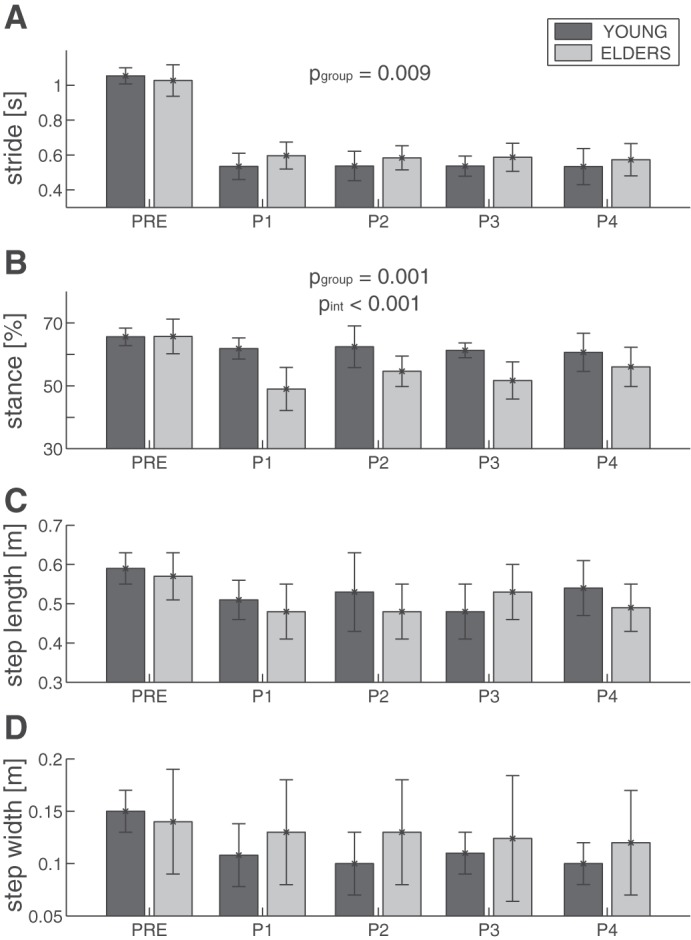
Temporal (stride duration and stance%; A and B) and spatial (step length and width; C and D) parameters are expressed as mean and 1 SD and refer to the perturbed limb (PL). Bars refer to young (dark gray; n = 10) and elderly (light gray; n = 10) people for all experimental conditions (i.e., PRE, P1, P2, P3, and P4). Significant P values related to the 2-way ANOVA on data POST are reported for group (pgoup) and perturbation intensity (pint) factors.
Fig. 3.
Fig. 3.
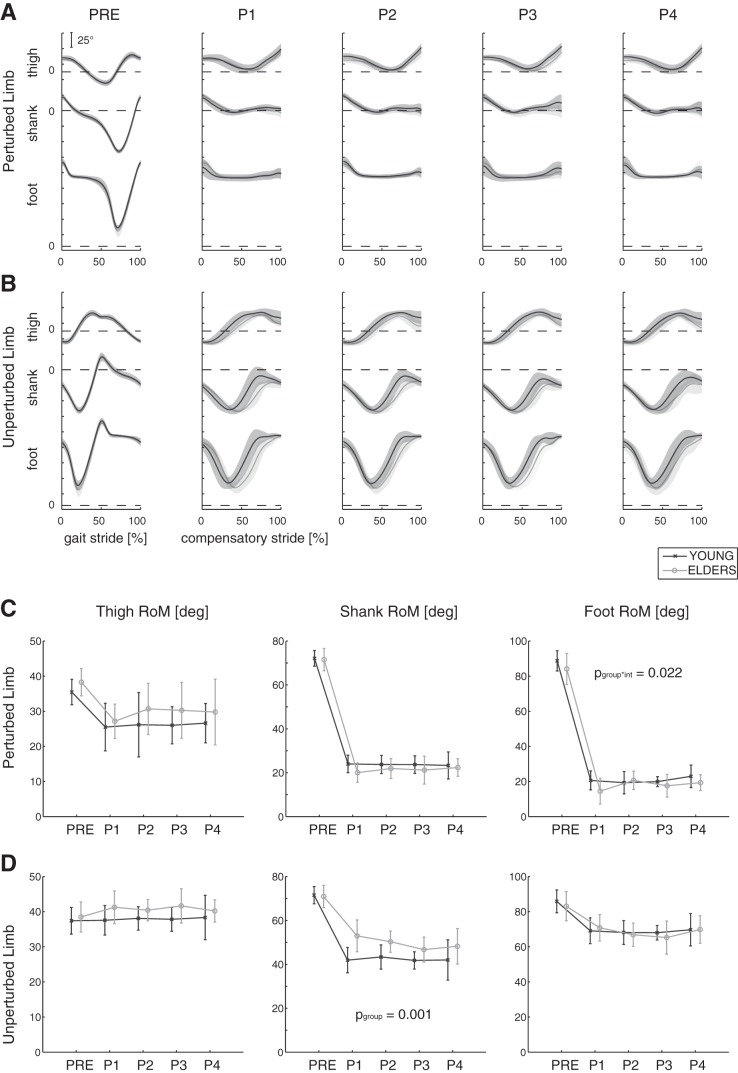
A and B: elevation angle profile of thigh, shank, and foot. The time course (in %) of the gait and compensatory cycles is represented along the horizontal axes for both the perturbed (PL; A) and the unperturbed limbs (UL; B); 0 and 100% correspond to 2 consecutive heel strikes of the PL. Mean (bold lines) and 1 SD (shaded areas) are shown for each group (young: n = 10, dark gray; elders: n = 10, light gray) and for all experimental conditions (i.e., PRE, P1, P2, P,3 and P4). C and D. Range of motion (RoM) of elevation angles (means ± 1 SD) is represented for young and elders (dark and light gray, respectively) and for all trials. Significant P values, related to the 2-way ANOVA on data POST, are reported for group (pgoup) and perturbation intensity (pint) factors.
Fig. 4.
Fig. 4.
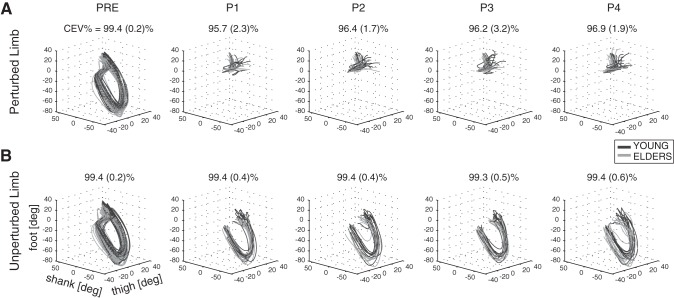
Planar covariation of elevation angles at thigh, shank, and foot (3-dimensional position/space) are shown for PL (A) and UL (B). Dark and light gray lines describe trajectories obtained for young (n = 10) and elderly people (n = 10), respectively. Trials performed by each subject are superimposed. The CEV% [i.e., mean value (1 SD) across all subjects] is represented for each limb (PL and UL) and each experimental condition (PRE, P1, P2, P3, and P4).

References

    1. Allard P. Three-Dimensional Analysis of Human Locomotion. Chichester, UK: Wiley, 1997.
    1. Aoyagi Y, Shephard RJ. Aging and muscle function. Sports Med 14: 376–396, 1992. doi:10.2165/00007256-199214060-00005. - DOI - PubMed
    1. Aprigliano F, Martelli D, Micera S, Monaco V. Intersegmental coordination elicited by unexpected multidirectional slipping-like perturbations resembles that adopted during steady locomotion. J Neurophysiol 115: 728–740, 2016. doi:10.1152/jn.00327.2015. - DOI - PubMed
    1. Aprigliano F, Martelli D, Tropea P, Micera S, Monaco V. Effects of slipping-like perturbation intensity on the dynamical stability. Conf Proc IEEE Eng Med Biol Soc 2015: 5295–5298, 2015. doi:10.1109/EMBC.2015.7319586. - DOI - PubMed
    1. Barliya A, Omlor L, Giese MA, Flash T. An analytical formulation of the law of intersegmental coordination during human locomotion. Exp Brain Res 193: 371–385, 2009. doi:10.1007/s00221-008-1633-0. - DOI - PubMed

Publication types

LinkOut - more resources