


A retrospective study of titanium elastic stable intramedullary nailing in displaced mid-shaft clavicle fractures
- PMID: 28702383
- PMCID: PMC5496991
- DOI: 10.1016/j.rboe.2016.07.005
A retrospective study of titanium elastic stable intramedullary nailing in displaced mid-shaft clavicle fractures
Abstract
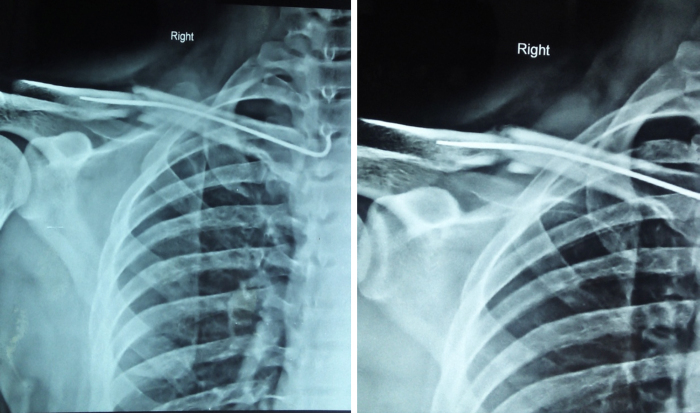
Objective: The aim of this study is to analyze the functional outcome following titanium elastic stable intra-medullary nailing (ESIN) for displaced mid-shaft clavicular fractures (DMCF).
Methods: A retrospective study of 60 patients between March 2009 and March 2015 was conducted. Patients were selected based on the inclusion criteria. Six patients were lost during follow up. Out of the remaining 54 patients, there were 39 males and 15 females. The mean age was 30.6 years. The functional outcome was analyzed using the Constant score, rate of bone union, complication, and earliest time of return to work.
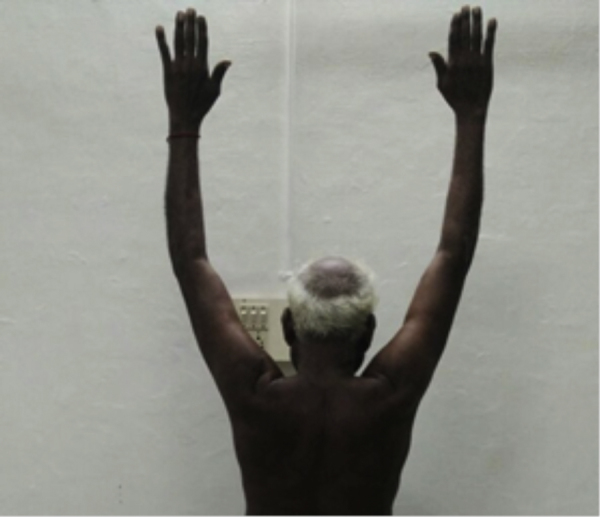
Results: All fractures united well, with an average time of 7.5 weeks. Follow-up period ranged between 12 months and 18 months (average, 14 months). 24 out of 54 patients had closed nailing, while 30 had minimal open reduction. The average size of ESIN was 2 mm (range, 1.5-3 mm). The average Constant score was 97.8 (range, 95-99). There were no major complications, but minor complications occurred, viz. skin irritation in 15 patients, temporary paresthesia in five patients, and three patients who developed superficial infections. One case had implant migration and perforation at the lateral cortex, and one case had delayed union. There were few implant-related problems, as the authors used a standard protocol to remove it after radiological union. All patients returned to work within 10 weeks of the post-operative period.
Conclusion: ESIN is a safe, minimally invasive, engenders rapid healing with good cosmesis, and provides an excellent functional outcome in terms of patient satisfaction, with fewer complications.
Objetivo: O objetivo deste estudo é analisar o desfecho funcional após o uso de haste intramedular estável elástica de titânio (HIEET) em fraturas deslocadas do terço médio da clavícula (FDMC).
Métodos: Realizou-se um estudo retrospectivo de 60 pacientes entre março de 2009 e março de 2015. Os pacientes foram selecionados com base nos critérios de inclusão. Houve perda de seguimento de seis pacientes. Dos 54 pacientes restantes, 39 eram homens e 15 mulheres. A média de idade foi de 30,6 anos. O desfecho funcional foi analisado pela escala de Constant, taxa de união óssea, taxa de complicação e tempo de retorno ao trabalho.
Resultados: Todas as fraturas apresentaram boa união, em uma média de 7,5 semanas. O período de acompanhamento variou entre 12 e 18 meses (média: 14 meses). Em 24 dos 54 pacientes usou-se redução fechada com hastes intramedulares; nos outros 30, foi utilizada a redução aberta com fixação mínima. O tamanho médio da HIEET foi de 2 mm (variação: 1,5-3 mm). A média da escala de Constant foi 97,8 (variação: 95-99). Nenhum paciente apresentou complicações de grande porte, mas algumas complicações de pequeno porte foram observadas, a saber: irritação da pele em 15 pacientes, parestesia temporária em cinco pacientes e infecções superficiais em três pacientes. Observou-se um caso de migração do implante e perfuração no córtex lateral; um caso teve união atrasada. A taxa de problemas relacionados ao implante foi baixa, uma vez que os autores usaram um protocolo padrão para removê-lo após a união radiológica. Todos os pacientes retornaram ao trabalho em até dez semanas após a cirurgia.
Conclusão: A HIEET é um método seguro, minimamente invasivo, que gera cicatrização rápida com boa cosmesis e proporciona um excelente resultado funcional em termos de satisfação do paciente, com menos complicações.
Keywords: Bone nails; Clavicle; Fracture fixation; Intramedullary; Titanium.
Figures




References
-
- Postacchini F., Gumina S., Santis P., Albo F. Epidemiology of clavicle fractures. J Shoulder Elbow Surg. 2002;11(5):452–456. - PubMed
-
- Nordqvist A., Peterson C. The incidence of fractures of the clavicle. Clin Orthop Relat Res. 1994;(300):127–132. - PubMed
-
- Robinson C.M., Court-Brown Cm, McQueen M.M., Wakefield A.E. Estimating the risk of nonunion following nonoperative treatment of a clavicular fractures. J Bone Joint Surg Am. 2004;86(7):1359–1365. - PubMed
-
- Lazarides S., Zafiropoulos G. Conservative treatment of fractures at the middle third of the clavicle. The relevance of shortening and clinical outcome. J Shoulder Elbow Surg. 2006;15(2):191–194. - PubMed
-
- Smekal V., Oberladstaetter J., Struve P., Krappinger D. Shaft fractures of the clavicle: current concepts. Arch Orthop Trauma Surg. 2009;129(6):807–815. - PubMed
LinkOut - more resources
Full Text Sources
Other Literature Sources