


Strong and Flexible: Developing a Three-Tiered Curriculum for the Regional Central America Field Epidemiology Training Program
- PMID: 28702503
- PMCID: PMC5502830
Strong and Flexible: Developing a Three-Tiered Curriculum for the Regional Central America Field Epidemiology Training Program
Abstract
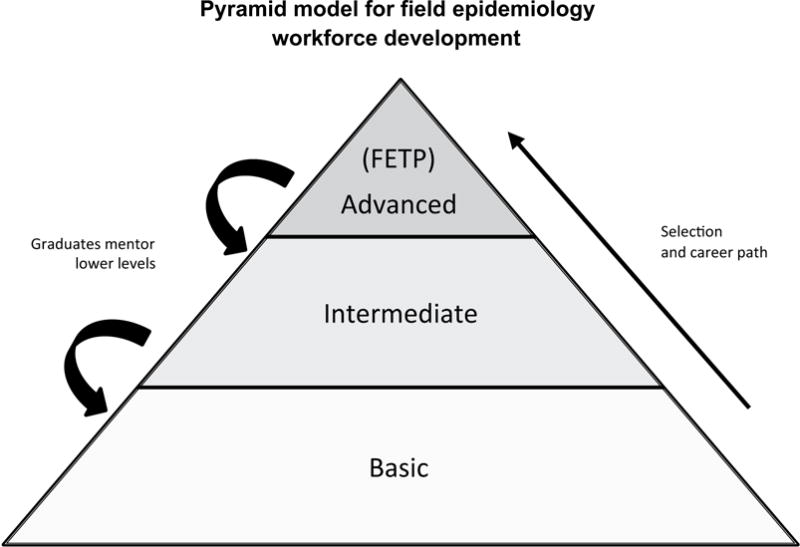
Field Epidemiology Training Programs (FETPs) are recognized worldwide as an effective means to strengthen countries' capacity in epidemiology, surveillance, and outbreak response. FETPs are field-based, with minimum classroom time and maximum time in the field, providing public health services while participants achieve competency. The Central America FETP (CAFETP) uses a three-level pyramid model: basic, intermediate, and advanced. In 2006, a multidisciplinary team used a methodical process based on adult learning practices to construct a competency-based curriculum for the CAFETP. The curriculum was designed based on the tasks related to disease surveillance and field epidemiology that public health officers would conduct at multiple levels in the system. The team used a design process that engaged subject matter experts and considered the unique perspective of each country. The designers worked backwards from the competencies to define field activities, evaluation methods, and classroom components. The 2006 pyramid curriculum has been accredited for a master's of science in field epidemiology by the Universidad del Valle de Guatemala and has been adapted by programs around the world. The team found the time and effort spent to familiarize subject matter experts with key adult learning principles was worthwhile because it provided a common framework to approach curriculum design. Early results of the redesigned curriculum indicate that the CAFETP supports consistent quality while allowing for specific country needs.
Keywords: adult learning; competencies; curriculum; epidemiology; global.
Conflict of interest statement
Declaration of Conflicting Interests The authors declared no potential conflicts of interest with respect to the research, authorship, and/or publication of this article.
Figures
References
-
- Alonso C, Suárez-Rangel G, López A, Jara J. Curso introductorio de la maestría en epidemiología de campo (FETP), Guatemala [Introductory course for the Masters of Field Epidemiology (FETP)] BREC Boletín Regional de Epidemiología de Campo. 2007;2(3):9.
-
- Center for Public Health Policy Columbia University School of Nursing. Competency to curriculum toolkit. New York, NY: Author; 2008.
-
- Ferrand C, Lerebours L, Pimentel R, Suárez-Rangel G. Encuestas rápidas de necesidades en albergues posterior al terremoto en Haití, febrero 2010 [Rapid needs assessment in shelters following the Haiti earthquake, February 2010] BREC Boletín Regional de Epidemiología de Campo. 2010;5(2):5.
Grants and funding
LinkOut - more resources
Full Text Sources