


Sexual Partner Concurrency Among Partners Reported by MSM with Recent HIV Infection
- PMID: 28702851
- PMCID: PMC5983362
- DOI: 10.1007/s10461-017-1855-x
Sexual Partner Concurrency Among Partners Reported by MSM with Recent HIV Infection
Abstract
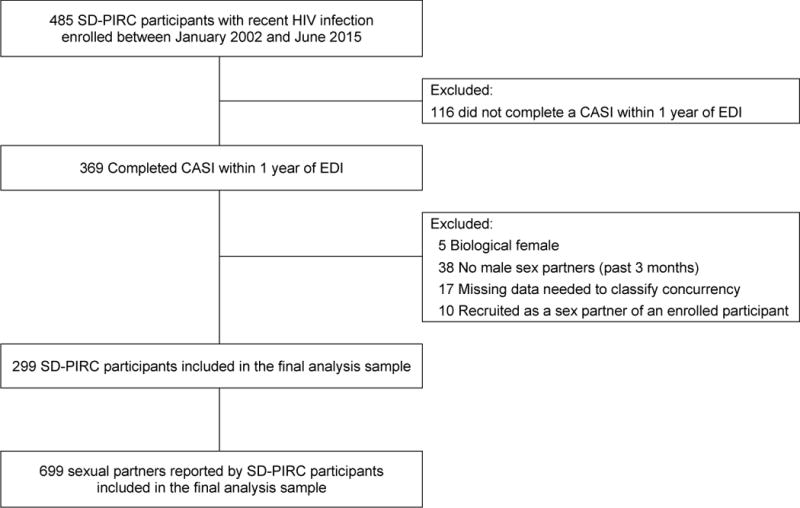
We examined concurrency among sexual partners reported by men who have sex with men (MSM) with recent (acute or early) HIV infection in San Diego, California (2002-2015). Partners overlapping in time in the past 3 months were considered concurrent. Logistic generalized linear mixed models were used to identify factors associated with concurrency at the partner-level. 56% (388/699) of partners were concurrent to ≥1 other partner. The odds of concurrency were higher among partners >10 years younger than the participant (vs. within 10 years of age) [adjusted odds ratio (AOR) = 2.22, 95% confidence interval (CI) 1.09-4.52], longer term partners (AOR per month = 1.02, 95% CI 1.01-1.03), and partners met online (AOR = 1.56, 95% CI 0.98-2.48). Concurrency is common among partners of recently HIV-infected MSM. Tailored HIV prevention strategies for MSM with older partners, longer term partners, and partners met online may help minimize the potential impact of concurrency on HIV transmission.
Keywords: Acute and early HIV infection; Concurrency; HIV transmission; MSM.
Conflict of interest statement
The authors have no other conflicts of interest to declare.
Figures
References
-
- Centers for Disease Control and Prevention. Diagnoses of HIV Infection in the United States and Dependent Areas, 2014. HIV Surveillance Report. 2015;26 Availbale at: http://www.cdc.gov/hiv/pdf/library/reports/surveillance/cdc-hiv-surveill.... Accessed 26 August 2016.
-
- UNAIDS. Consultation on concurrent sexual partnerships: recommendations from a meeting of the UNAIDS reference group on estimates, modelling and projecion held in Nairobi Kenya. 2009 Availbale at: http://www.epidem.org/sites/default/files/reports/Concurrency_meeting_re.... Accessed 10 November 2015.
-
- Morris M, Kretzschmar M. Concurrent partnerships and the spread of HIV. AIDS. 1997;11(5):641–648. - PubMed
-
- Morris M, Goodreau SM, Moody J. Sexual networks, concurrency, and STD/HIV. In: Holmes KK, Sparling PF, Stamm WE, Piot P, Wasserheit J, editors. Sexually Transmitted Diseases. 4th. New York, NY: McGraw Hill; 2008.
-
- Bohl DD, Raymond HF, Arnold M, McFarland W. Concurrent sexual partnerships and racial disparities in HIV infection among men who have sex with men. Sex Transm Infect. 2009;85(5):367–369. - PubMed
MeSH terms
Grants and funding
- K01 DA040543/DA/NIDA NIH HHS/United States
- U01 AI43638/National Institute of Allergy and Infectious Diseases
- K01 DA040543/National Institute on Drug Abuse
- R24 AI106039/National Institute of Allergy and Infectious Diseases
- El11-SD-005/California Collaborative Treatment Group
- U01 AI043638/AI/NIAID NIH HHS/United States
- P01 AI074621/National Institute of Allergy and Infectious Diseases
- P30 AI035214/National Institute of Allergy and Infectious Diseases
- P30 AI036214/AI/NIAID NIH HHS/United States
- R01 HD083042/National Institute of Allergy and Infectious Diseases
- R01 HD083042/HD/NICHD NIH HHS/United States
- P01 AI074621/AI/NIAID NIH HHS/United States
- R01 MH100974/National Institute of Allergy and Infectious Diseases
- R01 MH100974/MH/NIMH NIH HHS/United States
- R24 AI106039/AI/NIAID NIH HHS/United States
LinkOut - more resources
Full Text Sources
Other Literature Sources
Medical
Miscellaneous
