


Influence of lung CT changes in chronic obstructive pulmonary disease (COPD) on the human lung microbiome
- PMID: 28704452
- PMCID: PMC5509234
- DOI: 10.1371/journal.pone.0180859
Influence of lung CT changes in chronic obstructive pulmonary disease (COPD) on the human lung microbiome
Abstract
Background: Changes in microbial community composition in the lung of patients suffering from moderate to severe COPD have been well documented. However, knowledge about specific microbiome structures in the human lung associated with CT defined abnormalities is limited.
Methods: Bacterial community composition derived from brush samples from lungs of 16 patients suffering from different CT defined subtypes of COPD and 9 healthy subjects was analyzed using a cultivation independent barcoding approach applying 454-pyrosequencing of 16S rRNA gene fragment amplicons.
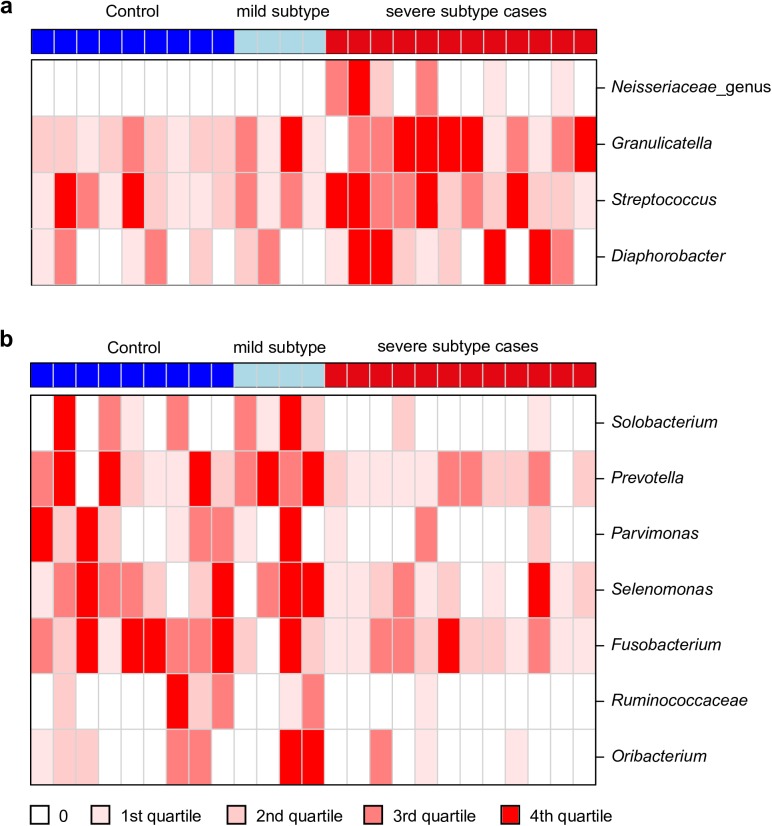
Results: We could show that bacterial community composition in patients with changes in CT (either airway or emphysema type changes, designated as severe subtypes) was different from community composition in lungs of patients without visible changes in CT as well as from healthy subjects (designated as mild COPD subtype and control group) (PC1, Padj = 0.002). Higher abundance of Prevotella in samples from patients with mild COPD subtype and from controls and of Streptococcus in the severe subtype cases mainly contributed to the separation of bacterial communities of subjects. No significant effects of treatment with inhaled glucocorticoids on bacterial community composition were detected within COPD cases with and without abnormalities in CT in PCoA. Co-occurrence analysis suggests the presence of networks of co-occurring bacteria. Four communities of positively correlated bacteria were revealed. The microbial communities can clearly be distinguished by their associations with the CT defined disease phenotype.
Conclusion: Our findings indicate that CT detectable structural changes in the lung of COPD patients, which we termed severe subtypes, are associated with alterations in bacterial communities, which may induce further changes in the interaction between microbes and host cells. This might result in a changed interplay with the host immune system.
Conflict of interest statement
Figures



References
-
- WHO. Chronic obstructive pulmonary disease (COPD). http://wwwwhoint/mediacentre/factsheets/fs315/en/. 2015;(Fact sheet N°315, updated January 2015).
-
- Vogelmeier CF, Criner GJ, Martinez FJ, Anzueto A, Barnes PJ, Bourbeau J, et al. Global Strategy for the Diagnosis, Management and Prevention of Chronic Obstructive Lung Disease 2017 Report. Respirology. 2017;22(3):575–601. doi: 10.1111/resp.13012 - DOI - PubMed
-
- Singh D, Roche N, Halpin D, Agusti A, Wedzicha JA, Martinez FJ. Current Controversies in the Pharmacological Treatment of Chronic Obstructive Pulmonary Disease. American Journal of Respiratory and Critical Care Medicine. 2016;194(5):541–9. doi: 10.1164/rccm.201606-1179PP - DOI - PubMed
-
- Ziegler-Heitbrock L, Frankenberger M, Heimbeck I, Burggraf D, Wjst M, Häussinger K, et al. The EvA study: aims and strategy. European Respiratory Journal. 2012;40(4):823–9. doi: 10.1183/09031936.00142811 - DOI - PubMed
MeSH terms
Substances
LinkOut - more resources
Full Text Sources
Other Literature Sources
Medical
Research Materials
Miscellaneous
