


A system model of the effects of exercise on plasma Interleukin-6 dynamics in healthy individuals: Role of skeletal muscle and adipose tissue
- PMID: 28704555
- PMCID: PMC5507524
- DOI: 10.1371/journal.pone.0181224
A system model of the effects of exercise on plasma Interleukin-6 dynamics in healthy individuals: Role of skeletal muscle and adipose tissue
Abstract
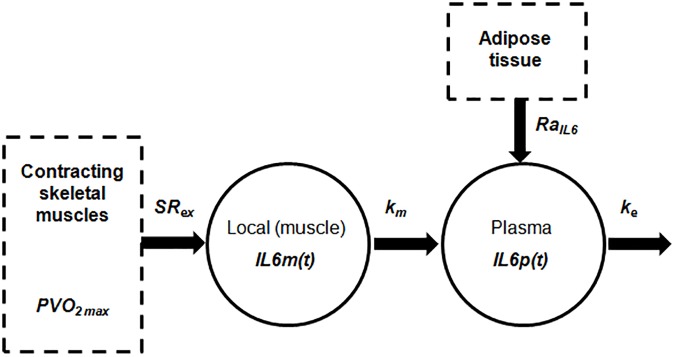
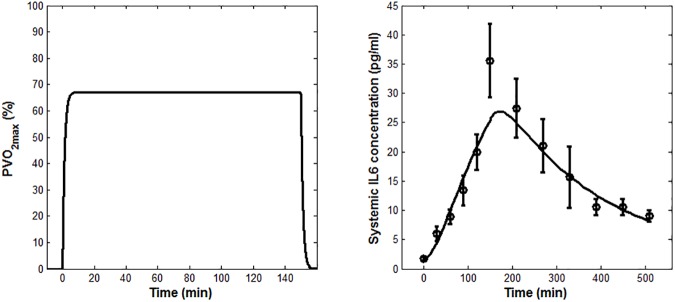
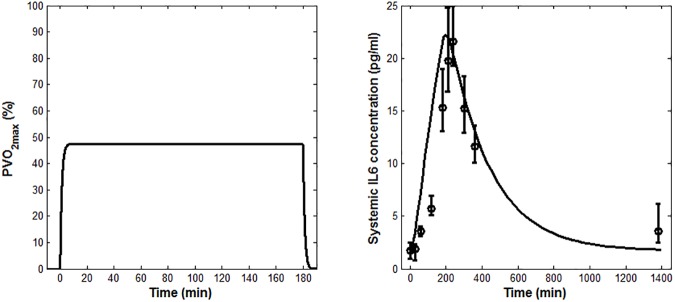
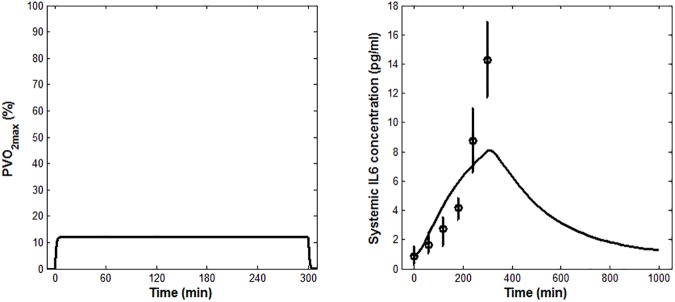
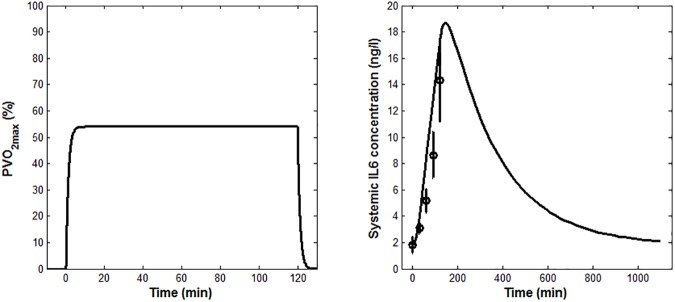
Interleukin-6 (IL-6) has been recently shown to play a central role in glucose homeostasis, since it stimulates the production and secretion of Glucagon-like Peptide-1 (GLP-1) from intestinal L-cells and pancreas, leading to an enhanced insulin response. In resting conditions, IL-6 is mainly produced by the adipose tissue whereas, during exercise, skeletal muscle contractions stimulate a marked IL-6 secretion as well. Available mathematical models describing the effects of exercise on glucose homeostasis, however, do not account for this IL-6 contribution. This study aimed at developing and validating a system model of exercise's effects on plasma IL-6 dynamics in healthy humans, combining the contributions of both adipose tissue and skeletal muscle. A two-compartment description was adopted to model plasma IL-6 changes in response to oxygen uptake's variation during an exercise bout. The free parameters of the model were estimated by means of a cross-validation procedure performed on four different datasets. A low coefficient of variation (<10%) was found for each parameter and the physiologically meaningful parameters were all consistent with literature data. Moreover, plasma IL-6 dynamics during exercise and post-exercise were consistent with literature data from exercise protocols differing in intensity, duration and modality. The model successfully emulated the physiological effects of exercise on plasma IL-6 levels and provided a reliable description of the role of skeletal muscle and adipose tissue on the dynamics of plasma IL-6. The system model here proposed is suitable to simulate IL-6 response to different exercise modalities. Its future integration with existing models of GLP-1-induced insulin secretion might provide a more reliable description of exercise's effects on glucose homeostasis and hence support the definition of more tailored interventions for the treatment of type 2 diabetes.
Conflict of interest statement
Figures
References
-
- Pedersen BK, Febbraio M. Muscle-derived interleukin-6—a possible link between skeletal muscle, adipose tissue, liver, and brain. Brain Behav Immun. 2005;19: 371–376. doi: 10.1016/j.bbi.2005.04.008 - DOI - PubMed
-
- Hotamisligil GS. Inflammation and metabolic disorders. Nature. 2006;444: 860–867. doi: 10.1038/nature05485 - DOI - PubMed
-
- Shoelson SE, Lee J, Goldfine AB. Inflammation and insulin resistance. J Clin Invest. 2006;116: 1793–1801. doi: 10.1172/JCI29069 - DOI - PMC - PubMed
-
- Xu H, Barnes GT, Yang Q, Tan G, Yang D, Chou CJ, et al. Chronic inflammation in fat plays a crucial role in the development of obesity-related insulin resistance. J Clin Invest. 2003;112: 1821–1830. doi: 10.1172/JCI19451 - DOI - PMC - PubMed
-
- Vozarova B, Weyer C, Hanson K, Tataranni PA, Bogardus C, Pratley RE. Circulating interleukin-6 in relation to adiposity, insulin action, and insulin secretion. Obes Res. 2001;9: 414–417. doi: 10.1038/oby.2001.54 - DOI - PubMed
MeSH terms
Substances
LinkOut - more resources
Full Text Sources
Other Literature Sources
Medical
