


Impact of e-liquid flavors on nicotine intake and pharmacology of e-cigarettes
- PMID: 28704768
- PMCID: PMC5565733
- DOI: 10.1016/j.drugalcdep.2017.05.042
Impact of e-liquid flavors on nicotine intake and pharmacology of e-cigarettes
Abstract
Objectives: To describe the effect of e-liquid flavors on nicotine intake and pharmacology of e-cigarettes.
Methods: 11 males and 3 females participated in a 3-day inpatient crossover study with strawberry, tobacco, and their usual flavor e-liquid. Nicotine levels were nominally 18mg/mL in the strawberry (pH 8.29) and tobacco (pH 9.10) e-liquids and ranged between 3-18mg/mL in the usual brands (mean pH 6.80). Each day consisted of a 15-puff session followed by 4h of abstinence, then 90min of ad libitum use. Subjects used a KangerTech mini ProTank 3.
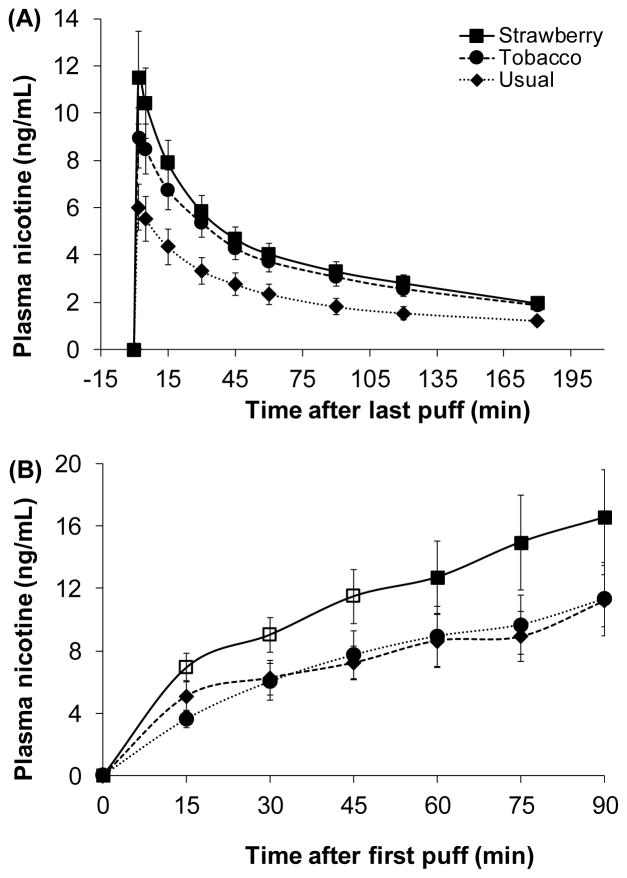
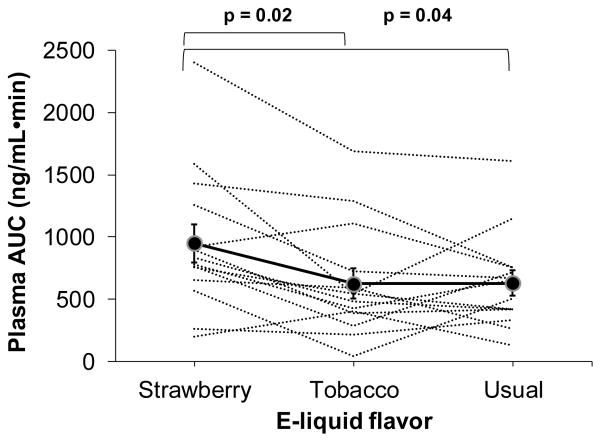
Results: After 15 puffs, the amount of nicotine inhaled and systemically retained were not significantly different between the strawberry and tobacco e-liquids but plasma AUC(0→180) was significantly higher with the strawberry e-liquid. While not significantly different, Cmax was 22% higher and various early time point AUCs to measure rate of rise of nicotine in blood ranged between 17 and 23% higher with the strawberry e-liquid compared to the tobacco e-liquid. During ad libitum use, systemic exposure to nicotine (AUC(0→90)) was the same for the tobacco and usual brand e-liquids but were both significantly lower than after using the strawberry e-liquid. The usual flavors were more liked and satisfying than the strawberry and tobacco e-liquids.
Conclusion: Flavors influence nicotine exposure through flavor liking, may affect rate of nicotine absorption possibly through pH effects, and contribute to heart rate acceleration and subjective effects of e-cigarettes. E-cigarette users titrate their nicotine exposure but the extent of titration may vary across flavors.
Keywords: E-cigarette pharmacology; E-cigarettes; Flavors; Nicotine delivery; Nicotine pharmacokinetics.
Copyright © 2017 Elsevier B.V. All rights reserved.
Conflict of interest statement
Dr. Benowitz has served on smoking cessation advisory boards for Pfizer and has been an occasional consultant to McNeil and GlaxoSmithKline, and has served as a paid expert witness in litigation against tobacco companies. All other authors declare that they have no conflicts of interest.
Figures
References
-
- Allen JG, Flanigan SS, LeBlanc M, Vallarino J, MacNaughton P, Stewart JH, Christiani DC. Flavoring Chemicals in E-Cigarettes: Diacetyl, 2, 3-Pentanedione, and Acetoin in a Sample of 51 Products, Including Fruit-, Candy-, and Cocktail-Flavored E-Cigarettes. Environ Health Perspect. 2016;124:733–739. - PMC - PubMed
-
- Bahl V, Lin S, Xu N, Davis B, Wang Y-h, Talbot P. Comparison of electronic cigarette refill fluid cytotoxicity using embryonic and adult models. Reprod Toxicol. 2012;34:529–537. - PubMed
-
- Becoña E, Vázquez FL, Fuentes MaJ, del Carmen Lorenzo Ma. Anxiety, affect, depression and cigarette consumption. Pers Individ Dif. 1998;26:113–119.
-
- Behar R, Davis B, Wang Y, Bahl V, Lin S, Talbot P. Identification of toxicants in cinnamon-flavored electronic cigarette refill fluids. Toxicol In Vitro. 2014;28:198–208. - PubMed
MeSH terms
Substances
Grants and funding
LinkOut - more resources
Full Text Sources
Other Literature Sources
Medical
