


Satisfaction with caregivers during labour among low risk women in the Netherlands: the association with planned place of birth and transfer of care during labour
- PMID: 28705146
- PMCID: PMC5513372
- DOI: 10.1186/s12884-017-1410-9
Satisfaction with caregivers during labour among low risk women in the Netherlands: the association with planned place of birth and transfer of care during labour
Abstract
Background: The caregiver has an important influence on women's birth experiences. When transfer of care during labour is necessary, care is handed over from one caregiver to the other, and this might influence satisfaction with care. It is speculated that satisfaction with care is affected in particular for women who need to be transferred from home to hospital. We examined the level of satisfaction with the caregiver among women with planned home versus planned hospital birth in midwife-led care.
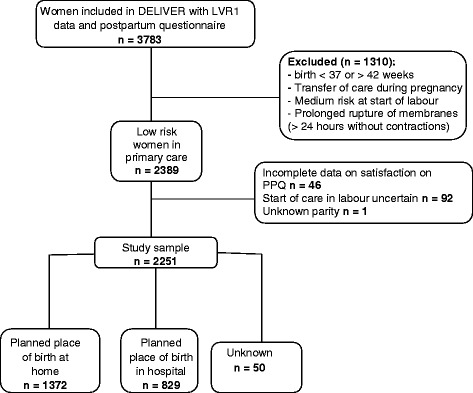
Methods: We used data from the prospective multicentre DELIVER (Data EersteLIjns VERloskunde) cohort-study, conducted in 2009 and 2010 in the Netherlands. Women filled in a postpartum questionnaire which contained elements of the Consumer Quality index. This instrument measures 'general rate of satisfaction with the caregiver' (scale from 1 to 10, with cut-off of below 9) and 'quality of treatment by the caregiver' (containing 7 items on a 4 point Likert scale, with cut-off of mean of 4 or lower).
Results: Women who planned a home birth (n = 1372) significantly more often rated 'quality of treatment by caregiver' high than women who planned a hospital birth (n = 829). Primiparous women who planned a home birth significantly more often had a high rate (9 or 10) for 'general satisfaction with caregiver' (adj.OR 1.48; 95% CI 1.1, 2.0). Also, primiparous women who planned a home birth and had care transferred during labour (331/553; 60%) significantly more often had a high rate (9 or 10) for 'general satisfaction' compared to those who planned a hospital birth and who had care transferred (1.44; 1.0-2.1). Furthermore, they significantly more often rated 'quality of treatment by caregiver' high, than 276/414 (67%) primiparous women who planned a hospital birth and who had care transferred (1.65; 1.2-2.3). No differences were observed for multiparous women who had planned home or hospital birth and who had care transferred.
Conclusions: Planning home birth is associated to a good experience of quality of care by the caregiver. Transferred planned home birth compared to a transferred planned hospital birth does not lead to a more negative experience of care received from the caregiver.
Keywords: Caregiver; Consumer Satisfaction; Home childbirth; Midwifery; Quality of care; Transfer.
Conflict of interest statement
Ethics approval and consent to participate
The design and conduct of the DELIVER study was approved by the Medical Ethics Committee of the VU University Medical Centre Amsterdam (2009/284). All participants were informed about the study and they were asked to participate by their consulting midwife. Informed consent was obtained verbally, but each midwifery-practice had to sign a statement that informed consent would be obtained from all pregnant women. This procedure was according the Dutch law and confirmed by a Dutch legal office in the year 2006–2007 when the DELIVER study was designed. Inclusion of participants occurred on an opting-out basis. Client participation was voluntary and they could withdraw at any time. Privacy was guaranteed in accordance with Dutch legislation. Clients’ anonymity was maintained by using anonymous patient and practice identifiers.
Consent for publication
Not applicable.
Competing interests
JvD is a member of the editorial board for BMC Pregnancy and Childbirth. None of the other authors have any competing interests.
Publisher’s Note
Springer Nature remains neutral with regard to jurisdictional claims in published maps and institutional affiliations.
Figures
References
Publication types
MeSH terms
LinkOut - more resources
Full Text Sources
Other Literature Sources
Medical
