


Ward social workers' views of what facilitates or hinders collaboration with specialist palliative care team social workers: A grounded theory
- PMID: 28705157
- PMCID: PMC5513353
- DOI: 10.1186/s12904-017-0214-z
Ward social workers' views of what facilitates or hinders collaboration with specialist palliative care team social workers: A grounded theory
Erratum in
-
Erratum to: BMC Palliative Care, Vol. 17.BMC Palliat Care. 2017 Oct 10;16(1):51. doi: 10.1186/s12904-017-0233-9. BMC Palliat Care. 2017. PMID: 29017489 Free PMC article. No abstract available.
Abstract
Background: Inpatient, generalist social workers in discharge planning roles work alongside specialist palliative care social workers to care for patients, often resulting in two social workers being concurrently involved in the same patient's care. Previous studies identifying components of effective collaboration, which impacts patient outcomes, care efficiency, professional job satisfaction, and healthcare costs, were conducted with nurses and physicians but not social workers. This study explores ward social workers' perceptions of what facilitates or hinders collaboration with palliative care social workers.
Methods: Grounded theory was used to explore the research aim. In-depth qualitative interviews with masters trained ward social workers (n = 14) working in six hospitals located in the Midwest, United States were conducted between February 2014 and January 2015. A theoretical model of ward social workers' collaboration with palliative care social workers was developed.
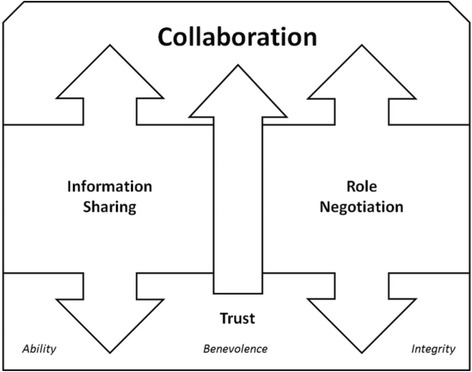
Results: The emerging model of collaboration consists of: 1) trust, which is comprised of a) ability, b) benevolence, and c) integrity, 2) information sharing, and 3) role negotiation. Effective collaboration occurs when all elements of the model are present.
Conclusion: Collaboration is facilitated when ward social workers' perceptions of trust are high, pertinent information is communicated in a time-sensitive manner, and a flexible approach to roles is taken. The theoretical model of collaboration can inform organisational policy and social work clinical practice guidelines, and may be of use to other healthcare professionals, as improvements in collaboration among healthcare providers may have a positive impact on patient outcomes.
Keywords: Cooperative behaviour; Grounded theory; Palliative care; Qualitative research; Social work.
Conflict of interest statement
Ethics approval and consent to participate
Ethics approval was obtained from the University of Michigan Institutional Review Board (approval number HUM00077521) and Lancaster University Ethics Committee. Participation was voluntary. Participants completed a written informed consent before the interview was initiated.
Consent for publication
Not applicable.
Competing interests
The authors declare that they have no competing interests.
Publisher’s Note
Springer Nature remains neutral with regard to jurisdictional claims in published maps and institutional affiliations.
Figures
References
-
- Tam S, Suen L, Ho K, Lee D. Assessing the safety and teamwork climate of intensive care staff. World Crit Care Nurs. 2011;8(1):21–5.
-
- Institute of Medicine: Crossing the Quality Chasm: A New Health System for the 21st Century. In.; 2001. - PubMed
MeSH terms
LinkOut - more resources
Full Text Sources
Other Literature Sources
Medical
