. 2017 Dec 1;123(6):1477-1486.
doi: 10.1152/japplphysiol.00341.2017. Epub 2017 Jul 13.

Evidence from high-altitude acclimatization for an integrated cerebrovascular and ventilatory hypercapnic response but different responses to hypoxia

Affiliations

Evidence from high-altitude acclimatization for an integrated cerebrovascular and ventilatory hypercapnic response but different responses to hypoxia

Zachary M Smith et al. J Appl Physiol (1985). .

Abstract

Ventilation and cerebral blood flow (CBF) are both sensitive to hypoxia and hypercapnia. To compare chemosensitivity in these two systems, we made simultaneous measurements of ventilatory and cerebrovascular responses to hypoxia and hypercapnia in 35 normal human subjects before and after acclimatization to hypoxia. Ventilation and CBF were measured during stepwise changes in isocapnic hypoxia and iso-oxic hypercapnia. We used MRI to quantify actual cerebral perfusion. Measurements were repeated after 2 days of acclimatization to hypoxia at 3,800 m altitude (partial pressure of inspired O2 = 90 Torr) to compare plasticity in the chemosensitivity of these two systems. Potential effects of hypoxic and hypercapnic responses on acute mountain sickness (AMS) were assessed also. The pattern of CBF and ventilatory responses to hypercapnia were almost identical. CO2 responses were augmented to a similar degree in both systems by concomitant acute hypoxia or acclimatization to sustained hypoxia. Conversely, the pattern of CBF and ventilatory responses to hypoxia were markedly different. Ventilation showed the well-known increase with acute hypoxia and a progressive decline in absolute value over 25 min of sustained hypoxia. With acclimatization to hypoxia for 2 days, the absolute values of ventilation and O2 sensitivity increased. By contrast, O2 sensitivity of CBF or its absolute value did not change during sustained hypoxia for up to 2 days. The results suggest a common or integrated control mechanism for CBF and ventilation by CO2 but different mechanisms of O2 sensitivity and plasticity between the systems. Ventilatory and cerebrovascular responses were the same for all subjects irrespective of AMS symptoms. NEW & NOTEWORTHY Ventilatory and cerebrovascular hypercapnic response patterns show similar plasticity in CO2 sensitivity following hypoxic acclimatization, suggesting an integrated control mechanism. Conversely, ventilatory and cerebrovascular hypoxic responses differ. Ventilation initially increases but adapts with prolonged hypoxia (hypoxic ventilatory decline), and ventilatory sensitivity increases following acclimatization. In contrast, cerebral blood flow hypoxic sensitivity remains constant over a range of hypoxic stimuli, with no cerebrovascular acclimatization to sustained hypoxia, suggesting different mechanisms for O2 sensitivity in the two systems.

Keywords: acute mountain sickness; cerebral blood flow; high altitude; hypoxia; hypoxic ventilatory response; magnetic resonance imaging.


Conflict of interest statement

No conflicts of interest, financial or otherwise, are declared by the authors.

Figures
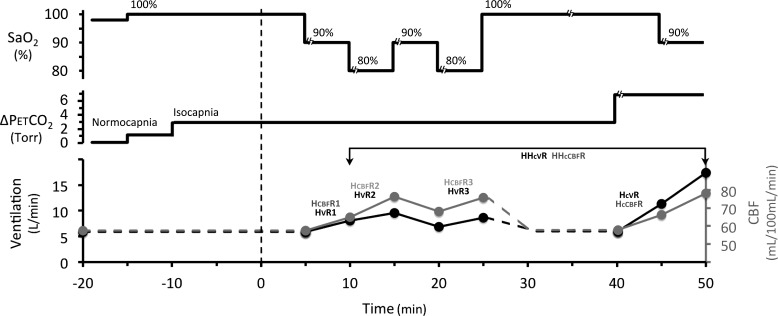
Fig. 1.
Fig. 1.
Time course of step changes in O2 saturation (SaO2; top) and PETCO2 (middle) for hypoxic and hypercapnic responses; bottom: time courses of ventilation and CBF responses. The paradigm is described in detail in Sato et al. (50). The initial 5 min is poikilocapnic ventilation while subjects acclimatize to the breathing apparatus. The rebreathing circuit is then connected, and after a further 5 min of hyperoxia, a small increase in PETCO2 (~3 Torr) is introduced to achieve isocapnic ventilation. The response measurements start once steady-state ventilation (or steady-state CBF) is achieved (indicated as 0 time on the timeline). The changes following SaO2 step changes define the hypoxic response. Subjects are then again returned to hyperoxia, and after a 10-min period to remove any residual hypoxic drive, the hypercapnic and combined hypoxic hypercapnic responses are measured.
Fig. 2.
Fig. 2.
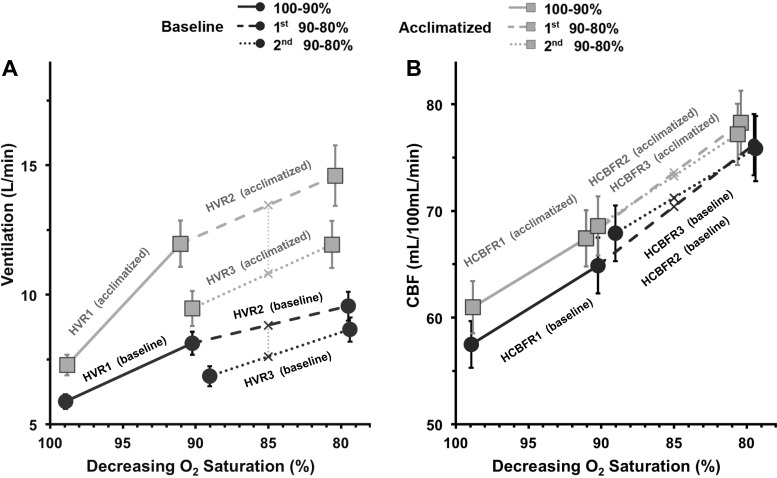
Sensitivity to hypoxia for both ventilation (A) and cerebral blood flow (CBF; B). HvR1, -2, and -3 and corresponding HcbfR1, -2, and -3 are the slopes of the lines indicated on the graphs. Absolute values of ventilation and CBF are estimated from these lines at 85% O2 saturation (V̇85% and CBF85%, indicated by “×”). A: following acclimatization, there was a significant increase in resting ventilation during normoxia between baseline and acclimatization to sustained hypoxia (P < 0.0005). There were also significant increases in HvR1 (P < 0.0005) and HvR2 (P < 0.01) and a greater decrease in V̇85% between HvR2 and HvR3 measurements (P < 0.01) following acclimatization. B: by contrast, following acclimatization, the resting CBF in normoxia was not significantly changed. HcbfR1, -2, and -3 did not change with acclimatization, and there was no significant difference in CBF85% between HcbfR measurements 2 and 3, before or after acclimatization. Data are mean values; error bars indicate 1 SE.
Fig. 3.
Fig. 3.
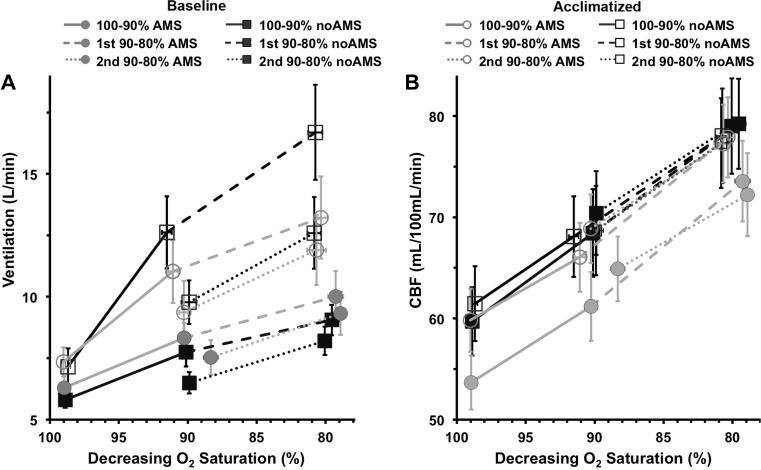
Changes in response to hypoxia, as illustrated in Fig. 2, but split by subjects who were symptomatic (AMS group, circular symbols) or asymptomatic (no-AMS group, square symbols) for AMS at altitude. A: there were no significant differences in the ventilation response with AMS. However, following acclimatization, asymptomatic subjects showed a trend toward a greater increase in HvR1 and HvR2 (i.e., slopes) relative to symptomatic subjects (P = 0.06). Asymptomatic subjects also had greater hypoxic ventilatory decline (decrease in ventilation estimated at 85% saturation between first and second 90–80% O2 saturation tests) after acclimatization (P < 0.05). B: during baseline, subjects symptomatic for AMS showed a lower CBF at all levels of hypoxia relative to asymptomatic or acclimatized subjects, but this was not significant, and there were no changes in O2 sensitivity (slopes). Data represent mean values; error bars indicate 1 SE.
Fig. 4.
Fig. 4.
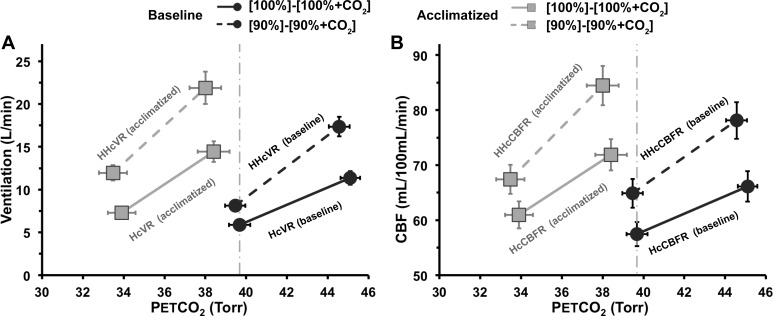
Hypercapnic and combined hypoxic/hypercapnic responses for ventilation (A) and CBF (B). After acclimatization, PETCO2 in normoxia decreases from ~40 Torr (dashed, vertical lines) to ~34 Torr, with a small increase in absolute value of ventilation and CBF. A: hypoxia significantly increased the ventilatory response to hypercapnia at baseline (HHcvR > HcvR, P < 0.0005) but not after acclimatization. The absolute value of ventilation in normoxia increased significantly with hypoxia at baseline and after acclimatization conditions (P < 0.05). B: the same pattern of changes and significant differences are seen for the CBF response to CO2 also. Data are mean values; error bars indicate 1 SE.
Fig. 5.
Fig. 5.
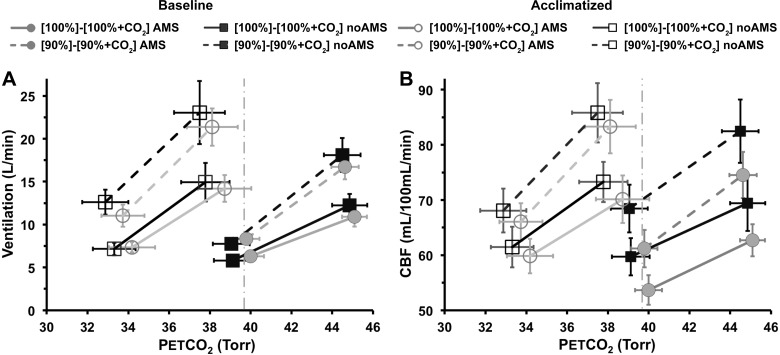
Changes in response to hypercapnia, as illustrated in Fig. 4, but split by subjects who were symptomatic (AMS group, circular symbols) or asymptomatic (no-AMS group, square symbols) for AMS at altitude. Subjects symptomatic for AMS show a small but consistent reduced ventilation (A) and CBF (B) at all levels of PETCO2 during normoxia and hypoxia and at baseline and following acclimatization, but this was not significant. Dashed, vertical lines indicate resting PETCO2 before acclimatization. Data are mean values; error bars indicate 1 SE.

Similar articles

Cited by

References

    1. Ainslie PN, Duffin J. Integration of cerebrovascular CO2 reactivity and chemoreflex control of breathing: mechanisms of regulation, measurement, and interpretation. Am J Physiol Regul Integr Comp Physiol 296: R1473–R1495, 2009. doi:10.1152/ajpregu.91008.2008. - DOI - PubMed
    1. Ainslie PN, Ogoh S. Regulation of cerebral blood flow in mammals during chronic hypoxia: a matter of balance. Exp Physiol 95: 251–262, 2010. doi:10.1113/expphysiol.2008.045575. - DOI - PubMed
    1. Atkinson JL, Anderson RE, Sundt TM Jr. The effect of carbon dioxide on the diameter of brain capillaries. Brain Res 517: 333–340, 1990. doi:10.1016/0006-8993(90)91046-J. - DOI - PubMed
    1. Basaran KE, Villongco M, Ho B, Ellis E, Zarndt R, Antonova J, Hopkins SR, Powell FL. Ibuprofen blunts ventilatory acclimatization to sustained hypoxia in humans. PLoS One 11: e0146087, 2016. doi:10.1371/journal.pone.0146087. - DOI - PMC - PubMed
    1. Berger MG, Vandier C, Bonnet P, Jackson WF, Rusch NJ. Intracellular acidosis differentially regulates KV channels in coronary and pulmonary vascular muscle. Am J Physiol 275: H1351–H1359, 1998. - PubMed

Publication types

LinkOut - more resources