


Comment
doi: 10.1126/science.aan4749.
Comment on "Molecular and neural basis of contagious itch behavior in mice"
Affiliations
- PMID: 28706013
- PMCID: PMC6200396
- DOI: 10.1126/science.aan4749
Item in Clipboard
Comment
Comment on "Molecular and neural basis of contagious itch behavior in mice"
Science.
.
Abstract
Yu et al (Reports, 10 March 2017, p. 1072) state that contagious itch occurs in mice based on imitative scratching in normal mice observing excessive scratching in genetically modified demonstrator mice. However, despite employing multiple behavioral analysis approaches, we were unable to extend these findings to normal mice observing the well-established histamine model of acute itch in demonstrator mice.
Copyright © 2017, American Association for the Advancement of Science.
Figures
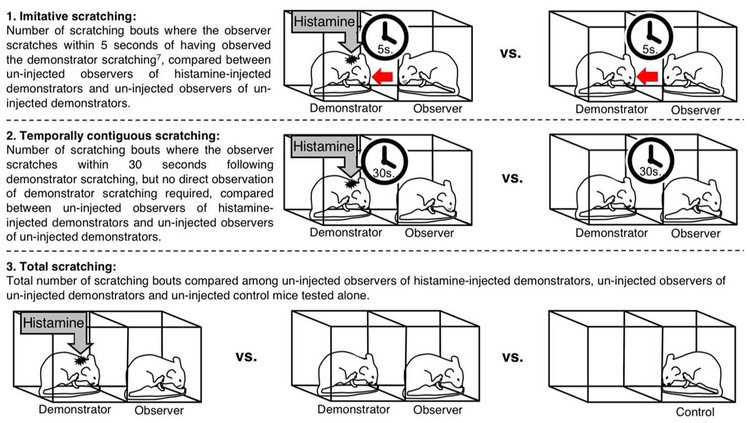
Three methods of assessing contagious itch in mice.
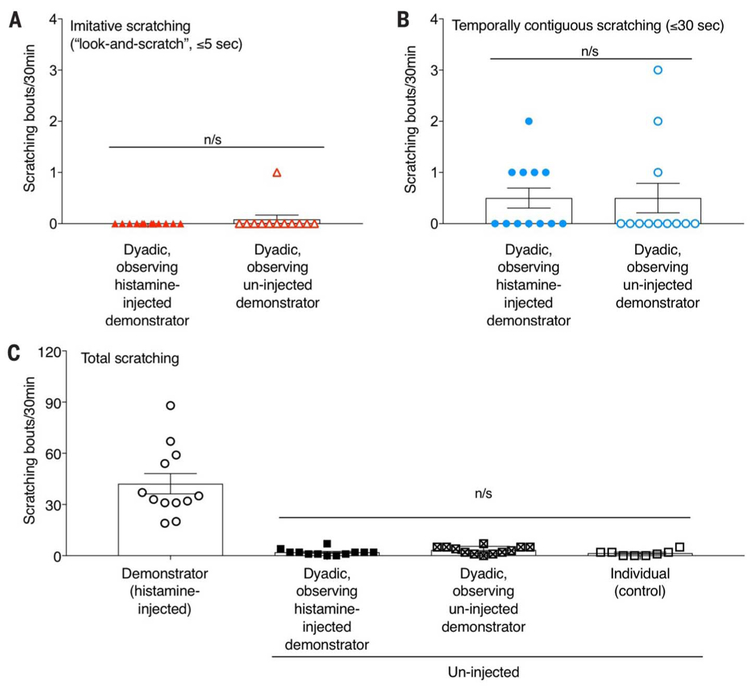
(A to C) In no case was scratching behavior in uninjected mice observing histamine-injected demonstrators significantly greater than that of uninjected mice observing uninjected demonstrators, indicating that contagious itch does not appear to occur in mice. Chi-square analysis was used for imitative (A) and temporally contiguous (B) scratching, whereas the Kruskal-Wallis H test was used to compare the three uninjected conditions in (C). P < 0.05 was considered significant in all cases. n/s, nonsignificant comparisons.
Comment in
-
Response to Comment on "Molecular and neural basis of contagious itch behavior in mice".Science. 2017 Jul 14;357(6347):eaan5000. doi: 10.1126/science.aan5000. Science. 2017. PMID: 28706014
Comment on
-
Molecular and neural basis of contagious itch behavior in mice.Science. 2017 Mar 10;355(6329):1072-1076. doi: 10.1126/science.aak9748. Science. 2017. PMID: 28280205 Free PMC article.
References
Publication types
MeSH terms
Substances
Grants and funding
LinkOut - more resources
Full Text Sources
Other Literature Sources
Medical
Research Materials
