


Changes in hypertension prevalence, awareness, treatment and control rates over 20 years in National Capital Region of India: results from a repeat cross-sectional study
- PMID: 28706098
- PMCID: PMC5734355
- DOI: 10.1136/bmjopen-2016-015639
Changes in hypertension prevalence, awareness, treatment and control rates over 20 years in National Capital Region of India: results from a repeat cross-sectional study
Abstract
Background and objectives: Despite being one of the leading risk factors of cardiovascular mortality, there are limited data on changes in hypertension burden and management from India. This study evaluates trend in the prevalence, awareness, treatment and control of hypertension in the urban and rural areas of India's National Capital Region (NCR).
Design and setting: Two representative cross-sectional surveys were conducted in urban and rural areas (survey 1 (1991-1994); survey 2 (2010-2012)) of NCR using similar methodologies.
Participants: A total of 3048 (mean age: 46.8±9.0 years; 52.3% women) and 2052 (mean age: 46.5±8.4 years; 54.2% women) subjects of urban areas and 2487 (mean age: 46.6±8.8 years; 57.0% women) and 1917 (mean age: 46.5±8.5 years; 51.3% women) subjects of rural areas were included in survey 1 and survey 2, respectively.
Primary and secondary outcome measures: Hypertension was defined as per Joint National Committee VII guidelines. Structured questionnaire was used to measure the awareness and treatment status of hypertension. A mean systolic blood pressure <140 mm Hg and diastolic blood pressure <90 mm Hg was defined as control of hypertension among the participants with hypertension.
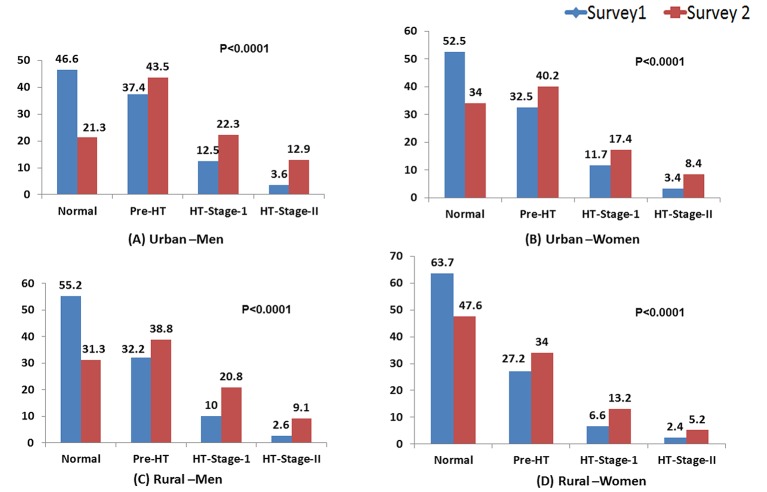
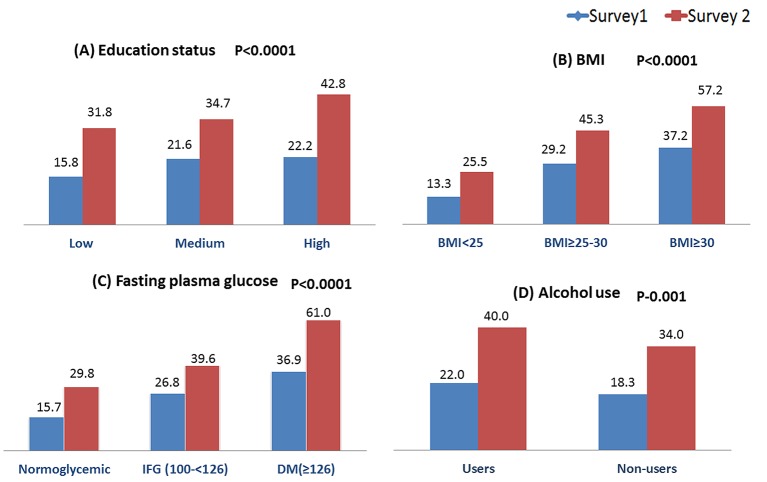
Results: The age and sex standardised prevalence of hypertension increased from 23.0% to 42.2% (p<0.001) and 11.2% to 28.9% (p<0.001) in urban and rural NCR, respectively. In both surveys, those with high education, alcohol use, obesity and high fasting blood glucose were at a higher risk for hypertension. However, the change in hypertension prevalence between the surveys was independent of these risk factors (adjusted OR (95% CI): urban (2.3 (2.0 to 2.7)) rural (3.1 (2.4 to 4.0))). Overall, there was no improvement in awareness, treatment and control rates of hypertension in the population.
Conclusion: There was marked increase in prevalence of hypertension over two decades with no improvement in management.
Keywords: Cardiovascular disease risk factors; Hypertension; India; Pre-Hypertension; Secular trends.
© Article author(s) (or their employer(s) unless otherwise stated in the text of the article) 2017. All rights reserved. No commercial use is permitted unless otherwise expressly granted.
Conflict of interest statement
Competing interests: None declared.
Figures
References
-
- Lim SS, Vos T, Flaxman AD, et al. . A comparative risk assessment of burden of disease and injury attributable to 67 risk factors and risk factor clusters in 21 regions, 1990-2010: a systematic analysis for the global burden of disease study 2010. Lancet 2012;380:2224–60. 10.1016/S0140-6736(12)61766-8 - DOI - PMC - PubMed
Publication types
MeSH terms
LinkOut - more resources
Full Text Sources
Other Literature Sources
Medical
Molecular Biology Databases
