


Mercury spikes suggest volcanic driver of the Ordovician-Silurian mass extinction
- PMID: 28706302
- PMCID: PMC5509715
- DOI: 10.1038/s41598-017-05524-5
Mercury spikes suggest volcanic driver of the Ordovician-Silurian mass extinction
Abstract
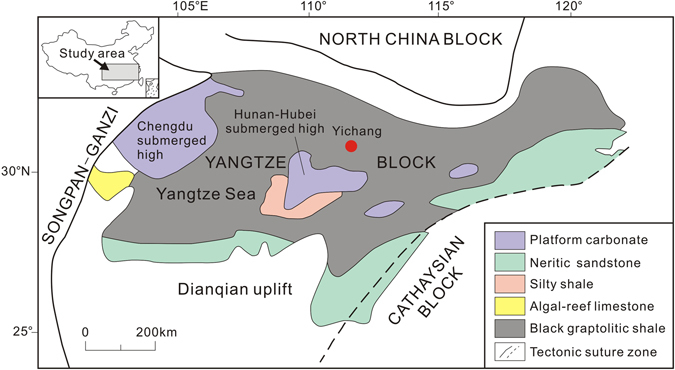
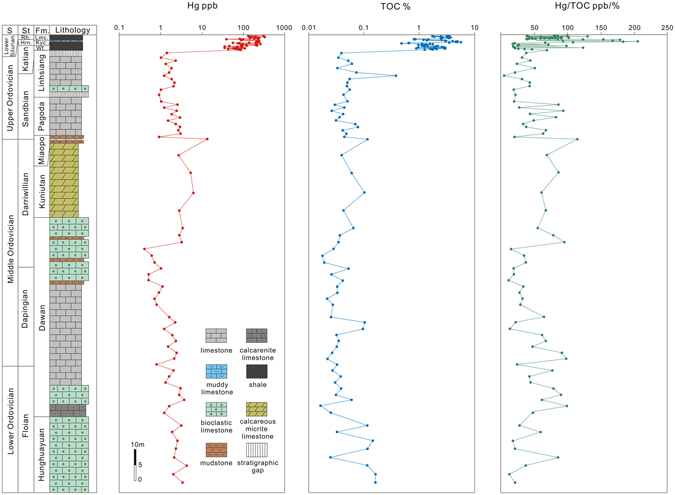
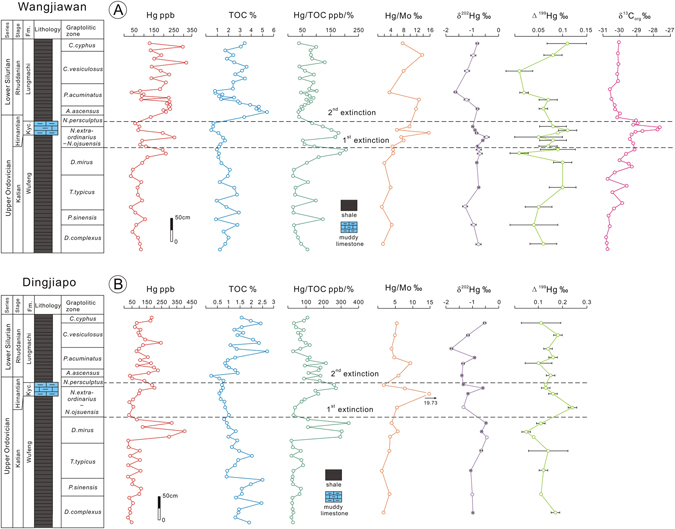
The second largest Phanerozoic mass extinction occurred at the Ordovician-Silurian (O-S) boundary. However, unlike the other major mass extinction events, the driver for the O-S extinction remains uncertain. The abundance of mercury (Hg) and total organic carbon (TOC) of Ordovician and early Silurian marine sediments were analyzed from four sections (Huanghuachang, Chenjiahe, Wangjiawan and Dingjiapo) in the Yichang area, South China, as a test for evidence of massive volcanism associated with the O-S event. Our results indicate the Hg concentrations generally vary in parallel with TOC, and that the Hg/TOC ratios remain low and steady state through the Early and Middle Ordovician. However, Hg concentrations and the Hg/TOC ratio increased rapidly in the Late Katian, and have a second peak during the Late Hirnantian (Late Ordovician) that was temporally coincident with two main pulses of mass extinction. Hg isotope data display little to no variation associated with the Hg spikes during the extinction intervals, indicating that the observed Hg spikes are from a volcanic source. These results suggest intense volcanism occurred during the Late Ordovician, and as in other Phanerozoic extinctions, likely played an important role in the O-S event.
Conflict of interest statement
The authors declare that they have no competing interests.
Figures
References
-
- Courtillot VE, Renne PR. On the ages of flood basalt events Sur l'âge des trapps basaltiques. C. R. Geoscience. 2003;335:113–140. doi: 10.1016/S1631-0713(03)00006-3. - DOI
-
- Wignall PB. The End-Permian mass extinction – how bad did it get? Geobiology. 2007;5:303–309. doi: 10.1111/j.1472-4669.2007.00130.x. - DOI
-
- Bond DPG, Wignall PB. Large igneous provinces and mass extinctions: An update. Geological Society of America Special Papers. 2014;505:29–55. doi: 10.1130/2014.2505(02). - DOI
-
- Bond, D. P. G. & Grasby, S. E. On the causes of mass extinctions. Palaeogeogr. Palaeoclimatol. Palaeoecol. doi:10.1016/j.palaeo.2016.11.005 In press (2016).
Publication types
LinkOut - more resources
Full Text Sources
Other Literature Sources
