. 2015 Mar 1;6(3):1973-1978.
doi: 10.1039/c4sc03495c. Epub 2015 Jan 7.

DNA-based visual majority logic gate with one-vote veto function

Affiliations

DNA-based visual majority logic gate with one-vote veto function

Daoqing Fan et al. Chem Sci. .

Abstract

A molecular logic gate is a basic element and plays a key role in molecular computing. Herein, we have developed a label-free and enzyme-free three-input visual majority logic gate which is realized for the first time according to DNA hybridization only, without DNA replacement and enzyme catalysis. Furthermore, a one-vote veto function was integrated into the DNA-based majority logic gate, in which one input has priority over other inputs. The developed system can also implement multiple basic and cascade logic gates.


Figures
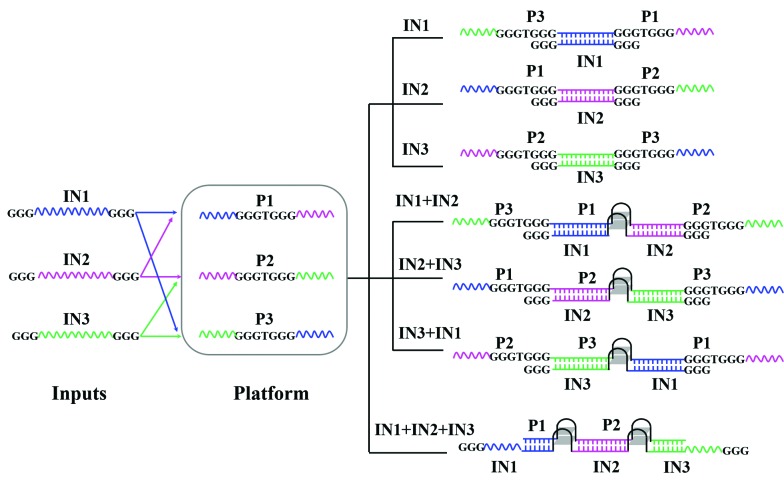
Scheme 1
Scheme 1. The operation principle of the designed three-input majority gate based on DNA hybridization.
Fig. 1
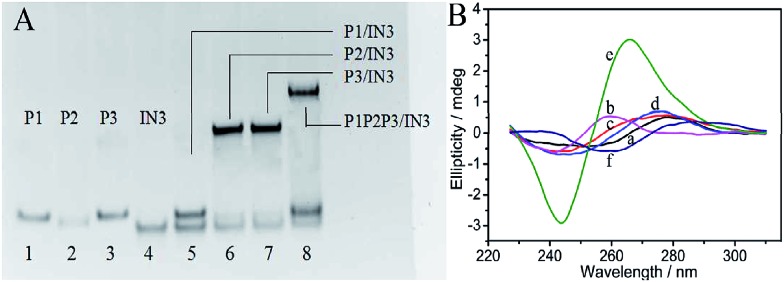
Fig. 1. (A) 15% native polyacrylamide gel analysis of the interaction between IN3 and the platform DNA strands, P1, P2 and P3. Lane 1: P1, Lane 2: P2, Lane 3: P3, Lane 4: IN3, Lane 5: P1 + IN3, Lane 6: P2 + IN3, Lane 7: P3 + IN3, Lane 8: addition of IN3 into the platform containing P1, P2 and P3. (B) CD spectra of different DNA inputs: platform DNA P1 (a), in the absence of platform with IN1 + IN2 (b), in the presence of P1 with IN1 (c), IN2 (d), IN1 + IN2 (e) and IN1 + IN2 + Cu2+ (f).
Fig. 2
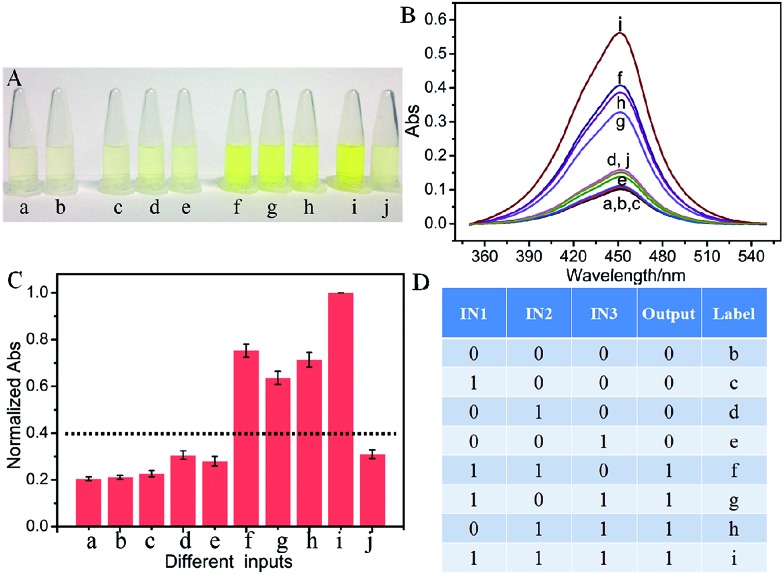
Fig. 2. (A) Photographs of the designed majority logic gate with one-vote veto function, (B) UV-vis absorbance curves of (hemin + TMB + H2O2) in the absence of any platform and input DNA strands (a), in the presence of platform DNA P1, P2 and P3 (b), in the presence of platform with IN1 (c), IN2 (d), IN3 (e), IN1 + IN2 (f), IN2 + IN3 (g), IN1 + IN3 (h), IN1 + IN2 + IN3 (i), IN1 + IN2 + IN3 + Cu2+ (j) and (C) the normalized absorbance intensity at 450 nm of the designed majority logic gate with one-vote veto function with error bars. The absorbance of curve (i) in (B) was set as 1. The threshold value was set at 0.4 to judge the output signals. The error bars were obtained according to three independent experimental results. (D) The truth table of the three-input majority logic gate.
Fig. 3
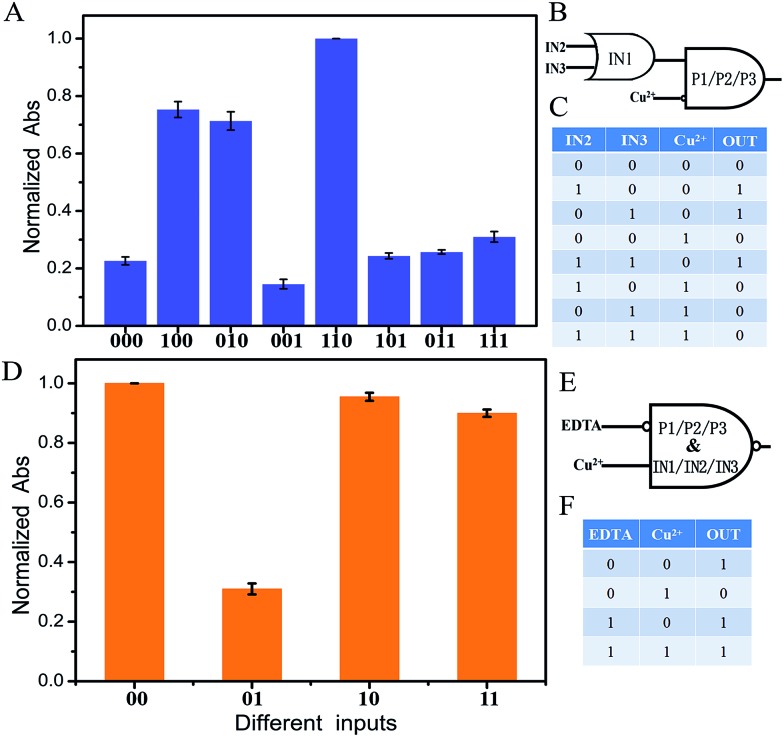
Fig. 3. (A) Normalized Abs at 450 nm of the different input modes of the OR–INHIBIT cascade logic circuit with error bars. Abs at 450 nm of curve (i) in Fig. 2B was set as 1. The threshold value was set at 0.4 to judge the output signals. The input statuses of IN2, IN3 and Cu2+ were represented by three binary numbers. (B) Diagram of the OR–INHIBIT cascade logic circuit. (C) Truth table of the OR–INHIBIT cascade logic circuit. (D) Normalized Abs at 450 nm of the different input modes of the IMPLICATION logic circuit with error bars. Abs at 450 nm of curve (i) in Fig. 2B was set as 1. The threshold value was set at 0.4 to judge the output signals. The input statuses of EDTA and Cu2+ were represented by two binary numbers. (E) Diagram of the IMPLICATION logic circuit. (F) Truth table of the IMPLICATION logic circuit. The error bars were obtained according to three independent experimental results.
Fig. 4
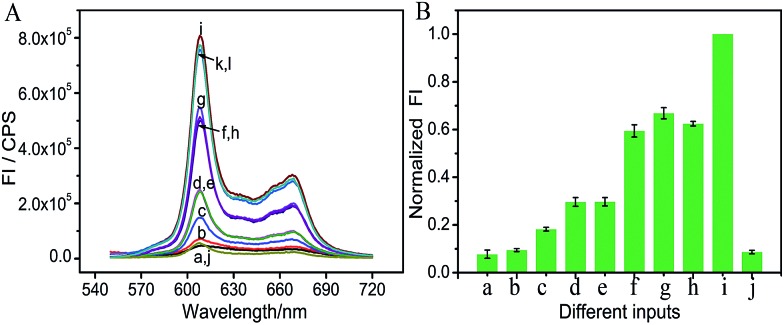
Fig. 4. (A) Fluorescence emission spectra of NMM in the absence of any platform and input DNA strands (a), in the presence of platform DNA P1, P2 and P3 (b), in the presence of platform with IN1 (c), IN2 (d), IN3 (e), IN1 + IN2 (f), IN2 + IN3 (g), IN1 + IN3 (h), IN1 + IN2 + IN3 (i), IN1 + IN2 + IN3 + Cu2+ (j), P + IN1 + IN2 + IN3 + EDTA (k) and P + IN1 + IN2 + IN3 + Cu2+ + EDTA (l), and (B) the normalized fluorescence intensity at 608 nm of the designed majority logic gate with one-vote veto function with error bars. The fluorescence intensity of curve (i) in (A) was set as 1. The error bars were obtained according to three independent experimental results.

References

    1. de Silva P. A., Gunaratne N. H. Q., McCoy C. P. Nature. 1993;364:42–44.
    1. Adleman L. Science. 1994;266:1021–1024. - PubMed
    1. Xie Z., Wroblewska L., Prochazka L., Weiss R., Benenson Y. Science. 2011;333:1307–1311. - PubMed
    1. Magri D. C., Brown G. J., McClean G. D., de Silva A. P. J. Am. Chem. Soc. 2006;128:4950–4951. - PubMed
    1. Genot A. J., Bath J., Turberfield A. J. J. Am. Chem. Soc. 2011;133:20080–20083. - PubMed

LinkOut - more resources