Biological Involvement of MicroRNAs in Proliferative Vitreoretinopathy
- PMID: 28706757
- PMCID: PMC5505124
- DOI: 10.1167/tvst.6.4.5
Biological Involvement of MicroRNAs in Proliferative Vitreoretinopathy
Abstract
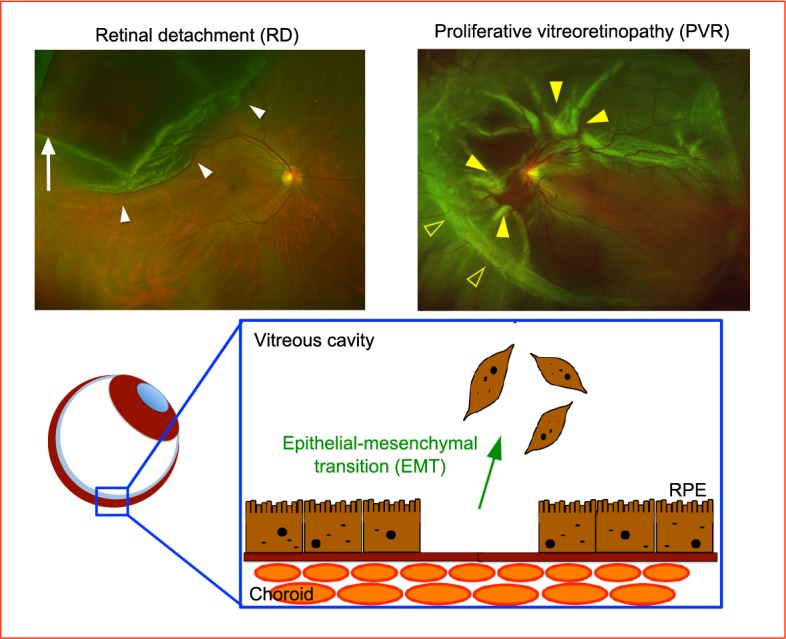
Even with a high surgical success rate for retinal detachment and proliferative vitreoretinopathy (PVR) supported by the robust improvement in vitrectomy surgery and its related devices, certain questions still remain for the pathogenesis and treatment of PVR. One of the important biological events in PVR is epithelial-mesenchymal transition (EMT) of the retinal pigment epithelial (RPE) cells. MicroRNAs are noncoding, small, single-strand RNAs that posttranscriptionally regulate gene expression and have essential roles in homeostasis and pathogenesis in many diseases. Recently, microRNAs also had a critical role in EMT in many tissues and cells. One main purpose of this brief review is to describe the knowledge obtained from microRNA research, especially concerning vitreoretinal diseases. In addition, the potential role of microRNAs in prevention of PVR by regulating EMT in RPE cells is described. Understanding microRNA involvement in PVR could be helpful for developing new biological markers or therapeutic targets and reducing the rate of visual disability due to PVR.
Keywords: epithelial-mesenchymal transition; microRNA; proliferative vitreoretinopathy; retinal detachment; retinal pigment epithelium.
Figures

Similar articles
-
Protective Effects of Fucoidan on Epithelial-Mesenchymal Transition of Retinal Pigment Epithelial Cells and Progression of Proliferative Vitreoretinopathy.Cell Physiol Biochem. 2018;46(4):1704-1715. doi: 10.1159/000489246. Epub 2018 Apr 23. Cell Physiol Biochem. 2018. PMID: 29698960
-
Role of macrophage migration inhibitory factor (MIF) in the effects of oxidative stress on human retinal pigment epithelial cells.Cell Biochem Funct. 2017 Oct;35(7):426-432. doi: 10.1002/cbf.3292. Epub 2017 Sep 14. Cell Biochem Funct. 2017. PMID: 28906008
-
Notch signaling modulates proliferative vitreoretinopathy via regulating retinal pigment epithelial-to-mesenchymal transition.Histochem Cell Biol. 2017 Mar;147(3):367-375. doi: 10.1007/s00418-016-1484-x. Epub 2016 Sep 7. Histochem Cell Biol. 2017. PMID: 27600720
-
Mechanisms of epithelial-mesenchymal transition in proliferative vitreoretinopathy.Discov Med. 2015 Oct;20(110):207-17. Discov Med. 2015. PMID: 26562474 Review.
-
Experimental Models to Study Epithelial-Mesenchymal Transition in Proliferative Vitreoretinopathy.Int J Mol Sci. 2023 Feb 24;24(5):4509. doi: 10.3390/ijms24054509. Int J Mol Sci. 2023. PMID: 36901938 Free PMC article. Review.
Cited by
-
Tacrolimus Modulates TGF-β Signaling-Related Genes and MicroRNAs in Human Retinal Pigment Epithelial Cells Activated by Lipopolysaccharide.Int J Mol Sci. 2025 Jun 4;26(11):5402. doi: 10.3390/ijms26115402. Int J Mol Sci. 2025. PMID: 40508210 Free PMC article.
-
The Role of Dysregulated miRNAs in the Pathogenesis, Diagnosis and Treatment of Age-Related Macular Degeneration.Int J Mol Sci. 2022 Jul 14;23(14):7761. doi: 10.3390/ijms23147761. Int J Mol Sci. 2022. PMID: 35887109 Free PMC article. Review.
-
Inflammatory and Fibrogenic Factors in Proliferative Vitreoretinopathy Development.Transl Vis Sci Technol. 2020 Feb 21;9(3):23. doi: 10.1167/tvst.9.3.23. Transl Vis Sci Technol. 2020. PMID: 32742753 Free PMC article. Review.
-
MicroRNAs in the Vitreous Humor of Patients with Retinal Detachment and a Different Grading of Proliferative Vitreoretinopathy: A Pilot Study.Transl Vis Sci Technol. 2020 May 22;9(6):23. doi: 10.1167/tvst.9.6.23. eCollection 2020 May. Transl Vis Sci Technol. 2020. PMID: 32821520 Free PMC article.
-
miR-204-5p promotes diabetic retinopathy development via downregulation of microtubule-associated protein 1 light chain 3.Exp Ther Med. 2019 Apr;17(4):2945-2952. doi: 10.3892/etm.2019.7327. Epub 2019 Feb 28. Exp Ther Med. 2019. PMID: 30936964 Free PMC article.
References
-
- Bonnet M,, Guenoun S. Surgical risk factors for severe postoperative proliferative vitreoretinopathy (PVR) in retinal detachment with grade B PVR. Graefes Arch Clin Exp Ophthalmol. 1995; 233: 789–791. - PubMed
-
- Tseng W,, Cortez RT,, Ramirez G,, Stinnett S,, Jaffe GJ. Prevalence and risk factors for proliferative vitreoretinopathy in eyes with rhegmatogenous retinal detachment but no previous vitreoretinal surgery. Am J Ophthalmol. 2004; 137: 1105–1115. - PubMed
-
- Lewis H,, Aaberg TM. Causes of failure after repeat vitreoretinal surgery for recurrent proliferative vitreoretinopathy. Am J Ophthalmol. 1991; 111: 15–19. - PubMed
-
- Sethi CS,, Lewis GP,, Fisher SK,, et al. Glial remodeling and neural plasticity in human retinal detachment with proliferative vitreoretinopathy. Invest Ophthalmol Vis Sci. 2005; 46: 329–342. - PubMed
Publication types
LinkOut - more resources
Full Text Sources
Other Literature Sources
Research Materials