


Role of metabolic stress for enhancing muscle adaptations: Practical applications
- PMID: 28706859
- PMCID: PMC5489423
- DOI: 10.5662/wjm.v7.i2.46
Role of metabolic stress for enhancing muscle adaptations: Practical applications
Abstract
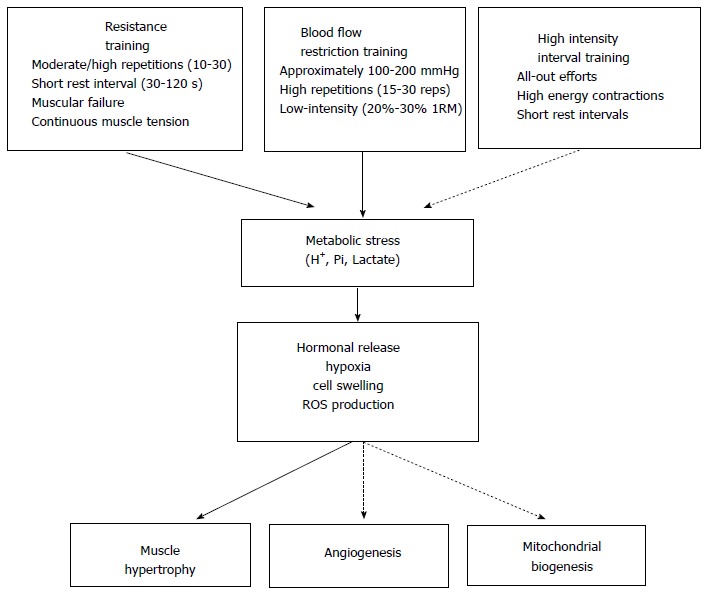
Metabolic stress is a physiological process that occurs during exercise in response to low energy that leads to metabolite accumulation [lactate, phosphate inorganic (Pi) and ions of hydrogen (H+)] in muscle cells. Traditional exercise protocol (i.e., Resistance training) has an important impact on the increase of metabolite accumulation, which influences hormonal release, hypoxia, reactive oxygen species (ROS) production and cell swelling. Changes in acute exercise routines, such as intensity, volume and rest between sets, are determinants for the magnitude of metabolic stress, furthermore, different types of training, such as low-intensity resistance training plus blood flow restriction and high intensity interval training, could be used to maximize metabolic stress during exercise. Thus, the objective of this review is to describe practical applications that induce metabolic stress and the potential effects of metabolic stress to increase systemic hormonal release, hypoxia, ROS production, cell swelling and muscle adaptations.
Keywords: Exercise; Metabolic stress; Muscle mass.
Conflict of interest statement
Conflict-of-interest statement: None.
Figures
References
-
- Coffey VG, Shield A, Canny BJ, Carey KA, Cameron-Smith D, Hawley JA. Interaction of contractile activity and training history on mRNA abundance in skeletal muscle from trained athletes. Am J Physiol Endocrinol Metab. 2006;290:E849–E855. - PubMed
-
- Egan B, Zierath JR. Exercise metabolism and the molecular regulation of skeletal muscle adaptation. Cell Metab. 2013;17:162–184. - PubMed
-
- Hood DA, Irrcher I, Ljubicic V, Joseph AM. Coordination of metabolic plasticity in skeletal muscle. J Exp Biol. 2006;209:2265–2275. - PubMed
-
- Camera DM, Smiles WJ, Hawley JA. Exercise-induced skeletal muscle signaling pathways and human athletic performance. Free Radic Biol Med. 2016;98:131–143. - PubMed
Publication types
LinkOut - more resources
Full Text Sources
Other Literature Sources
Medical
Research Materials
Miscellaneous
