Review
. 2017 Aug;14(4):235-250.
doi: 10.1007/s11897-017-0343-y.

From Inflammation to Fibrosis-Molecular and Cellular Mechanisms of Myocardial Tissue Remodelling and Perspectives on Differential Treatment Opportunities

Affiliations
Review

From Inflammation to Fibrosis-Molecular and Cellular Mechanisms of Myocardial Tissue Remodelling and Perspectives on Differential Treatment Opportunities

Navin Suthahar et al. Curr Heart Fail Rep. 2017 Aug.

Abstract

Purpose of review: In this review, we highlight the most important cellular and molecular mechanisms that contribute to cardiac inflammation and fibrosis. We also discuss the interplay between inflammation and fibrosis in various precursors of heart failure (HF) and how such mechanisms can contribute to myocardial tissue remodelling and development of HF.

Recent findings: Recently, many research articles attempt to elucidate different aspects of the interplay between inflammation and fibrosis. Cardiac inflammation and fibrosis are major pathophysiological mechanisms operating in the failing heart, regardless of HF aetiology. Currently, novel therapeutic options are available or are being developed to treat HF and these are discussed in this review. A progressive disease needs an aggressive management; however, existing therapies against HF are insufficient. There is a dynamic interplay between inflammation and fibrosis in various precursors of HF such as myocardial infarction (MI), myocarditis and hypertension, and also in HF itself. There is an urgent need to identify novel therapeutic targets and develop advanced therapeutic strategies to combat the syndrome of HF. Understanding and describing the elements of the inflammatory and fibrotic pathways are essential, and specific drugs that target these pathways need to be evaluated.

Keywords: Cardiac; ECM; Fibrosis; HF; Heart; Inflammation; Macrophages.


Conflict of interest statement

Conflict of Interest

The authors declare that they have no conflicts of interest.

Human and Animal Rights and Informed Consent

This article does not contain any studies with human or animal subjects performed by any of the authors.

Figures

Fig. 1
Fig. 1
A simplified depiction of sequence of events in an inflammatory response and the role of proresolution mediators in its termination. Tissue injury elicits an initial vascular response, followed by an influx of neutrophils and monocytes to the damaged area. After reaching the tissue, monocytes transform into macrophages and actively phagocytose the debris. Lymphocytes, which are cells of the adaptive immune system, later modulate this initial response. The basic mechanisms of resolution of inflammation are highlighted which are (1) lipid mediator class switching producing proresolution molecules such as lipoxins and resolvins; (2) increased efferocytosis by macrophages; (3) anti-inflammatory cytokines secreted by “resolving” macrophages and regulatory T cells. Failure to resolve leads to persistence of inflammation resulting in a chronic inflammatory state, causing sustained tissue injury. Adapted figure reproduced from [17] Buckley et al. 2014 with permission from the authors. PGE2, prostaglandin E2; PGI2, prostacyclin
Fig. 2
Fig. 2
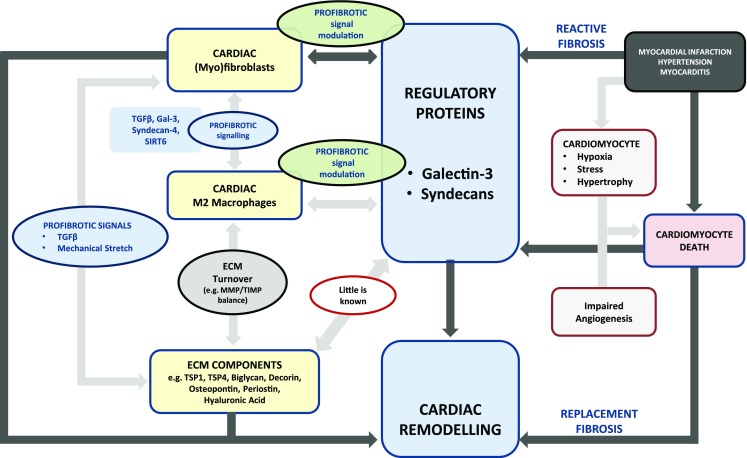
Basic mechanisms of cardiac fibrosis highlighting the role of regulatory proteins in profibrotic signal modulation. ECM matrix deposition is the hallmark of fibrosis and myofibroblasts are the central cells in ECM synthesis. M2 macrophages also play a crucial role in fibrosis and influence ECM turnover chiefly by influencing MMP/TIMP proportions. There is extensive communication between these two cell types occurring through direct cell-cell interactions and also through paracrine signalling. In this diagram, we emphasize the central role of regulatory proteins, such as galectin-3 and syndecans, and how they can directly moderate fibrotic signalling between myofibroblasts and M2 macrophages. However, little is known about the interaction of regulatory proteins directly with ECM components and this could be the focus of future research. Two commonly occurring fibrotic scenarios in the heart are also depicted. In reactive fibrosis, cardiomyocyte death is usually the consequence of fibrosis; while in replacement fibrosis, cardiomyocyte death is the key driver of fibrosis. ECM, extracellular matrix
Fig. 3
Fig. 3
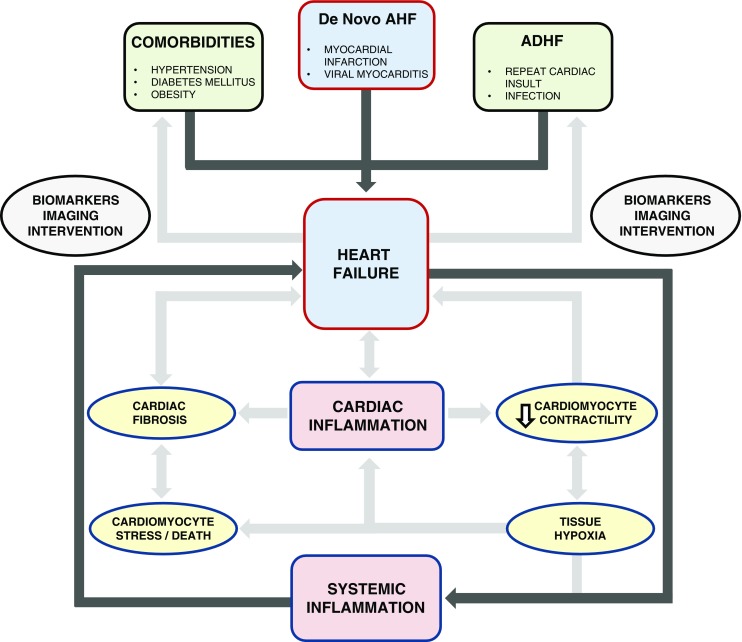
The interplay between systemic inflammation, cardiac inflammation and heart failure (HF) is highlighted. HF can arise de novo, for instance after myocardial infarction (MI) or can result from exacerbation of pre-existing HF. Long-standing systemic diseases such as hypertension, diabetes mellitus (DM) or obesity can also adversely affect cardiac function through various mechanisms (outside the rectangular box). HF is a systemic inflammatory state and promotes cardiac inflammation. Inflammation can affect cardiac function through several mechanisms such as (A) reduced contractility affecting mechanical properties of the heart, (B) cardiac stress leading up to cardiomyocyte death and (C) cardiac fibrosis. All these effects lead to HF or exacerbate pre-existing HF, and this is illustrated within the rectangular framework. Biomarkers and imaging can aid us in identifying the HF process early in the disease course and in assessing the nature of HF to choose appropriate therapeutic interventions. AHF, acute heart failure; ADHF, acute decompensated heart failure

References

    1. Bui AL, Horwich TB, Fonarow GC. Epidemiology and risk profile of heart failure. Nat Rev Cardiol. 2011;8:30–41. doi: 10.1038/nrcardio.2010.165. - DOI - PMC - PubMed
    1. Miller KD, Siegel RL, Lin CC, Mariotto AB, Kramer JL, Rowland JH, et al. Cancer treatment and survivorship statistics, 2016. CA Cancer J Clin. 2016;66:271–289. doi: 10.3322/caac.21349. - DOI - PubMed
    1. Giamouzis G, Kalogeropoulos A, Georgiopoulou V, Laskar S, Smith AL, Dunbar S, et al. Hospitalization epidemic in patients with heart failure: risk factors, risk prediction, knowledge gaps, and future directions. J Card Fail. 2011;17:54–75. doi: 10.1016/j.cardfail.2010.08.010. - DOI - PubMed
    1. Kong P, Christia P, Frangogiannis NG. The pathogenesis of cardiac fibrosis. Cell Mol Life Sci. 2014;71:549–574. doi: 10.1007/s00018-013-1349-6. - DOI - PMC - PubMed
    1. Lee SB, Kalluri R. Mechanistic connection between inflammation and fibrosis. Kidney Int Suppl. 2010;100:S22–S26. doi: 10.1038/ki.2010.418. - DOI - PMC - PubMed