


Prevalence of respiratory viruses among adults, by season, age, respiratory tract region and type of medical unit in Paris, France, from 2011 to 2016
- PMID: 28708843
- PMCID: PMC5510824
- DOI: 10.1371/journal.pone.0180888
Prevalence of respiratory viruses among adults, by season, age, respiratory tract region and type of medical unit in Paris, France, from 2011 to 2016
Abstract
Background: Multiplex PCR tests have improved our understanding of respiratory viruses' epidemiology by allowing their wide range detection. We describe here the burden of these viruses in hospital settings over a five-year period.
Methods: All respiratory samples from adult patients (>20 years old) tested by multiplex-PCR at the request of physicians, from May 1 2011 to April 30 2016, were included retrospectively. Viral findings are reported by season, patient age group, respiratory tract region (upper or lower) and type of clinical unit (intensive care unit, pneumology unit, lung transplantation unit and other medical units).
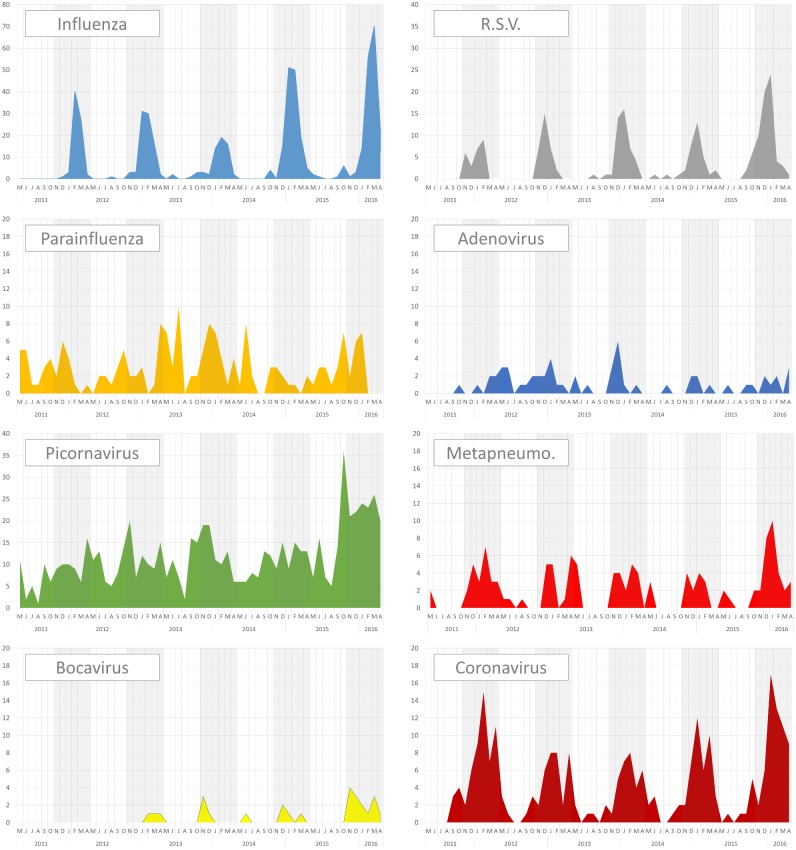
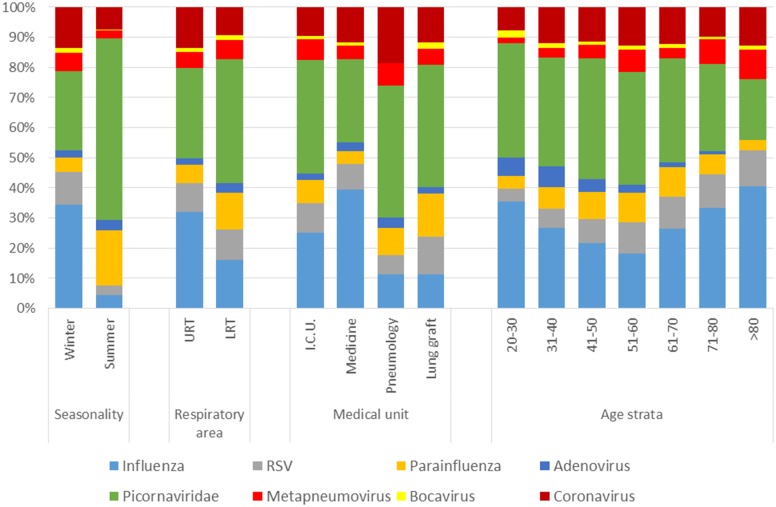
Results: In total, 7196 samples (4958 patients) were included; 29.2% tested positive, with viral co-infections detected in 1.6% of samples. Overall, two viral groups accounted for 60.2% of all viruses identified: picornaviruses (rhinovirus or enterovirus, 34.3%) and influenza (26.6%). Influenza viruses constituted the group most frequently identified in winter (34.4%), in the upper respiratory tract (32%) and in patients over the age of 70 years (36.4%). Picornavirus was the second most frequently identified viral group in these populations and in all other groups, including lower respiratory tract infections (41.3%) or patients in intensive care units (37.6%).
Conclusion: This study, the largest to date in Europe, provides a broad picture of the distribution of viruses over seasons, age groups, types of clinical unit and respiratory tract regions in the hospital setting. It highlights the burden associated with the neglected picornavirus group. These data have important implications for the future development of vaccines and antiviral drugs.
Conflict of interest statement
Figures
References
-
- Berry M, Gamieldien J, Fielding BC. Identification of new respiratory viruses in the new millennium. Viruses. 2015;7: 996–1019. doi: 10.3390/v7030996 - DOI - PMC - PubMed
-
- Peiris JSM, Yuen KY, Osterhaus ADME, Stöhr K. The severe acute respiratory syndrome. N Engl J Med. 2003;349: 2431–2441. doi: 10.1056/NEJMra032498 - DOI - PubMed
-
- To KKW, Chan JFW, Chen H, Li L, Yuen K-Y. The emergence of influenza A H7N9 in human beings 16 years after influenza A H5N1: a tale of two cities. Lancet Infect Dis. 2013;13: 809–821. doi: 10.1016/S1473-3099(13)70167-1 - DOI - PMC - PubMed
-
- Girard MP, Tam JS, Assossou OM, Kieny MP. The 2009 A (H1N1) influenza virus pandemic: A review. Vaccine. 2010;28: 4895–4902. doi: 10.1016/j.vaccine.2010.05.031 - DOI - PubMed
-
- de Groot RJ, Baker SC, Baric RS, Brown CS, Drosten C, Enjuanes L, et al. Middle East respiratory syndrome coronavirus (MERS-CoV): announcement of the Coronavirus Study Group. J Virol. 2013;87: 7790–7792. doi: 10.1128/JVI.01244-13 - DOI - PMC - PubMed
MeSH terms
Substances
LinkOut - more resources
Full Text Sources
Other Literature Sources
Miscellaneous
