


Putting women at the center: a review of Indian policy to address person-centered care in maternal and newborn health, family planning and abortion
- PMID: 28709417
- PMCID: PMC5513115
- DOI: 10.1186/s12889-017-4575-2
Putting women at the center: a review of Indian policy to address person-centered care in maternal and newborn health, family planning and abortion
Erratum in
-
Erratum to: BMC Public Health, Vol. 18.BMC Public Health. 2017 Sep 22;17(1):736. doi: 10.1186/s12889-017-4709-6. BMC Public Health. 2017. PMID: 28938882 Free PMC article. No abstract available.
Abstract
Background: Person-centered care is a critical component of quality care, essential to enable treatment adherence, and maximize health outcomes. Improving the quality of health services is a key strategy to achieve the new global target of zero preventable maternal deaths by 2030. Recognizing this, the Government of India has in the last decade initiated a number of strategies to address quality of care in health and family welfare services.
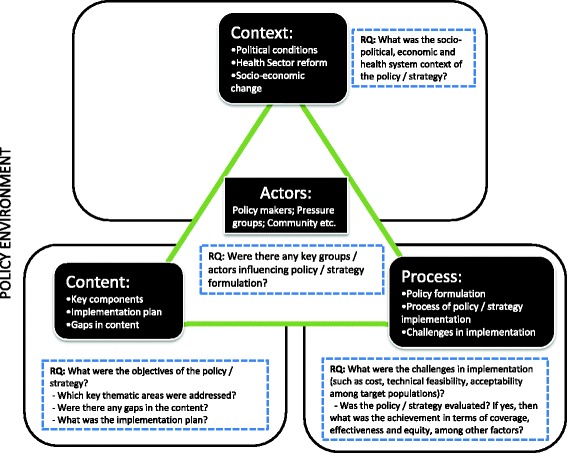
Methods: We conducted a policy review of quality improvement strategies in India from 2005 to 15, covering three critical areas- maternal and newborn health, family planning, and abortion (MNHFP + A). Based on Walt and Gilson's policy triangle framework, we analyzed the extent to which policies incorporated person-centered care, while identifying unaddressed issues. Data was sourced from Government of India websites, scientific and grey literature databases.
Results: Twenty-two national policy documents, comprising two policy statements and 20 implementation guidelines of specific schemes were included in the review. Quality improvement strategies span infrastructure, commodities, human resources, competencies, and accountability that are driving quality assurance in MNHFP + A services. However, several implementation challenges have affected compliance with person-centered care, thereby affecting utilization and outcomes.
Conclusion: Focus on person-centered care in Indian MNHFP + A policy has increased in recent years. Nevertheless, some aspects must still be strengthened, such as positive interpersonal behavior, information sharing and promptness of care. Implementation can be improved through better provider training, patient feedback and monitoring mechanisms. Moreover, unless persisting structural challenges are addressed implementation of person-centered care in facilities will not be effective.
Keywords: Abortion; Family planning; India; Maternal and newborn health; Person-centered care; Policy; Quality of care.
Conflict of interest statement
Ethics approval and consent to participate
This study obtained ethical approval from the University of California, San Francisco (153312) and the Institutional Ethics Committee of the Public Health Foundation of India (TRC-IEC-276/15).
Competing interests
The authors declare that they have no competing interests.
Publisher’s Note
Springer Nature remains neutral with regard to jurisdictional claims in published maps and institutional affiliations.
Figures
References
-
- Institute of Medicine. Crossing the Quality Chasm: A New Health System for the 21st Century. Washington: National Academy Press. 2001. http://www.nap.edu/books/0309072808/html/. Accessed 15 Mar 2016.
-
- United Nations. Transforming our world: the 2030 agenda for sustainable development. United Nations. 2015. https://sustainabledevelopment.un.org/content/documents/21252030%20Agend.... Accessed 21 Mar 2016.
-
- Government of India Planning Commission . Twelfth five year plan (2012–2017) New Delhi: Sage Publications India Private Limited; 2013.
MeSH terms
LinkOut - more resources
Full Text Sources
Other Literature Sources
Medical
