


Area-based socioeconomic factors and Human Papillomavirus (HPV) vaccination among teen boys in the United States
- PMID: 28709420
- PMCID: PMC5513319
- DOI: 10.1186/s12889-017-4567-2
Area-based socioeconomic factors and Human Papillomavirus (HPV) vaccination among teen boys in the United States
Erratum in
-
Erratum to: BMC Public Health, Vol. 18.BMC Public Health. 2017 Sep 22;17(1):736. doi: 10.1186/s12889-017-4709-6. BMC Public Health. 2017. PMID: 28938882 Free PMC article. No abstract available.
Abstract
Background: This study is the first to examine associations between several area-based socioeconomic factors and human papillomavirus (HPV) vaccine uptake among boys in the United States (U.S.).
Methods: Data from the 2012-2013 National Immunization Survey-Teen restricted-use data were analyzed to examine associations of HPV vaccination initiation (receipt of ≥1 dose) and series completion (receipt of three doses) among boys aged 13-17 years (N = 19,518) with several individual-level and ZIP Code Tabulation Area (ZCTA) census measures. Multivariable logistic regression was used to estimate the odds of HPV vaccination initiation and series completion separately.
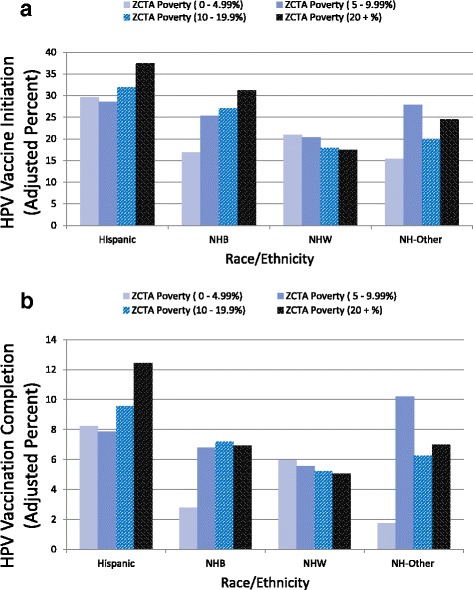
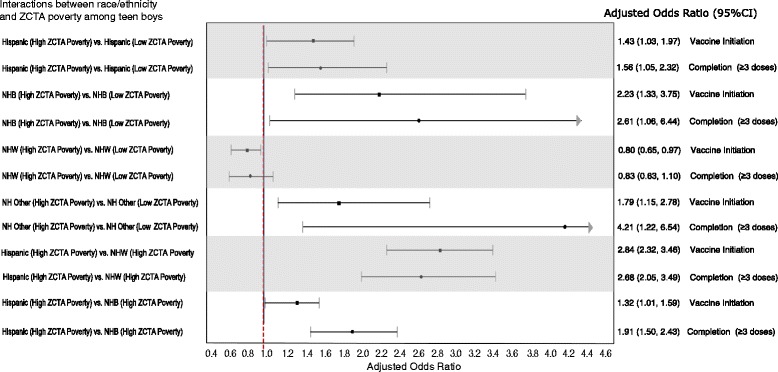
Results: In 2012-2013 approximately 27.9% (95% CI 26.6%-29.2%) of boys initiated and 10.38% (95% CI 9.48%-11.29%) completed the HPV vaccine series. Area-based poverty was not statistically significantly associated with HPV vaccination initiation. It was, however, associated with series completion, with boys living in high-poverty areas (≥20% of residents living below poverty) having higher odds of completing the series (AOR 1.22, 95% CI 1.01-1.48) than boys in low-poverty areas (0-4.99%). Interactions between race/ethnicity and ZIP code-level poverty indicated that Hispanic boys living in high-poverty areas had a statistically significantly higher odds of HPV vaccine initiation (AOR 1.43, 95% CI 1.03-1.97) and series completion (AOR 1.56, 95% CI 1.05-2.32) than Hispanic boys in low-poverty areas. Non-Hispanic Black boys in high poverty areas had higher odds of initiation (AOR 2.23, 95% CI 1.33-3.75) and completion (AOR 2.61, 95% CI 1.06-6.44) than non-Hispanic Black boys in low-poverty areas. Rural/urban residence and population density were also significant factors, with boys from urban or densely populated areas having higher odds of initiation and completion compared to boys living in non-urban, less densely populated areas.
Conclusion: Higher HPV vaccination coverage in urban areas and among racial/ethnic minorities in areas with high poverty may be attributable to factors such as vaccine acceptance, health-care practices, and their access to HPV vaccines through the Vaccines for Children Program, which provides free vaccines to uninsured and under-insured children. Given the low HPV vaccination rates among boys in the U.S., these results provide important evidence to inform public health interventions to increase HPV vaccination.
Keywords: Cancer prevention; Cervical cancer; Geographic factors; HPV vaccination; Health disparities; Human papillomavirus.
Conflict of interest statement
Ethics approval and consent to participate
Data collection for National Immunization Survey Teen (NIS-T) was approved by the United States National Center for Health Statistics (NCHS) Research Ethics Review Board. Analysis of de-identified data from the survey is exempt from the federal regulations for the protection of human research participants. Analysis of restricted data through the NCHS Research Data Center is also approved by the NCHS ERB. The Institutional Review Board at Temple University determined this study was exempt from review.
Consent for publication
Not applicable.
Competing interests
The authors declare that they have no competing interests.
Publisher’s Note
Springer Nature remains neutral with regard to jurisdictional claims in published maps and institutional affiliations.
Figures
References
-
- Ryerson AB, Eheman CR, Altekruse SF, Ward JW, Jemal A, Sherman RL, Henley SJ, Holtzman D, Lake A, Noone AM, et al. Annual report to the nation on the status of cancer, 1975-2012, featuring the increasing incidence of liver cancer. Cancer. 2016;122(9):1312–1337. doi: 10.1002/cncr.29936. - DOI - PMC - PubMed
-
- Jemal A, Simard EP, Dorell C, Noone AM, Markowitz LE, Kohler B, Eheman C, Saraiya M, Bandi P, Saslow D, et al. Annual report to the nation on the status of cancer, 1975-2009, featuring the burden and trends in human papillomavirus(HPV)-associated cancers and HPV vaccination coverage levels. J Natl Cancer Inst. 2013;105(3):175–201. doi: 10.1093/jnci/djs491. - DOI - PMC - PubMed
MeSH terms
Substances
Grants and funding
LinkOut - more resources
Full Text Sources
Other Literature Sources
Medical
