Outcomes following revision surgery performed for adverse reactions to metal debris in non-metal-on-metal hip arthroplasty patients: Analysis of 185 revisions from the National Joint Registry for England and Wales
- PMID: 28710154
- PMCID: PMC5539305
- DOI: 10.1302/2046-3758.67.BJR-2017-0017.R2
Outcomes following revision surgery performed for adverse reactions to metal debris in non-metal-on-metal hip arthroplasty patients: Analysis of 185 revisions from the National Joint Registry for England and Wales
Abstract
Objectives: Few studies have assessed outcomes following non-metal-on-metal hip arthroplasty (non-MoMHA) revision surgery performed for adverse reactions to metal debris (ARMD). We assessed outcomes following non-MoMHA revision surgery performed for ARMD, and identified predictors of re-revision.
Methods: We performed a retrospective observational study using data from the National Joint Registry for England and Wales. All non-MoMHAs undergoing revision surgery for ARMD between 2008 and 2014 were included (185 hips in 185 patients). Outcome measures following ARMD revision were intra-operative complications, mortality and re-revision surgery. Predictors of re-revision were identified using Cox regression.
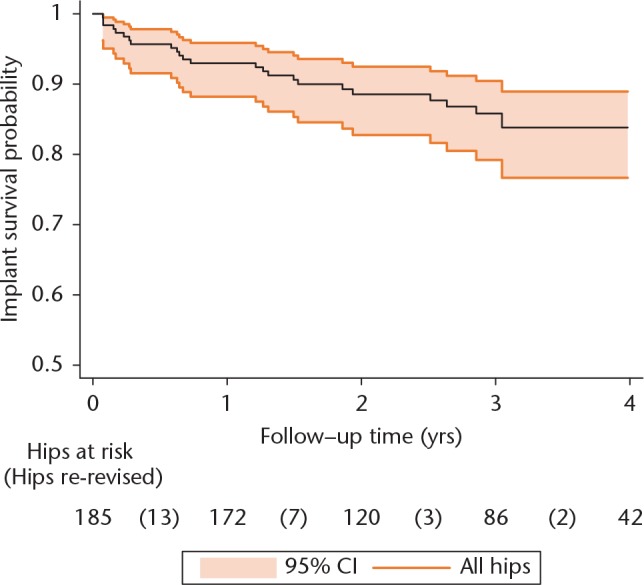
Results: Intra-operative complications occurred in 6.0% (n = 11) of the 185 cases. The cumulative four-year patient survival rate was 98.2% (95% CI 92.9 to 99.5). Re-revision surgery was performed in 13.5% (n = 25) of hips at a mean time of 1.2 years (0.1 to 3.1 years) following ARMD revision. Infection (32%; n = 8), dislocation/subluxation (24%; n = 6), and aseptic loosening (24%; n = 6) were the most common re-revision indications. The cumulative four-year implant survival rate was 83.8% (95% CI 76.7 to 88.9). Multivariable analysis identified three predictors of re-revision: multiple revision indications (hazard ratio (HR) = 2.78; 95% CI 1.03 to 7.49; p = 0.043); selective component revisions (HR = 5.76; 95% CI 1.28 to 25.9; p = 0.022); and ceramic-on-polyethylene revision bearings (HR = 3.08; 95% CI 1.01 to 9.36; p = 0.047).
Conclusions: Non-MoMHAs revised for ARMD have a high short-term risk of re-revision, with important predictors of future re-revision including selective component revision, multiple revision indications, and ceramic-on-polyethylene revision bearings. Our findings may help counsel patients about the risks of ARMD revision, and guide reconstructive decisions. Future studies attempting to validate the predictors identified should also assess the effects of implant design (metallurgy and modularity), given that this was an important study limitation potentially influencing the reported prognostic factors.Cite this article: G. S. Matharu, A. Judge, D. W. Murray, H. G. Pandit. Outcomes following revision surgery performed for adverse reactions to metal debris in non-metal-on-metal hip arthroplasty patients: Analysis of 185 revisions from the National Joint Registry for England and Wales. Bone Joint Res 2017;6:405-413. DOI: 10.1302/2046-3758.67.BJR-2017-0017.R2.
Keywords: Adverse reactions to metal debris; Complications; Mortality; Non-metal-on-metal hip arthroplasty; Revision surgery.
© 2017 Matharu et al.
Conflict of interest statement
Conflicts of Interest Statement: One of the authors provides expert testimony to Kennedys Law, which includes work relating to metal-on-metal hip replacements.
Figures
References
-
- Smith AJ, Dieppe P, Vernon K, Porter M, Blom AW; National Joint Registry of England and Wales. Failure rates of stemmed metal-on-metal hip replacements: analysis of data from the National Joint Registry for England and Wales. Lancet 2012;379:1199–1204. - PubMed
-
- Smith AJ, Dieppe P, Howard PW, Blom AW, National Joint Registry for England and Wales. Failure rates of metal-on-metal hip resurfacings: analysis of data from the National Joint Registry for England and Wales. Lancet 2012;380:1759-1766. - PubMed
-
- National Joint Registry for England, Wales, Northern Ireland and the Isle of Man. 13th Annual Report 2016. http://www.njrcentre.org.uk/njrcentre/Portals/0/Documents/England/Report... (last accessed 12 May 2017).
-
- Australian Orthopaedic Association. National Joint Replacement Registry: Hip, Knee & Shoulder Arthroplasty. Annual Report 2016. https://aoanjrr.sahmri.com/documents/10180/275066/Hip%2C%20Knee%20%26%20... (last accessed 12 May 2017).
-
- Grammatopoulos G, Pandit H, Kwon YM, et al. Hip resurfacings revised for inflammatory pseudotumour have a poor outcome. J Bone Joint Surg [Br] 2009;91-B:1019-1024. - PubMed
LinkOut - more resources
Full Text Sources
Other Literature Sources