Review
. 2017 Aug 7;10(8):1035-1046.
doi: 10.1016/j.molp.2017.07.002. Epub 2017 Jul 13.

Expanding Roles of PIFs in Signal Integration from Multiple Processes

Affiliations
Review

Expanding Roles of PIFs in Signal Integration from Multiple Processes

Inyup Paik et al. Mol Plant. .

Abstract

PHYTOCHROME-INTERACTING FACTORs (PIFs) are members of the basic helix-loop-helix (bHLH) family of transcription factors in Arabidopsis. Since their discovery in phytochrome-mediated light signaling pathways, recent studies have unraveled new functions of PIFs in integrating multiple signaling pathways not only through their role as transcription factors directly targeting gene expression but also by interacting with diverse groups of factors to optimize plant growth and development. These include endogenous (e.g., hormonal) as well as abiotic (light, circadian, and elevated temperature) and biotic (defense responses) pathways. PIFs interact with key factors in each of these pathways and tailor the outcome of the signal integration among these pathways. This review discusses the roles of PIFs as pivotal signal integrators in regulating plant growth and development.

Keywords: circadian clock; growth–defense tradeoff; hormone signaling; phytochrome-interacting factor; signal integration; thermomorphogenesis.


Figures

Figure 1
Figure 1
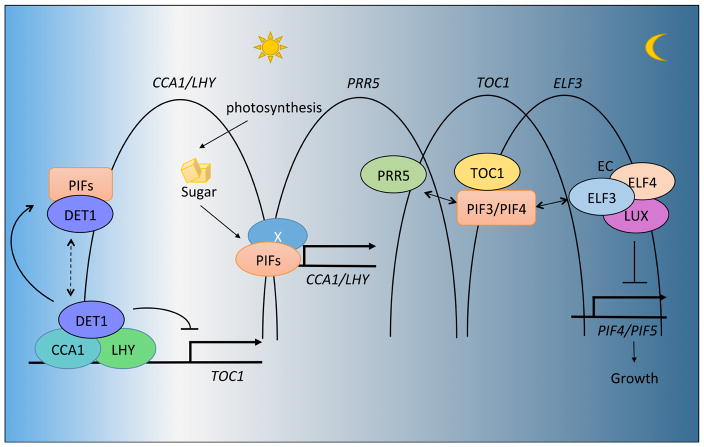
Dynamic involvement of PIFs in regulating circadian clock and diurnal growth in Arabidopsis. PIFs have been shown to participate in both the input and output pathways of circadian clock. (Left) DET1 forms a complex with CCA1/LHY to repress TOC1 expression in the morning. DET1 also directly interacts with and stabilizes PIFs in the dark. PIFs might form a complex with DET1-CCA1-LHY to form a transcription complex as indicated by a dotted line. (Middle) PIF1, PIF3, PIF4 and PIF5 are necessary to mediate metabolic signaling to the clock by directly binding to the CCA1/LHY promoters in response to sugar. X, indicates an unknown factor or sugar-induced modification necessary for enhanced PIF binding to the CCA1/LHY promoters. (Right) Sequential expression of PRR5 and TOC1 gates the growth by inhibiting PIF functions, while ELF3-ELF4-LUX forms an evening complex (EC) that represses PIF4/PIF5 expression to repress growth during early evening.
Figure 2
Figure 2
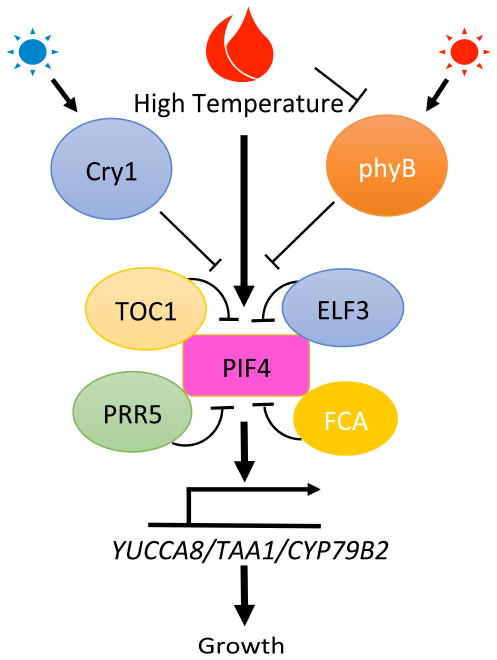
PIF4 plays a central role in integrating light and high temperature signaling to promote growth. High ambient temperature induces PIF4 expression and also stabilizes PIF4 protein. Multiple regulators have been shown to directly interact with PIF4 and regulate its function by inhibiting DNA binding, transcription activity and protein stability. While two photoreceptors, phyB and Cry1 function to inhibit PIF4 activity in response to red and blue light signals, respectively, only phyB has been shown to act as a thermosensor in Arabidopsis. PIF4 directly activates the expression of YUC/TAA1/CYP79B2 genes to promote growth.
Figure 3
Figure 3
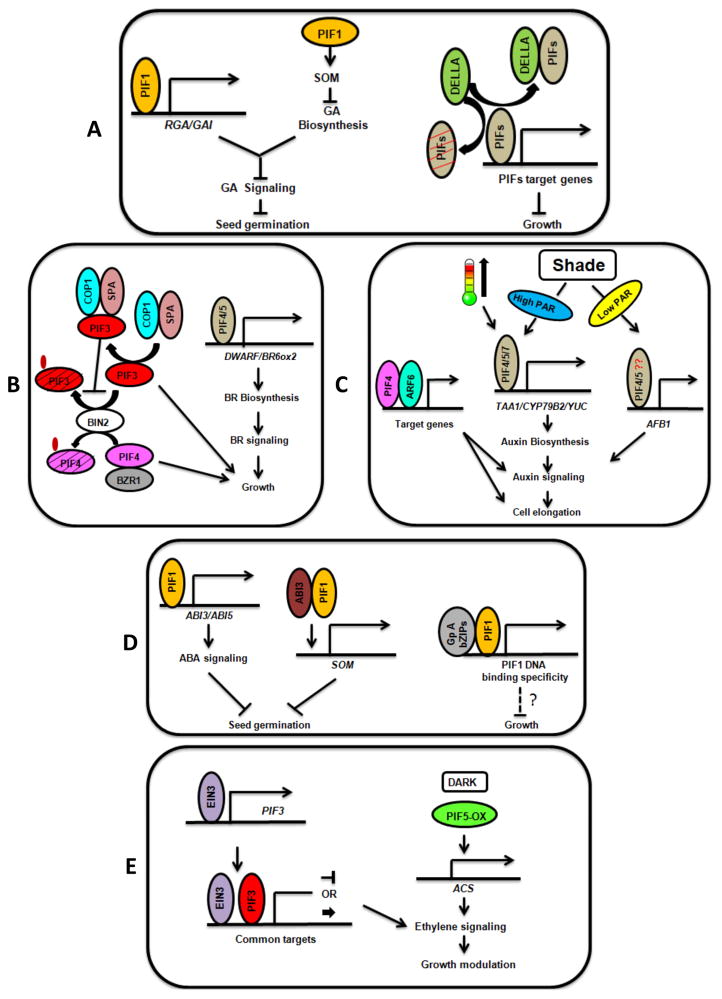
PIFs integrate light and hormone signaling pathways to modulate growth in Arabidopsis. (A, left) PIF1 has an exclusive role in regulating seed germination by directly activating RGA and GAI expression that inhibit GA signaling. PIF1 also inhibits GA biosynthesis indirectly by activating SOM expression, resulting in inhibition of seed germination in the dark. Light-induced degradation of PIF1 promotes seed germination. (Right) PIFs physically interact with DELLA proteins and this interaction results in inhibition of DNA binding activities of PIFs. DELLA proteins also induce degradation of PIFs in darkness and inhibit subsequent growth. (B, left) PIF4 interacts with BZR1 and regulates growth in response to BR and light signal. BIN2 phosphorylates PIF3 and PIF4 independent of light and promotes their degradation in darkness. However, COP1/SPA1 interact with PIF3 and prevent BIN2-mediated phosphorylation and degradation in the dark. (Right) PIF4 and PIF5 directly activate BR biosynthetic pathway genes to promote growth. (C, left) PIF4 forms a complex with ARF6 and promotes growth in response to light and auxin signaling. (Middle) In response to high ambient temperature and shade conditions, PIF4/PIF5/PIF7 promote auxin biosynthesis to promote cell elongation. (Right) PIF4/PIF5 and possibly other PIFs also activate the expression of auxin receptor AFB5 in response to low PAR shade conditions to promote auxin signaling and subsequent growth. (D, left) PIF1 directly activates the expression of the ABA signaling components (ABI3 and ABI5). PIF1 also interacts with ABI3 and the PIF1-ABI3 complex directly inhibits the expression of SOM, which in turn inhibits GA biosynthesis to suppress seed germination. (Right) PIF1 and possibly other PIFs directly interact with group A bZIP proteins (e.g., ABI5). This interaction regulates the DNA binding specificity and target gene selection of PIF1 and possibly other PIFs. (E, left) Ethylene signaling factor, EIN3 directly activates the expression of PIF3, which in turn binds to DNA along with EIN3 to regulate ethylene signaling as well as chlorophyll biosynthesis and growth. (Right) Overexpression of PIF5 activates the expression of ACC Synthase (ACS) genes, which results in increased ethylene biosynthesis and signaling to modulate growth.
Figure 4
Figure 4
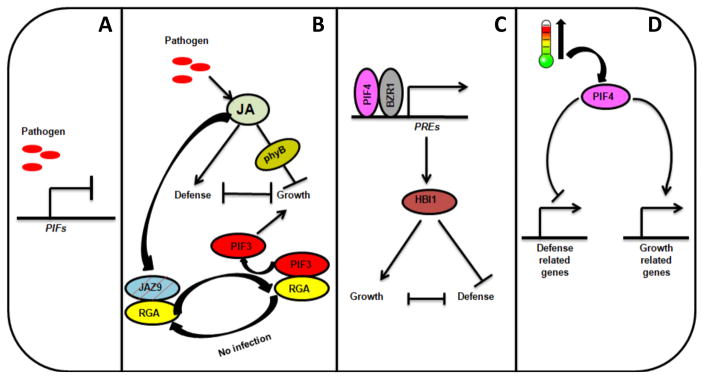
PIFs regulate growth-defense trade-offs in Arabidopsis. Plants use multiple mechanisms involving PIFs as core factors to fine-tune growth in response to pathogen attacks. (A) In response to pathogen attack, plants down-regulate the expression of PIFs to suppress growth. (B) To counter the pathogen attacks, plants activate the JA signaling which promotes defense responses, while suppressing growth by modulating the functions of light signaling components. Activated JA signaling promotes the degradation of JAZ9, releasing RGA from JAZ9-RGA complex, which in-turn forms another complex with PIF3 to inactivate PIF3 activity. Secondly, activated JA signaling genetically interacts with phyB to repress plant growth. (C) PIF4 interacts with BZR1 to form a complex and collectively activates the expression of PREs. PREs in turn indirectly activate HBI1. HBI1 promotes growth, while suppresses defense signaling in the absence of pathogen challenge. (D) High temperature-activated PIF4 actively promotes growth by upregulating the growth-related genes and simultaneously represses the defense responses by suppressing the expression of genes involved in plant defense.

References

    1. Bae G, Choi G. Decoding of light signals by plant phytochromes and their interacting proteins. Annu Rev Plant Biol. 2008;59:281–311. - PubMed
    1. Bailey PC, Martin C, Toledo-Ortiz G, Quail PH, Huq E, Heim M, Jakoby M, Werber M, Weisshaar B. Update on the Basic/Helix-Loop-Helix Transcription Factor Gene Family in Arabidopsis thaliana. The Plant Cell. 2003;15:2497–2501. - PMC - PubMed
    1. Ballaré CL. Light regulation of plant defense. Annual Review of Plant Biology. 2014;65:335–363. - PubMed
    1. Battisti DS, Naylor RL. Historical warnings of future food insecurity with unprecedented seasonal heat. Science. 2009;323:240–244. - PubMed
    1. Bernardo-García S, de Lucas M, Martínez C, Espinosa-Ruiz A, Daviere JM, Prat S. BR-dependent phosphorylation modulates PIF4 transcriptional activity and shapes diurnal hypocotyl growth. Genes & Development. 2014;28:1681–1694. - PMC - PubMed

Publication types

MeSH terms

Substances

LinkOut - more resources