Review
. 2017:2017:6972732.
doi: 10.1155/2017/6972732. Epub 2017 Jun 20.

Small Molecule, Big Prospects: MicroRNA in Pregnancy and Its Complications

Affiliations
Review

Small Molecule, Big Prospects: MicroRNA in Pregnancy and Its Complications

Meng Cai et al. J Pregnancy. 2017.

Abstract

MicroRNAs are small, noncoding RNA molecules that regulate target gene expression in the posttranscriptional level. Unlike siRNA, microRNAs are "fine-tuners" rather than "switches" in the regulation of gene expression; thus they play key roles in maintaining tissue homeostasis. The aberrant microRNA expression is implicated in the disease process. To date, numerous studies have demonstrated the regulatory roles of microRNAs in various pathophysiological conditions. In contrast, the study of microRNA in pregnancy and its associated complications, such as preeclampsia (PE), fetal growth restriction (FGR), and preterm labor, is a young field. Over the last decade, the knowledge of pregnancy-related microRNAs has increased and the molecular mechanisms by which microRNAs regulate pregnancy or its associated complications are emerging. In this review, we focus on the recent advances in the research of pregnancy-related microRNAs, especially their function in pregnancy-associated complications and the potential clinical applications. Here microRNAs that associate with pregnancy are classified as placenta-specific, placenta-associated, placenta-derived circulating, and uterine microRNA according to their localization and origin. MicroRNAs offer a great potential for developing diagnostic and therapeutic targets in pregnancy-related disorders.


Figures
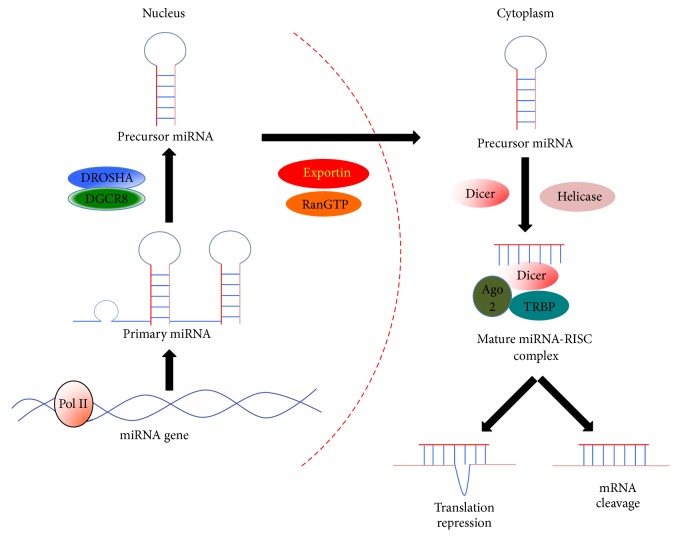
Figure 1
Figure 1
A schematic diagram showing miRNA biogenesis and miRNA-mediated target mRNA suppression. The primary miRNAs (pri-miRNA) are transcribed from miRNA genes by RNA polymerase II or III in the nucleus and subsequently processed by Drosha and DGCR8 to form precursor miRNA (pre-miRNA). Next, the pre-miRNAs are exported into cytoplasm by exportin 5 and RanGTP. In the cytoplasm, the pre-miRNAs are further cleaved by Dicer and resulted in two ssRNAs. Finally, the ssRNAs integrate into RISC protein complex which includes Argonaute 2, Dicer, and TRBP. Functionally, the miRNA-RISC complex inhibits target mRNA expression through either translational repression or mRNA cleavage.
Figure 2
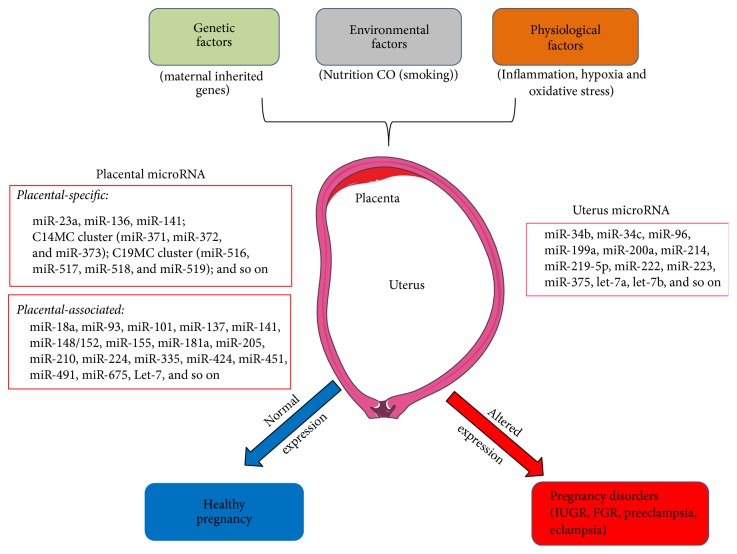
Figure 2
The pregnancy process is regulated by genetic, environmental, and physiological factors. MiRNAs in the placenta and uterus respond to the change of these factors during pregnancy. Altered expression of miRNAs leads to the pregnancy disorders.
Figure 3
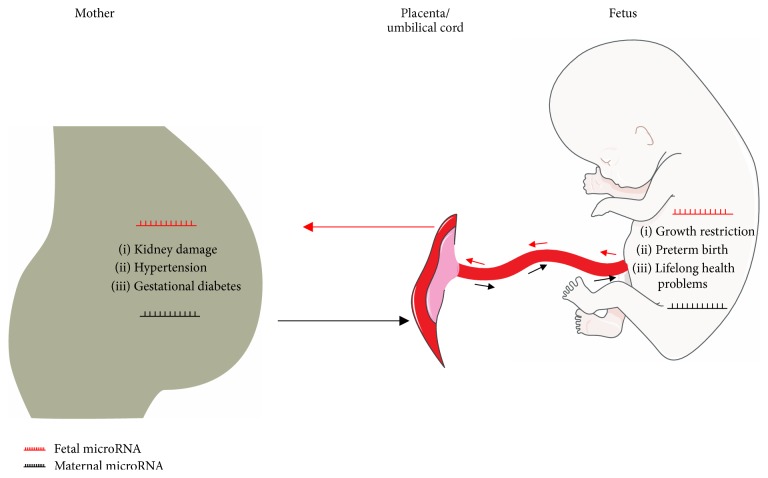
Figure 3
The mutual communication of miRNAs between fetus and mother in the pregnancy may link to most pregnancy-associated maternal and fetal disorders. The aberrant exchange of fetal and maternal miRNAs during pregnancy may even lead to lifelong problems in the fetus and mother.

References

    1. Mattick J. S. The genetic signatures of noncoding RNAs. PLoS Genetics. 2009;5 doi: 10.1371/journal.pgen.1000459.e1000459 - DOI - PMC - PubMed
    1. Zheng R., Shen Z., Tripathi V., et al. Polypurine-repeat-containing RNAs: A novel class of long non-coding RNA in mammalian cells. Journal of Cell Science. 2010;123(21):3734–3744. doi: 10.1242/jcs.070466. - DOI - PMC - PubMed
    1. Han J., Lee Y., Yeom K., Kim Y., Jin H., Kim V. N. The Drosha-DGCR8 complex in primary microRNA processing. Genes and Development. 2004;18(24):3016–3027. doi: 10.1101/gad.1262504. - DOI - PMC - PubMed
    1. Bernstein E., Caudy A. A., Hammond S. M., Hannon G. J. Role for a bidentate ribonuclease in the initiation step of RNA interference. Nature. 2001;409(6818):363–366. doi: 10.1038/35053110. - DOI - PubMed
    1. Hammond S. M. Dicing and slicing: the core machinery of the RNA interference pathway. FEBS Letters. 2005;579(26):5822–5829. doi: 10.1016/j.febslet.2005.08.079. - DOI - PubMed

LinkOut - more resources