


Illegal gold miners in French Guiana: a neglected population with poor health
- PMID: 28716015
- PMCID: PMC5513330
- DOI: 10.1186/s12889-017-4557-4
Illegal gold miners in French Guiana: a neglected population with poor health
Erratum in
-
Erratum to: BMC Public Health, Vol. 18.BMC Public Health. 2017 Sep 22;17(1):736. doi: 10.1186/s12889-017-4709-6. BMC Public Health. 2017. PMID: 28938882 Free PMC article. No abstract available.
Abstract
Background: In French Guiana, a French overseas territory in South America, 6 to 10 thousands undocumented persons work illegally in gold mining sites in the Amazonian forest. Precarious life conditions lead to poor health but few data exist on the health status of illegal gold miners in French Guiana. The objective of this article was to describe the sociodemographic and health status of this vulnerable population.
Method: A prospective cross-sectional survey was conducted in 2015 on gold mine supply sites at the border between French Guiana and Suriname. Health status was assessed through medical examination, past medical history, haemoglobin concentration, and HIV and malaria testing. A questionnaire was used to collect data about the migration itinerary and life conditions on mining sites.
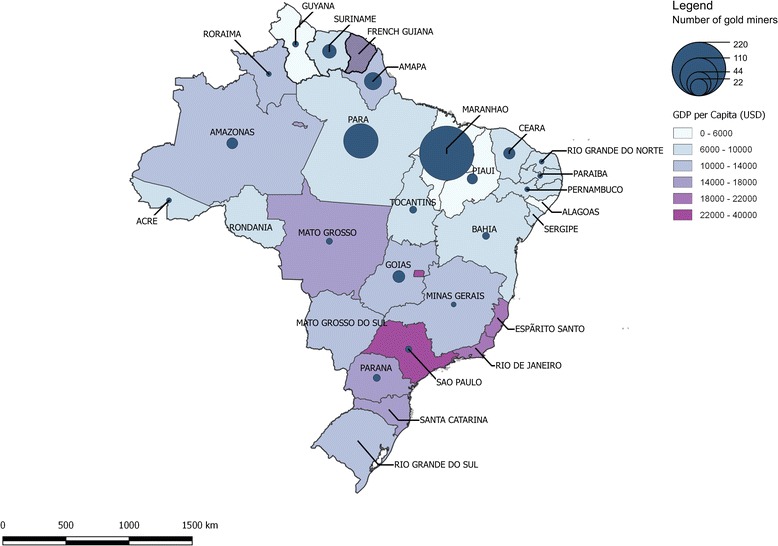
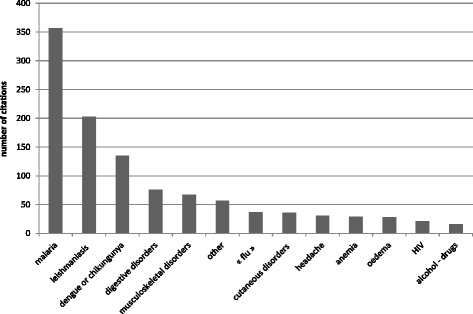
Results: Among the 421 adults included in the study, 93.8% (395/421) were Brazilian, mainly from Maranhão (55.7%, 220/395), the poorest Brazilian state. The sex ratio was 2.4. Overall, 48% of persons never went to school or beyond the primary level. The median time spent in gold mining was quite long (10 years), with a high turn-over. One third of the surveyed population (37.1%, 156/421) had high blood pressure, and only two had a medical follow-up. Most persons had experienced malaria (89.3%, 376/421). They declared frequent arboviroses and digestive disorders. Active leishmaniasis was observed in 8.3% of gold miners. Among women, 28.5% were anemic. Concerning HIV, 36.6% (154/421) of persons, mainly men, never got tested before and 6 were tested positive, which represented an HIV prevalence of 1.43% (95%CI =0.29-2.5).
Conclusion: These findings support the hypothesis that mining in remote areas is linked to several specific illnesses. Theoretically, gold miners would be presumed to start their economical migration to French Guiana as a healthy group. However, their strenuous working and living conditions there lead to poor health caused by infectious and non infectious diseases. This description of their health status is precious for health policy planners in French Guiana given the importance of controlling communicable disease, and the severity and range of specific illnesses acquired by this neglected population.
Trial registration: Clinical trial registration PRS N° NCT02903706 . Retrospectively registered 09/13/2016.
Keywords: French Guiana; Global health; Gold mining; HIV; Hypertension; Malaria; Neglected population; Transborder.
Conflict of interest statement
Authors’ information
Dr. Maylis Douine is a medical doctor with an PHD degree at the Clinical Investigation Center in Cayenne. She is working mainly on epidemiological studies assessing infectious diseases as malaria, chikungunya, Buruli ulcer and papillomavirus.
Ethics approval and consent to participate
The study was approved by the Comitéd’Evaluation Ethique de l’Inserm, an Ethics Committee on Research: Process n°14–187 (IRB00003888 FWA00005831). All participants gave their written consent.
Consent for publication
Not applicable.
Competing interests
The authors declare that they have not conflict of interest.
Publisher’s Note
Springer Nature remains neutral with regard to jurisdictional claims in published maps and institutional affiliations.
Figures
References
-
- Moullet D, Saffache P, Transler A-L. L’orpaillage en Guyane française : synthèse des connaissances. Études Caribéennes [Internet]. 2006 [cited 2016 Jul 19];(4). Availablefrom: http://etudescaribeennes.revues.org/753. Accessed 19 Jul 2016.
-
- Petot J. Histoire contemporaine de l’or de Guyane. Paris: L’Harmattan; 1992.
-
- World Wild Fund France. Lutte contre l’orpaillage illégal en Guyane: des pistes scientifiques pour tracer les grains d’or [Internet]. 2016. Available from: http://www.wwf.fr/?7202/Lutte-contre-l-orpaillage-illegal-en-Guyane-des-.... Accessed 4 Jan 2017.
-
- World Wild Fund. Dossier de presse : L’orpaillage illégal en Guyane : Fléau majeur pour la forêt, l’eau et la santé humaine [Internet]. 2008. Available from: https://documentation.outre-mer.gouv.fr/Record.htm?idlist=1&record=19101.... Accessed 19 Jul 2016.
-
- Hammond DS, Gond V, de Thoisy B, Forget P-M, DeDijn BPE. Causes and consequences of a tropical forest gold rush in the Guiana shield. South America Ambio. 2007;36(8):661–670. - PubMed
MeSH terms
Substances
Associated data
LinkOut - more resources
Full Text Sources
Other Literature Sources
Medical
Miscellaneous
