Review
. 2017 Jul 18;5(1):53.
doi: 10.1186/s40425-017-0257-y.

Colony-stimulating factor 1 receptor (CSF1R) inhibitors in cancer therapy

Affiliations
Review

Colony-stimulating factor 1 receptor (CSF1R) inhibitors in cancer therapy

Michael A Cannarile et al. J Immunother Cancer. .

Abstract

The tumor-permissive and immunosuppressive characteristics of tumor-associated macrophages (TAM) have fueled interest in therapeutically targeting these cells. In this context, the colony-stimulating factor 1 (CSF1)/colony-stimulating factor 1 receptor (CSF1R) axis has gained the most attention, and various approaches targeting either the ligands or the receptor are currently in clinical development. Emerging data on the tolerability of CSF1/CSF1R-targeting agents suggest a favorable safety profile, making them attractive combination partners for both standard treatment modalities and immunotherapeutic agents. The specificity of these agents and their potent blocking activity has been substantiated by impressive response rates in diffuse-type tenosynovial giant cell tumors, a benign connective tissue disorder driven by CSF1 in an autocrine fashion. In the malignant disease setting, data on the clinical activity of immunotherapy combinations with CSF1/CSF1R-targeting agents are pending. As our knowledge of macrophage biology expands, it becomes apparent that the complex phenotypic and functional properties of macrophages are heavily influenced by a continuum of survival, differentiation, recruitment, and polarization signals within their specific tissue environment. Thus, the role of macrophages in regulating tumorigenesis and the impact of depleting and/or reprogramming TAM as therapeutic approaches for cancer patients may vary greatly depending on organ-specific characteristics of these cells. We review the currently available clinical safety and efficacy data with CSF1/CSF1R-targeting agents and provide a comprehensive overview of ongoing clinical studies. Furthermore, we discuss the local tissue macrophage and tumor-type specificities and their potential impact on CSF1/CSF1R-targeting treatment strategies for the future.

Keywords: CSF1; CSF1R; Cancer therapy; Clinical trial; Dt-GCT; PVNS; Tumor-associated macrophage.


Figures
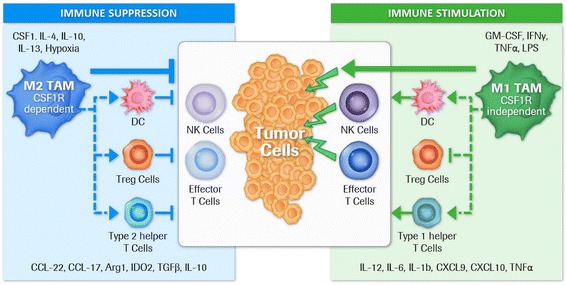
Fig. 1
Fig. 1
Direct and indirect regulation of immune suppression or stimulation by tumor associated macrophage subtypes. Macrophage polarization within the tumor microenvironment is highly dependent on the local cytokine milieu which originates either from tumor cells, other stromal cells such as immune cells or fibroblasts, as well as macrophages themselves. The M2 TAM phenotype is a consequence of the continuous presence of growth factors such as colony-stimulating factor-1 (CSF1) as well as CD4+ T cell-derived Th2 cytokines interleukin (IL)-4, IL-13 and IL-10 (5). Besides the direct tumor growth promoting abilities of M2 TAM (not illustrated here), these macrophages efficiently suppress immune effector functions that are able to contribute to tumor cell elimination (3,4). This silencing of immune effector cells is achieved by producing cytokines and enzymes that may directly suppress effector cells or indirectly via other immune cell types such as intratumoral dendritic cells (DC), T regulatory cells (Treg cells) and Type 2 helper T cells. In contrast, M1 TAM are attributed with tumoricidal functions and are generated in the presence of GM-CSF and pro-inflammatory stimuli like IFNγ, LPS or TNFα (5). Tumoricidal function can either be achieved through direct killing of tumor cells or by producing cytokines/chemokines that are activating/recruiting other immune stimulatory immune cells and inhibiting immune suppressive cells like Treg cells. Eventually a predominant M1 TAM phenotype may result in an anti-tumor immune effector cell activation. Published data suggest that tumor promoting and immune suppressive M2 macrophages/TAM are dependent on CSF1R mediated signals (31) making this receptor an attractive target to eliminate or repolarize these cells
Fig. 2
Fig. 2
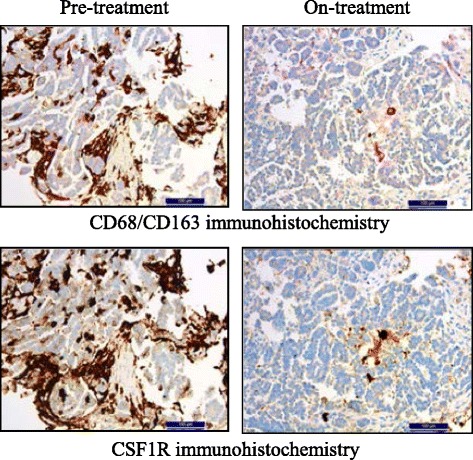
Depletion of tumor-associated macrophages with emactuzumab in cancer patients. Immunohistochemistry of paired tumor biopsies from a representative ovarian cancer patient illustrating co-localization and reduction of CD68+CD163+ TAM (upper panel) and CSF1R+ cells (lower panel) after 4 weeks/two infusions of emactuzumab at the 1000 mg dose level. Permission for re-use granted by I. Klaman [18]

References

    1. Lamagna C, Aurrand-Lions M, Imhof BA. Dual role of macrophages in tumor growth and angiogenesis. J Leukoc Biol. 2006;80:705–713. doi: 10.1189/jlb.1105656. - DOI - PubMed
    1. Mills CD. M1 and M2 Macrophages: Oracles of Health and Disease. Crit Rev Immunol. 2012;32:463–488. doi: 10.1615/CritRevImmunol.v32.i6.10. - DOI - PubMed
    1. Noy R, Pollard JW. Tumor-associated macrophages: from mechanisms to therapy. Immunity. 2014;41:49–61. doi: 10.1016/j.immuni.2014.06.010. - DOI - PMC - PubMed
    1. Ostuni R, Kratochvill F, Murray PJ, Natoli G. Macrophages and cancer: from mechanisms to therapeutic implications. Trends Immunol. 2015;36:229–239. doi: 10.1016/j.it.2015.02.004. - DOI - PubMed
    1. Pedersen MB, Danielsen AV, Hamilton-Dutoit SJ, Bendix K, Norgaard P, Moller MB, Steiniche T, d’Amore F. High intratumoral macrophage content is an adverse prognostic feature in anaplastic large cell lymphoma. Histopathology. 2014;65:490–500. doi: 10.1111/his.12407. - DOI - PubMed

MeSH terms

Substances