


Measures of chronic kidney disease and risk of incident peripheral artery disease: a collaborative meta-analysis of individual participant data
- PMID: 28716631
- PMCID: PMC5649254
- DOI: 10.1016/S2213-8587(17)30183-3
Measures of chronic kidney disease and risk of incident peripheral artery disease: a collaborative meta-analysis of individual participant data
Abstract
Background: Some evidence suggests that chronic kidney disease is a risk factor for lower-extremity peripheral artery disease. We aimed to quantify the independent and joint associations of two measures of chronic kidney disease (estimated glomerular filtration rate [eGFR] and albuminuria) with the incidence of peripheral artery disease.
Methods: In this collaborative meta-analysis of international cohorts included in the Chronic Kidney Disease Prognosis Consortium (baseline measurements obtained between 1972 and 2014) with baseline measurements of eGFR and albuminuria, at least 1000 participants (this criterion not applied to cohorts exclusively enrolling patients with chronic kidney disease), and at least 50 peripheral artery disease events, we analysed adult participants without peripheral artery disease at baseline at the individual patient level with Cox proportional hazards models to quantify associations of creatinine-based eGFR, urine albumin-to-creatinine ratio (ACR), and dipstick proteinuria with the incidence of peripheral artery disease (including hospitalisation with a diagnosis of peripheral artery disease, intermittent claudication, leg revascularisation, and leg amputation). We assessed discrimination improvement through c-statistics.
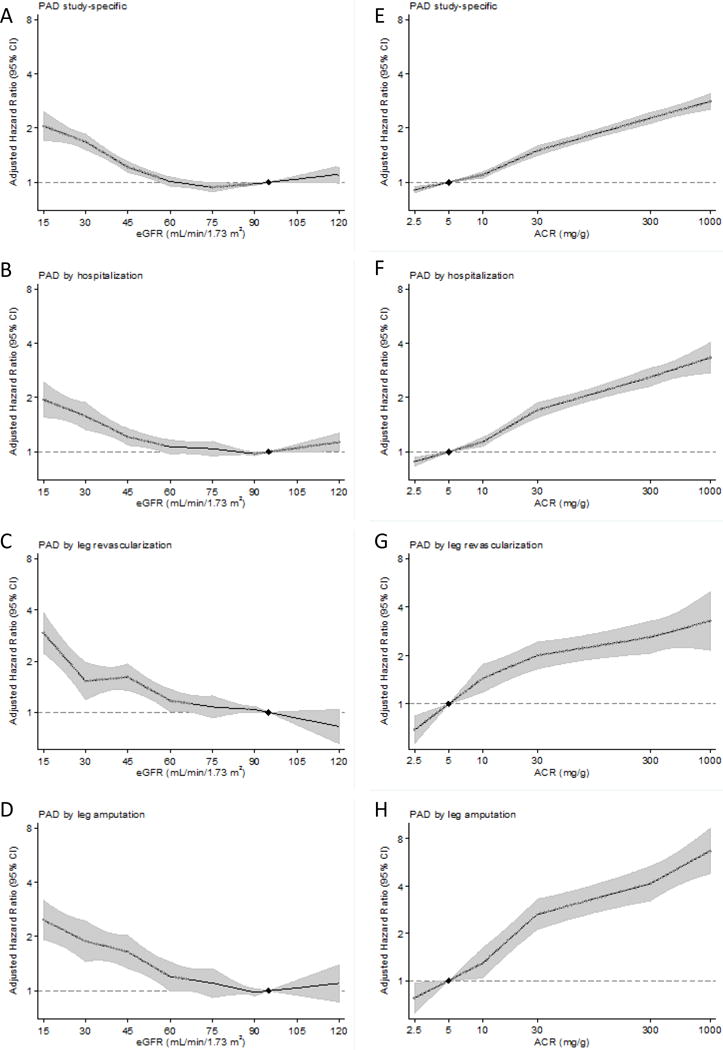
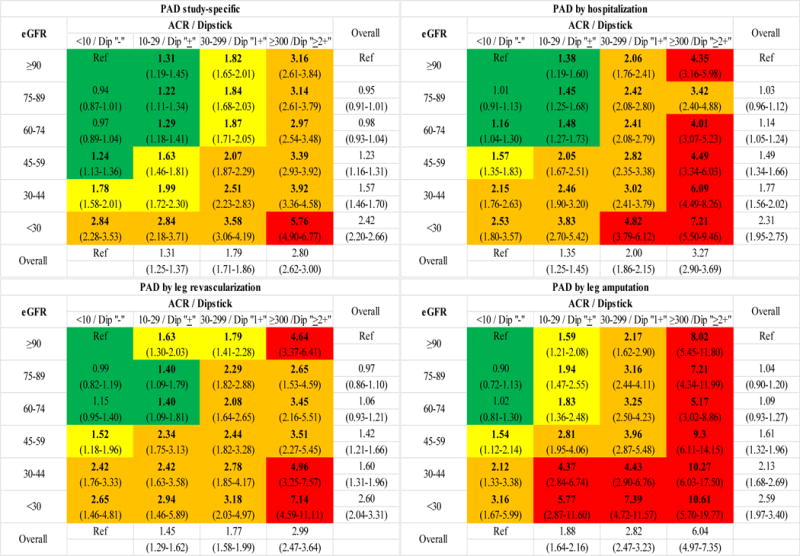
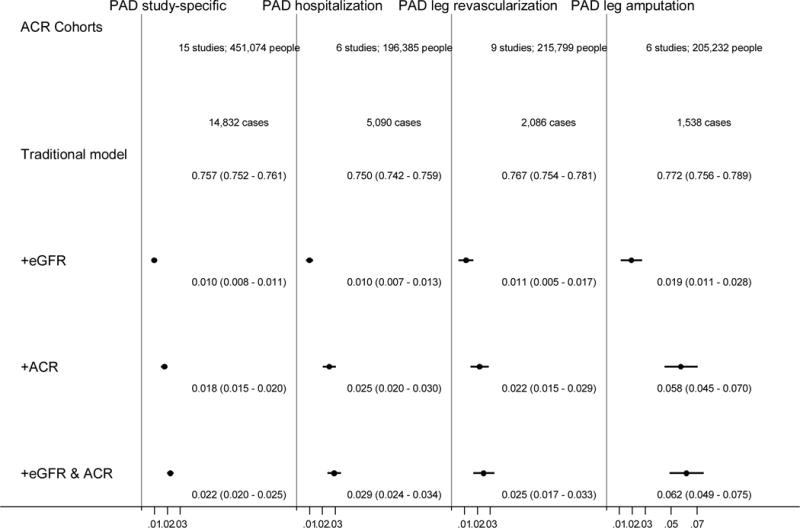
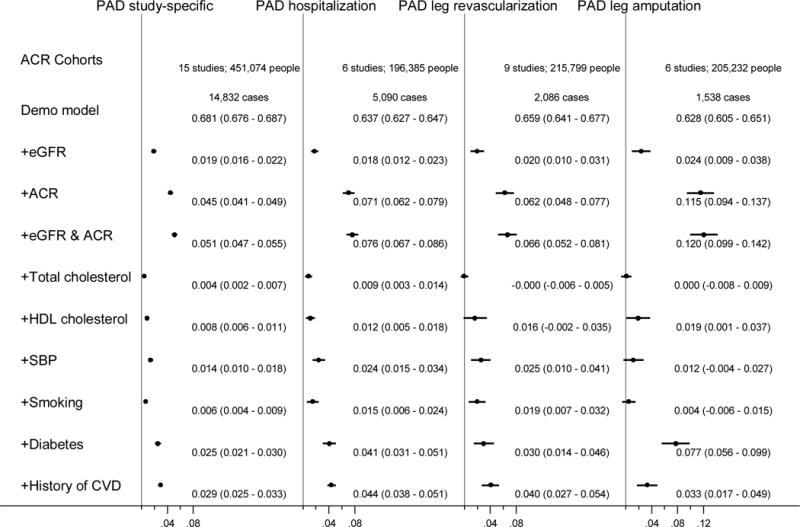
Findings: We analysed 817 084 individuals without a history of peripheral artery disease at baseline from 21 cohorts. 18 261 cases of peripheral artery disease were recorded during follow-up across cohorts (median follow-up was 7·4 years [IQR 5·7-8·9], range 2·0-15·8 years across cohorts). Both chronic kidney disease measures were independently associated with the incidence of peripheral artery disease. Compared with an eGFR of 95 mL/min per 1·73 m2, adjusted hazard ratios (HRs) for incident study-specific peripheral artery disease was 1·22 (95% CI 1·14-1·30) at an eGFR of 45 mL/min per 1·73 m2 and 2·06 (1·70-2·48) at an eGFR of 15 mL/min per 1·73 m2. Compared with an ACR of 5 mg/g, the adjusted HR for incident study-specific peripheral artery disease was 1·50 (1·41-1·59) at an ACR of 30 mg/g and 2·28 (2·12-2·44) at an ACR of 300 mg/g. The adjusted HR at an ACR of 300 mg/g versus 5 mg/g was 3·68 (95% CI 3·00-4·52) for leg amputation. eGFR and albuminuria contributed multiplicatively (eg, adjusted HR 5·76 [4·90-6·77] for incident peripheral artery disease and 10·61 [5·70-19·77] for amputation in eGFR <30 mL/min per 1·73 m2 plus ACR ≥300 mg/g or dipstick proteinuria 2+ or higher vs eGFR ≥90 mL/min per 1·73 m2 plus ACR <10 mg/g or dipstick proteinuria negative). Both eGFR and ACR significantly improved peripheral artery disease risk discrimination beyond traditional predictors, with a substantial improvement prediction of amputation with ACR (difference in c-statistic 0·058, 95% CI 0·045-0·070). Patterns were consistent across clinical subgroups.
Interpretation: Even mild-to-moderate chronic kidney disease conferred increased risk of incident peripheral artery disease, with a strong association between albuminuria and amputation. Clinical attention should be paid to the development of peripheral artery disease symptoms and signs in people with any stage of chronic kidney disease.
Funding: American Heart Association, US National Kidney Foundation, and US National Institute of Diabetes and Digestive and Kidney Diseases.
Copyright © 2017 Elsevier Ltd. All rights reserved.
Conflict of interest statement
Figures
Comment in
-
Common measures of chronic kidney disease improve vascular risk prediction.Lancet Diabetes Endocrinol. 2017 Sep;5(9):675-677. doi: 10.1016/S2213-8587(17)30256-5. Epub 2017 Jul 14. Lancet Diabetes Endocrinol. 2017. PMID: 28716630 No abstract available.
References
-
- Mozaffarian D, Benjamin EJ, Go AS, et al. Executive Summary: Heart Disease and Stroke Statistics-2016 Update: A Report From the American Heart Association. Circulation. 2016;133:447–54. - PubMed
-
- Fowkes FGR, Rudan D, Rudan I, et al. Comparison of global estimates of prevalence and risk factors for peripheral artery disease in 2000 and 2010: a systematic review and analysis. Lancet. 2013;382:1329–40. - PubMed
-
- Nehler MR, Duval S, Diao L, et al. Epidemiology of peripheral arterial disease and critical limb ischemia in an insured national population. J Vasc Surg. 2014;60:686–95 e2. - PubMed
Publication types
MeSH terms
Substances
Grants and funding
- HHSN268201100012C/HL/NHLBI NIH HHS/United States
- N01 HC085080/HL/NHLBI NIH HHS/United States
- N01 HC095161/HL/NHLBI NIH HHS/United States
- HHSN268201100010C/HL/NHLBI NIH HHS/United States
- N01 HC095166/HC/NHLBI NIH HHS/United States
- N01 HC095159/HL/NHLBI NIH HHS/United States
- R01 AG007181/AG/NIA NIH HHS/United States
- HHSN268201100006C/HL/NHLBI NIH HHS/United States
- N01 HC055222/HL/NHLBI NIH HHS/United States
- MR/M501633/2/MRC_/Medical Research Council/United Kingdom
- N01 HC095163/HC/NHLBI NIH HHS/United States
- N01 HC095162/HC/NHLBI NIH HHS/United States
- N01 HC085081/HL/NHLBI NIH HHS/United States
- N01 HC095167/HC/NHLBI NIH HHS/United States
- HHSN268201100008C/HL/NHLBI NIH HHS/United States
- U01 HL080295/HL/NHLBI NIH HHS/United States
- UL1 TR001079/TR/NCATS NIH HHS/United States
- N01 HC085082/HL/NHLBI NIH HHS/United States
- HHSN268201100007C/HL/NHLBI NIH HHS/United States
- HHSN268200800007C/HL/NHLBI NIH HHS/United States
- N01 HC085086/HL/NHLBI NIH HHS/United States
- N01 HC085083/HL/NHLBI NIH HHS/United States
- HHSN268201100011C/HL/NHLBI NIH HHS/United States
- N01 HC095164/HC/NHLBI NIH HHS/United States
- HHSN268201200036C/HL/NHLBI NIH HHS/United States
- R01 DK031801/DK/NIDDK NIH HHS/United States
- N01 HC085079/HL/NHLBI NIH HHS/United States
- N01 HC095169/HC/NHLBI NIH HHS/United States
- N01 HC095165/HC/NHLBI NIH HHS/United States
- HHSN268201500003I/HL/NHLBI NIH HHS/United States
- HHSN268201100009C/HL/NHLBI NIH HHS/United States
- HHSN268201100005C/HL/NHLBI NIH HHS/United States
- N01 HC095168/HC/NHLBI NIH HHS/United States
- MR/K007017/1/MRC_/Medical Research Council/United Kingdom
- UL1 TR000040/TR/NCATS NIH HHS/United States
- MC_PC_13040/MRC_/Medical Research Council/United Kingdom
- R01 DK100446/DK/NIDDK NIH HHS/United States
- R01 AG023629/AG/NIA NIH HHS/United States
- MR/M501633/1/MRC_/Medical Research Council/United Kingdom
- N01 HC095160/HL/NHLBI NIH HHS/United States
LinkOut - more resources
Full Text Sources
Other Literature Sources
Medical
Research Materials
Miscellaneous
