


Removal of Cu, Zn, Pb, and Cr from Yangtze Estuary Using the Phragmites australis Artificial Floating Wetlands
- PMID: 28717650
- PMCID: PMC5498921
- DOI: 10.1155/2017/6201048
Removal of Cu, Zn, Pb, and Cr from Yangtze Estuary Using the Phragmites australis Artificial Floating Wetlands
Abstract
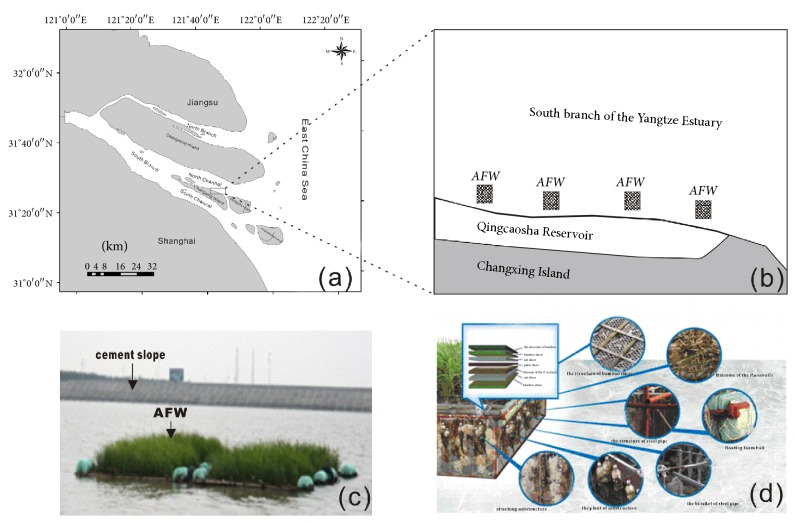
Contamination of heavy metals would threaten the water and soil resources; phytoremediation can be potentially used to remediate metal contaminated sites. We constructed the Phragmites australis artificial floating wetlands outside the Qingcaosha Reservoir in the Yangtze Estuary. Water characteristic variables were measured in situ by using YSI Professional Pro Meter. Four heavy metals (copper, zinc, lead, and chromium) in both water and plant tissues were determined. Four heavy metals in estuary water were as follows: 0.03 mg/Kg, 0.016 mg/Kg, 0.0015 mg/Kg, and 0.004 mg/Kg. These heavy metals were largely retained in the belowground tissues of P. australis. The bioaccumulation (BAF) and translation factor (TF) value of four heavy metals were affected by the salinity, temperature, and dissolved oxygen. The highest BAF of each metal calculated was as follows: Cr (0.091 in winter) > Cu (0.054 in autumn) > Pb (0.016 in summer) > Zn (0.011 in summer). Highest root-rhizome TF values were recorded for four metals: 6.450 for Cu in autumn, 2.895 for Zn in summer, 7.031 for Pb in autumn, and 2.012 for Cr in autumn. This indicates that the P. australis AFW has potential to be used to protect the water of Qingcaosha Reservoir from heavy metal contamination.
Figures


References
-
- Klavins M., Briede A. Heavy metals in aquatic macrophytes in lakes of Latvia. Proceedings of the Latvian Academy of Sciences Section B Natural Exact and Applied Sciences; 1999; pp. 80–86.
-
- Chen Z., Saito Y., Kanai Y., et al. Low concentration of heavy metals in the Yangtze estuarine sediments, China: A diluting setting. Estuarine, Coastal and Shelf Science. 2004;60(1):91–100. doi: 10.1016/j.ecss.2003.11.021. - DOI
-
- Hunt A. J., Anderson C. W. N., Bruce N., et al. Phytoextraction as a tool for green chemistry. Green Processing and Synthesis. 2014;3(1):3–22. doi: 10.14315/evth-2014-0205. - DOI
-
- Heaton A. C. P., Rugh C. L., Wang N.-J., Meagher R. B. Phytoremediation of mercury- and methylmercury-polluted soils using genetically engineered plants. Soil and Sediment Contamination. 1998;7(4):497–509. doi: 10.1080/10588339891334384. - DOI
MeSH terms
Substances
LinkOut - more resources
Full Text Sources
Other Literature Sources
Miscellaneous
