Seasonal Variation in the Epidemiology of Asymptomatic Plasmodium falciparum Infections across Two Catchment Areas in Bongo District, Ghana
- PMID: 28719306
- PMCID: PMC5508908
- DOI: 10.4269/ajtmh.16-0959
Seasonal Variation in the Epidemiology of Asymptomatic Plasmodium falciparum Infections across Two Catchment Areas in Bongo District, Ghana
Abstract
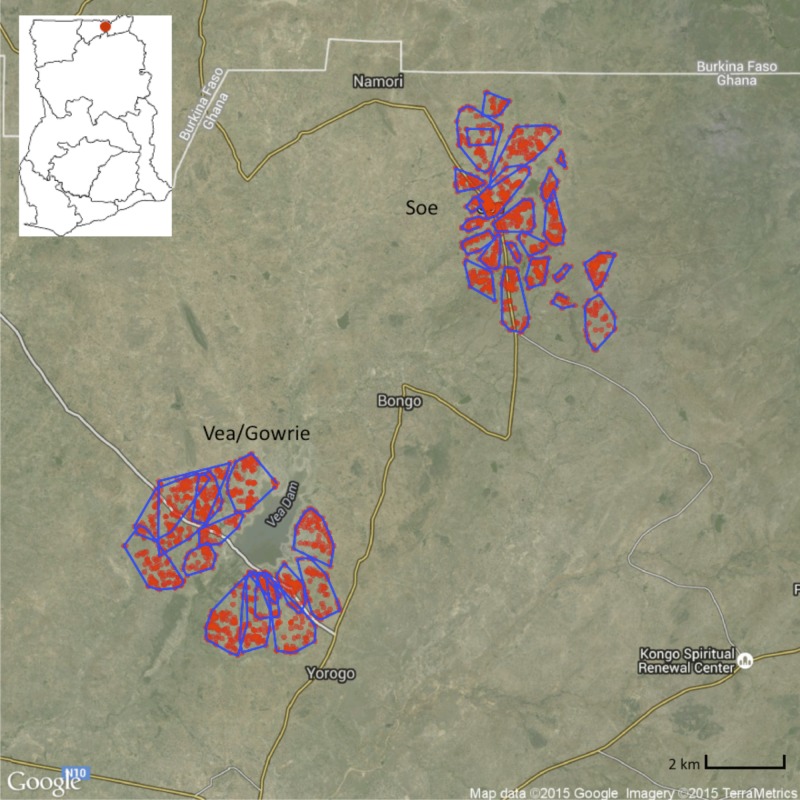
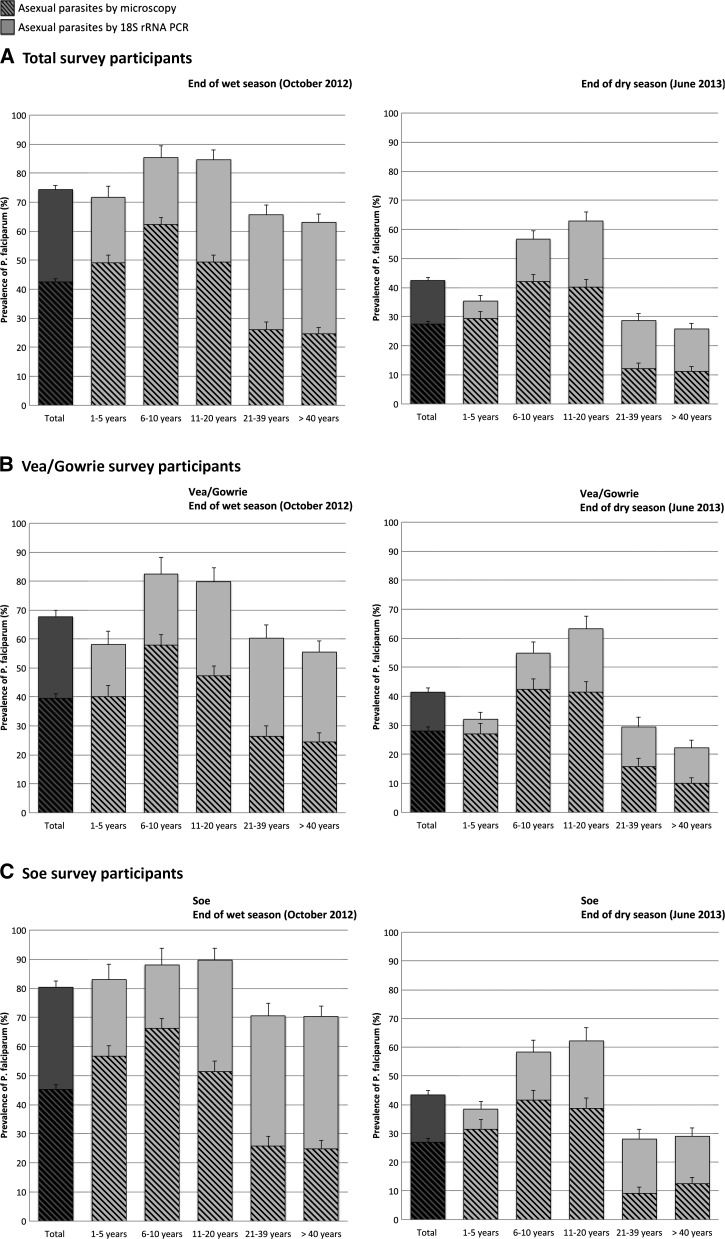
Understanding the epidemiology of asymptomatic Plasmodium falciparum infections is critical for countries to move toward malaria elimination. Using different methods for parasite detection, we evaluated how seasonality, spatial location, and other factors affect the age-specific epidemiology of asymptomatic malaria in Bongo District, Ghana. Asymptomatic prevalence by microscopy decreased significantly from 42.5% at the end of the wet to 27.5% at the end of the dry season (P < 0.001). Using the 18S rRNA polymerase chain reactions (PCRs), all microscopy-negative samples were screened and prevalence of submicroscopic infections also decreased significantly from the wet (55.4%) to the dry (20.7%) season (P < 0.001). Combining detection methods, 74.4% and 42.5% of the population in the wet and dry seasons, respectively, had evidence of a P. falciparum infection. Interestingly in those > 20 years of age, we found evidence of infection in 64.3% of the population in the wet and 27.0% in the dry season. Using both microscopy and PCR, the asymptomatic P. falciparum reservoir peaks at the end of the wet season and infections in all age groups constitute the reservoir of malaria infection. At the end of the wet season, spatial heterogeneity in the prevalence and density of P. falciparum infections was observed between the two catchment areas surveyed in Bongo District. These results indicate that if elimination is to succeed, interventions will need to target not just P. falciparum infections in children but also in adults, and be implemented toward the end of the dry season in this area of West Africa.
Figures
References
-
- Bhatt S, Weiss DJ, Cameron E, Bisanzio D, Mappin B, Dalrymple U, Battle KE, Moyes CL, Henry A, Eckhoff PA, Wenger EA, Briet O, Penny MA, Smith TA, Bennett A, Yukich J, Eisele TP, Griffin JT, Fergus CA, Lynch M, Lindgren F, Cohen JM, Murray CLJ, Smith DL, Hay SI, 2015. The effect of malaria control on Plasmodium falciparum in Africa between 2000 and 2015. Nature 526: 207–211. - PMC - PubMed
-
- Lindblade K, Steinhardt L, Samuels A, Kachur SP, Slutsker L, 2013. The silent threat: asymptomatic parasitemia and malaria transmission. Expert Rev Anti Infect Ther 11: 623–639. - PubMed
-
- Ouédraogo AL, Gonçalves BP, Gnémé A, Wenger EA, Guelbeogo MW, Ouédraogo A, Gerardin J, Bever CA, Lyons H, Pitroipa X, Verhave JP, Eckhoff PA, Drakeley C, Sauerwein R, Luty AJ, Kouyaté B, Bousema T, 2015. Dynamics of the human infectious reservoir for malaria determined by mosquito feeding assays and ultrasensitive malaria diagnosis in Burkina Faso. J Infect Dis 213: 90–99. - PubMed
MeSH terms
Grants and funding
LinkOut - more resources
Full Text Sources
Other Literature Sources
Molecular Biology Databases