


A whey protein-based multi-ingredient nutritional supplement stimulates gains in lean body mass and strength in healthy older men: A randomized controlled trial
- PMID: 28719669
- PMCID: PMC5515445
- DOI: 10.1371/journal.pone.0181387
A whey protein-based multi-ingredient nutritional supplement stimulates gains in lean body mass and strength in healthy older men: A randomized controlled trial
Erratum in
-
Correction: A whey protein-based multi-ingredient nutritional supplement stimulates gains in lean body mass and strength in healthy older men: A randomized controlled trial.PLoS One. 2020 Dec 15;15(12):e0243876. doi: 10.1371/journal.pone.0243876. eCollection 2020. PLoS One. 2020. PMID: 33320850 Free PMC article.
Abstract
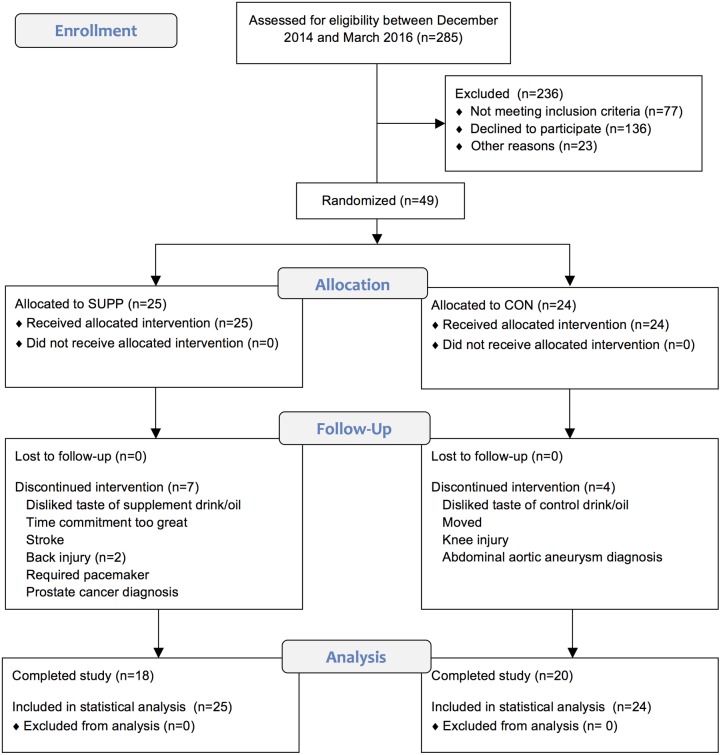
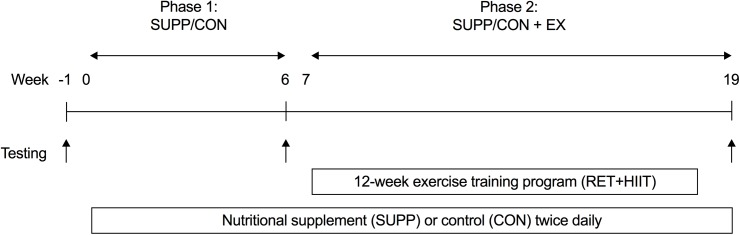
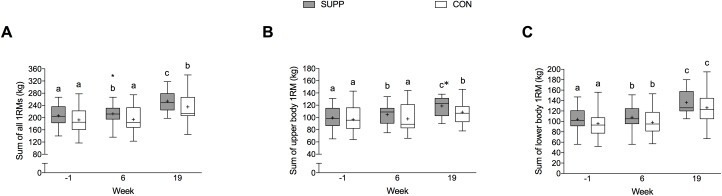
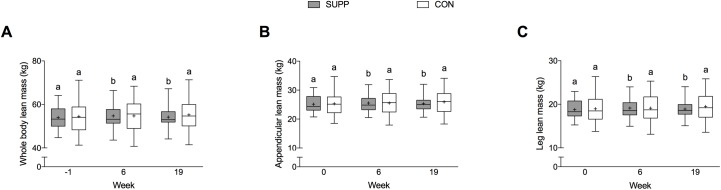
Protein and other compounds can exert anabolic effects on skeletal muscle, particularly in conjunction with exercise. The objective of this study was to evaluate the efficacy of twice daily consumption of a protein-based, multi-ingredient nutritional supplement to increase strength and lean mass independent of, and in combination with, exercise in healthy older men. Forty-nine healthy older men (age: 73 ± 1 years [mean ± SEM]; BMI: 28.5 ± 1.5 kg/m2) were randomly allocated to 20 weeks of twice daily consumption of either a nutritional supplement (SUPP; n = 25; 30 g whey protein, 2.5 g creatine, 500 IU vitamin D, 400 mg calcium, and 1500 mg n-3 PUFA with 700 mg as eicosapentanoic acid and 445 mg as docosahexanoic acid); or a control (n = 24; CON; 22 g of maltodextrin). The study had two phases. Phase 1 was 6 weeks of SUPP or CON alone. Phase 2 was a 12 week continuation of the SUPP/CON but in combination with exercise: SUPP + EX or CON + EX. Isotonic strength (one repetition maximum [1RM]) and lean body mass (LBM) were the primary outcomes. In Phase 1 only the SUPP group gained strength (Σ1RM, SUPP: +14 ± 4 kg, CON: +3 ± 2 kg, P < 0.001) and lean mass (LBM, +1.2 ± 0.3 kg, CON: -0.1 ± 0.2 kg, P < 0.001). Although both groups gained strength during Phase 2, upon completion of the study upper body strength was greater in the SUPP group compared to the CON group (Σ upper body 1RM: 119 ± 4 vs. 109 ± 5 kg, P = 0.039). We conclude that twice daily consumption of a multi-ingredient nutritional supplement increased muscle strength and lean mass in older men. Increases in strength were enhanced further with exercise training.
Trial registration: ClinicalTrials.gov NCT02281331.
Conflict of interest statement
Figures
References
-
- Curtis E, Litwic A, Cooper C, Dennison E. Determinants of Muscle and Bone Aging. J Cell Physiol. 2015;230(11):2618–25. doi: 10.1002/jcp.25001 - DOI - PMC - PubMed
-
- Gale CR, Martyn CN, Cooper C, Sayer AA. Grip strength, body composition, and mortality. Int J Epidemiol. 2007;36(1):228–35. doi: 10.1093/ije/dyl224 - DOI - PubMed
-
- Sirven N, Rapp T, Coretti S, Ruggeri M, Cicchetti A. Preventing mobility disability in Europe: a health economics perspective from the SPRINTT study. Aging Clin Exp Res. 2017. - PubMed
-
- Cermak NM, Res PT, de Groot LC, Saris WH, van Loon LJ. Protein supplementation augments the adaptive response of skeletal muscle to resistance-type exercise training: a meta-analysis. Am J Clin Nutr. 2012;96(6):1454–64. doi: 10.3945/ajcn.112.037556 - DOI - PubMed
-
- Devries MC, Phillips SM. Creatine supplementation during resistance training in older adults-a meta-analysis. Med Sci Sports Exerc. 2014;46(6):1194–203. doi: 10.1249/MSS.0000000000000220 - DOI - PubMed
Publication types
MeSH terms
Substances
Associated data
LinkOut - more resources
Full Text Sources
Other Literature Sources
Medical
