


Determinants and Predictors of Grief Severity and Persistence: The Rotterdam Study
- PMID: 28720010
- PMCID: PMC5680907
- DOI: 10.1177/0898264317720715
Determinants and Predictors of Grief Severity and Persistence: The Rotterdam Study
Abstract
Objective: We aimed to explore correlates and predictors of bereavement severity and persistence (triggered by "loss of a loved one"; referent group partner loss) in the Rotterdam cohort.
Method: We used linear regression to examine factors associated with grief severity using a cross-sectional analysis and logistic regression to determine prospective associations.
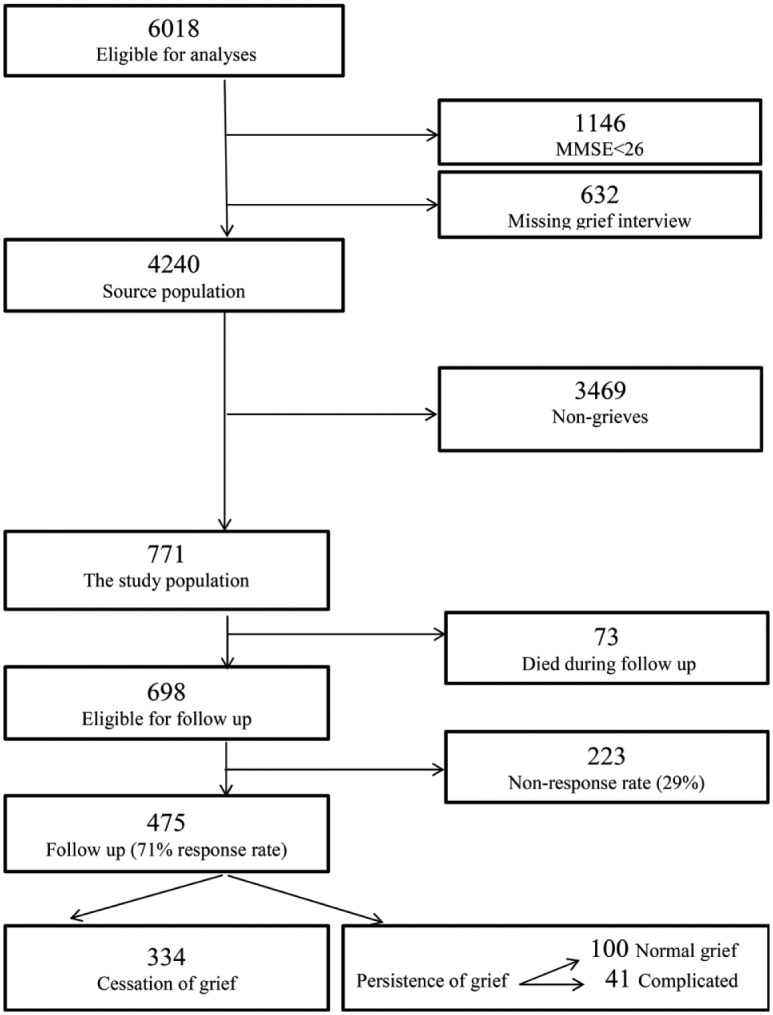
Results: Cross-sectionaly, females, child-lost, higher depressive symptoms, lower education, and difficulties in daily activities were independently associated with a higher bereavement severity. Prospectively (6 years; response rate 71%), the baseline value of the grief severity was the single predictor significantly associated with grief persistence.
Discussion: Our results suggest that only grief severity is independently associated with grief persistence. Further studies are needed to confirm our findings.
Keywords: end of life; epidemiology; families; geriatrics; mental health.
Conflict of interest statement
Figures
References
-
- Ball J. F. (1977). Widow’s grief: The impact of age and mode of death. Omega: Journal of Death and Dying, 7, 307-333.
-
- Beekman A. T., Deeg D. J., Van Limbeek J., Braam A. W., De Vries M. Z., Van Tilburg W. (1997). Criterion validity of the Center for Epidemiologic Studies Depression scale (CES-D): Cognition, structural brain changes and complicated grief results from a community-based sample of older subjects in The Netherlands. Psychological Medicine, 27, 231-235. - PubMed
-
- Beneria L., Permanyer I. (2010). The measurement of socio-economic gender inequality revisited. Development and Change, 41, 375-399. doi:10.1111/j.1467-7660.2010.01648.x - DOI
MeSH terms
LinkOut - more resources
Full Text Sources
Other Literature Sources
Molecular Biology Databases
