


Predictors of return to work among patients in treatment for common mental disorders: a pre-post study
- PMID: 28720129
- PMCID: PMC5516307
- DOI: 10.1186/s12889-017-4581-4
Predictors of return to work among patients in treatment for common mental disorders: a pre-post study
Erratum in
-
Erratum to: BMC Public Health, Vol. 18.BMC Public Health. 2017 Sep 22;17(1):736. doi: 10.1186/s12889-017-4709-6. BMC Public Health. 2017. PMID: 28938882 Free PMC article. No abstract available.
Abstract
Background: Effects of return to work (RTW) interventions vary, and more knowledge is needed about the factors that contribute to RTW. This study investigated changes in work participation and mental health, and predictors of RTW among patients being treated for common mental disorders (CMDs).
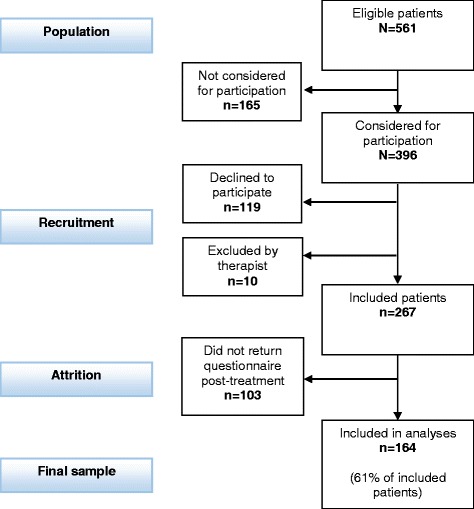
Methods: The study was a prospective pre-post study of 164 patients treated at an RTW outpatient clinic for CMDs. Differences between before and after treatment were analysed using paired t tests for continuous variables and marginal homogeneity test for categorical variables. Univariable and multivariable logistic regression analyses were used to identify factors associated with RTW. Baseline data (patient characteristics, clinical status, generalized self-efficacy, expectations of future work ability) and treatment variables were used as independent variables in logistic regressions. Further analysis investigated whether improvements in symptoms, work ability, expectations of future work ability and generalized self-efficacy were associated with RTW.
Results: Number of individuals with full work participation increased, and there were improvements in symptoms, work ability and generalized self-efficacy. In the final model for predicting RTW, baseline work ability and expectancy of future work ability, a history of psychiatric treatment and focus on RTW in the treatment predicted RTW. Improvement in expectations of future work ability at post-treatment did also predict RTW.
Conclusions: Assessing work ability and expectations of RTW at the beginning of treatment is recommended to identify patients at risk of long-term sick leave. Individuals with a history of psychiatric treatment are also risking long-term work disability. It is essential that treatment focus not only on symptom-relief, but also on improving work ability and expectations of RTW. An RTW-focused approach in therapy is associated with RTW.
Trail registration: ClinicalTrails.gov ID NCT01181635 . Registered 08/12/2010.
Keywords: Common mental disorders; Psychotherapy; Return to work; Sick leave; Sickness absence; Work disability prevention.
Conflict of interest statement
Ethics approval and consent to participate
The study was approved by the Regional Committee for Medical and Health Research Ethics, South East Norway (case number 2010/494) and was registered at
Consent for publication
Not applicable.
Competing interests
MV and BL are employees at Lovisenberg Hospital in Oslo and work at the return to work clinic where the data was collected. TR declares that he has no competing interest.
Publisher’s Note
Springer Nature remains neutral with regard to jurisdictional claims in published maps and institutional affiliations.
References
-
- Brage S, Nossen JP, Kann IC, Thune O. Sykefravær med diagnose innen psykiske lidelser 2000-2011 (sickness absence with mental health diagnoses 2000-2011) Arbeid og velferd. 2012;3:24–37.
-
- Nigatu YT, Liu Y, Uppal M, McKinney S, Rao S, Gillis K, et al. Interventions for enhancing return to work in individuals with a common mental illness: systematic review and meta-analysis of randomized controlled trials. Psychol Med. 2016:1–12. - PubMed
-
- Nieuwenhuijsen K, Faber B, Verbeek JH, Neumeyer-Gromen A, Hees HL, Verhoeven AC, et al. Interventions to help depressed people resume work. Cochrane Database Syst Rev. 2014;12
MeSH terms
Associated data
LinkOut - more resources
Full Text Sources
Other Literature Sources
Medical
