Review
. 2017 Jul 19:19:e10.
doi: 10.1017/erm.2017.10.

FMR1 CGG repeat expansion mutation detection and linked haplotype analysis for reliable and accurate preimplantation genetic diagnosis of fragile X syndrome

Affiliations
Review

FMR1 CGG repeat expansion mutation detection and linked haplotype analysis for reliable and accurate preimplantation genetic diagnosis of fragile X syndrome

Indhu-Shree Rajan-Babu et al. Expert Rev Mol Med. .

Abstract

Fragile X mental retardation 1 (FMR1) full-mutation expansion causes fragile X syndrome. Trans-generational fragile X syndrome transmission can be avoided by preimplantation genetic diagnosis (PGD). We describe a robust PGD strategy that can be applied to virtually any couple at risk of transmitting fragile X syndrome. This novel strategy utilises whole-genome amplification, followed by triplet-primed polymerase chain reaction (TP-PCR) for robust detection of expanded FMR1 alleles, in parallel with linked multi-marker haplotype analysis of 13 highly polymorphic microsatellite markers located within 1 Mb of the FMR1 CGG repeat, and the AMELX/Y dimorphism for gender identification. The assay was optimised and validated on single lymphoblasts isolated from fragile X reference cell lines, and applied to a simulated PGD case and a clinical in vitro fertilisation (IVF)-PGD case. In the simulated PGD case, definitive diagnosis of the expected results was achieved for all 'embryos'. In the clinical IVF-PGD case, delivery of a healthy baby girl was achieved after transfer of an expansion-negative blastocyst. FMR1 TP-PCR reliably detects presence of expansion mutations and obviates reliance on informative normal alleles for determining expansion status in female embryos. Together with multi-marker haplotyping and gender determination, misdiagnosis and diagnostic ambiguity due to allele dropout is minimised, and couple-specific assay customisation can be avoided.


Figures
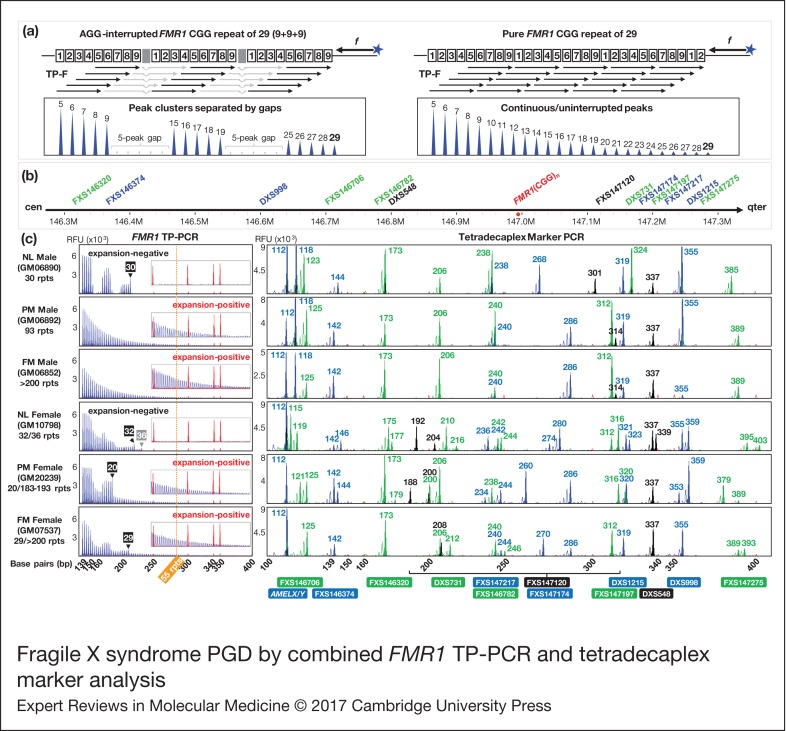
Figure 1.
Figure 1.
Fragile X syndrome PGD by combined FMR1 TP-PCR and tetradecaplex marker analysis. (a) FMR1 TP-PCR schematic depicting the annealing pattern of TP-F primer according to CGG repeat structure, and expected electropherograms. Shaded boxes indicate AGG interruptions. (b) Schematic showing STR marker loci relative to FMR1 (CGG)n. (c) FMR1 TP-PCR and tetradecaplex marker PCR electropherograms of representative whole-genome amplified single lymphoblasts. CGG repeat sizes of normal allele(s) determined by TP-PCR are indicated in numbered black/gray boxes. The 55-repeat cut-off for FMR1 expansion detection is represented by a vertical dotted orange line. Numbers in the tetradecaplex marker PCR electropherograms indicate amplicon fragment sizes in bp, and STR names are indicated below their corresponding allele peaks. Red peaks in electropherograms are from the ROX-labeled internal size calibrator. FMR1, Fragile X mental retardation 1; TP-PCR, triplet-primed polymerase chain reaction; NL, normal; PM, premutation; FM, full-mutation; rpts, repeats, including AGG interruptions; RFU, relative fluorescence units.
Figure 2.
Figure 2.
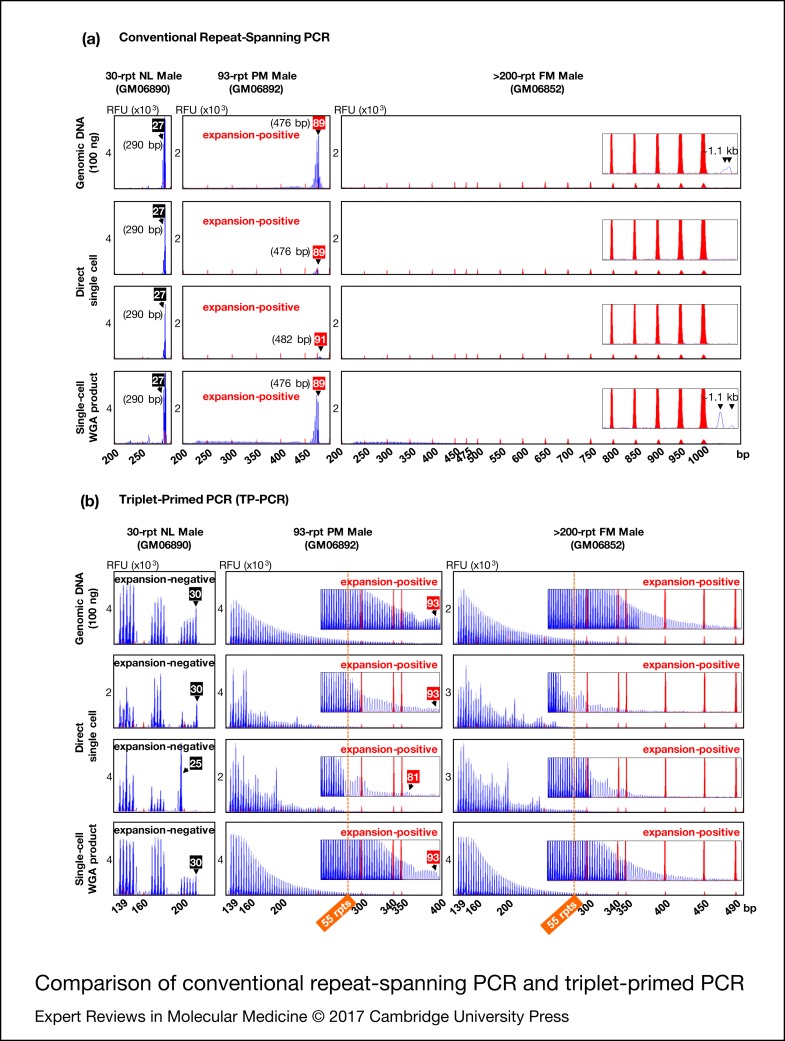
Comparison of conventional repeat-spanning PCR (a) and triplet-primed PCR (b). Black and red numbered boxes indicate the repeat sizes of normal and premutation alleles, respectively. TP-PCR, triplet-primed polymerase chain reaction. NL, normal; PM, premutation; FM, full-mutation; WGA, whole-genome amplification, rpt/rpts, repeats, including AGG interruptions.
Figure 3.
Figure 3.
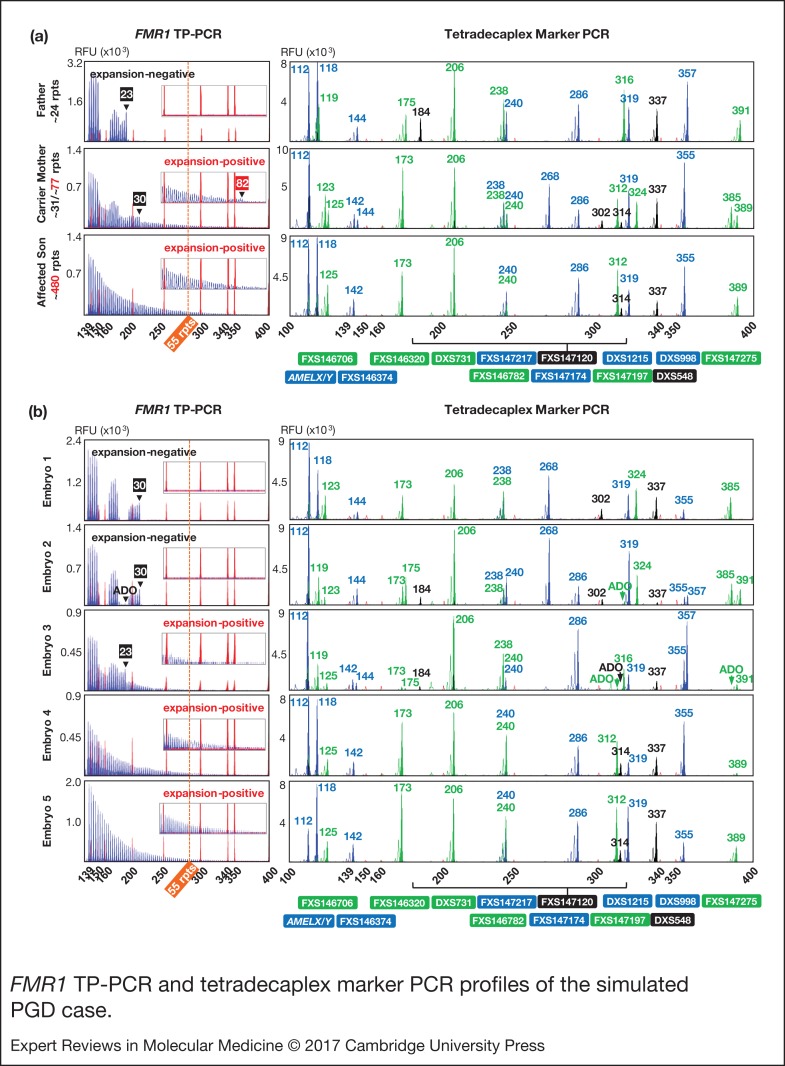
FMR1 TP-PCR and tetradecaplex marker PCR profiles of the simulated PGD case. (a) FMR1 TP-PCR and tetradecaplex marker PCR profiles of parent-son trio genomic DNA samples. (b) FMR1 TP-PCR and tetradecaplex marker PCR profiles of whole-genome amplified ‘blastomeres’. Electropherograms of one of the two genotyped blastomeres of each ‘embryo’ are shown. ADO, allele dropout; FMR1, Fragile X mental retardation 1; TP-PCR, triplet-primed polymerase chain reaction.
Figure 4.
Figure 4.
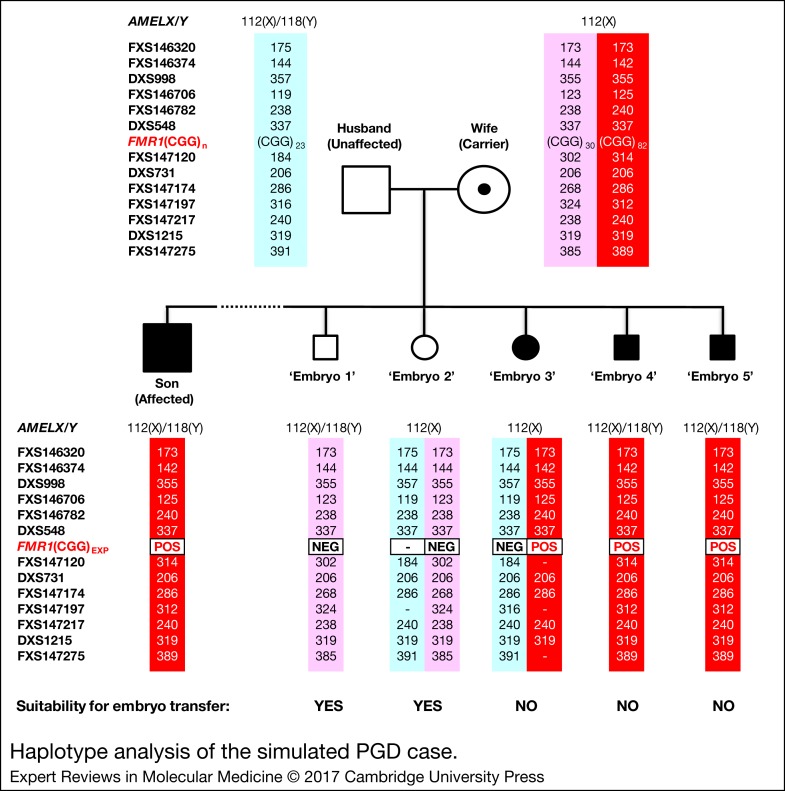
Haplotype analysis of the simulated PGD case. Haplotypes of father (unaffected), mother (carrier), son (fragile X syndrome-affected) and five ‘embryos’ are shown. Light- and dark-shaded numbered columns denote marker haplotypes linked to normal and mutant FMR1 alleles, respectively. Haplotyped markers are ordered from centromere (top) to telomere (bottom) of q-arm. FMR1 CGG repeat expansion status of each embryo is denoted as POS (positive) or NEG (negative). Dashes (–) indicate allele dropout, and numbers indicate STR amplicon size in bp. The haplotype linked to the maternal FMR1 mutant allele was present in embryos 3, 4 and 5, while embryos 1 and 2 inherited the maternal FMR1 normal allele. FMR1, Fragile X mental retardation 1.
Figure 5.
Figure 5.
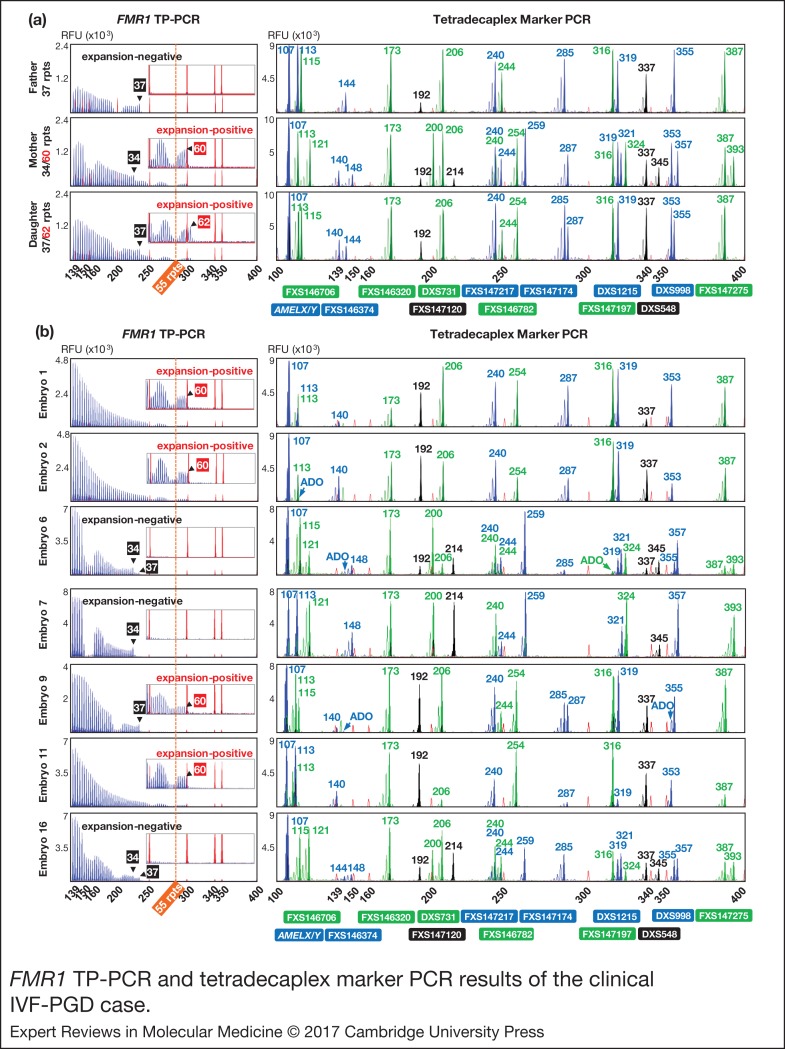
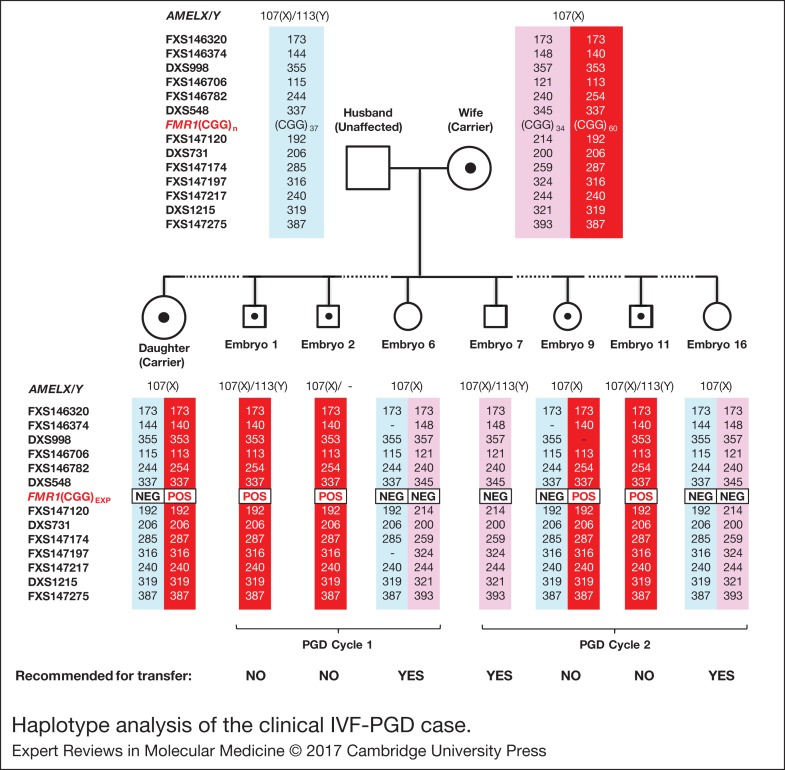
FMR1 TP-PCR and tetradecaplex marker PCR results of the clinical IVF-PGD case. (a) FMR1 TP-PCR and tetradecaplex marker PCR profiles of parent-daughter trio genomic DNA samples. (b) Representative FMR1 TP-PCR and tetradecaplex marker PCR profiles of seven whole-genome amplified embryo blastomeres. Except for embryo 16, electropherograms of one of the two genotyped blastomeres are shown. FMR1, Fragile X mental retardation 1; TP-PCR, triplet-primed polymerase chain reaction.
Figure 6.
Figure 6.
Haplotype analysis of the clinical IVF-PGD case. Haplotypes of father (unaffected), mother (carrier), daughter (carrier) and seven embryos from cycles 1 and 2 are shown.

References

    1. Verkerk A.J. et al. (1991) Identification of a gene (FMR-1) containing a CGG repeat coincident with a breakpoint cluster region exhibiting length variation in fragile X syndrome. Cell 65, 905-914 - PubMed
    1. Oberle I. et al. (1991) Instability of a 550-base pair DNA segment and abnormal methylation in fragile X syndrome. Science 252, 1097-1102 - PubMed
    1. Yu S. et al. (1991) Fragile X genotype characterized by an unstable region of DNA. Science 252, 1179-1181 - PubMed
    1. Hill M.K. et al. (2010) A systematic review of population screening for fragile X syndrome. Genetics in Medicine 12, 396-410 - PubMed
    1. Monaghan K.G. et al. (2013) ACMG standards and guidelines for fragile X testing: a revision to the disease-specific supplements to the Standards and Guidelines for Clinical Genetics Laboratories of the American College of Medical Genetics and Genomics. Genetics in Medicine 15, 575-586 - PubMed

Publication types

Substances