


Empowering survivors after colorectal and lung cancer treatment: Pilot study of a Self-Management Survivorship Care Planning intervention
- PMID: 28720259
- PMCID: PMC5539921
- DOI: 10.1016/j.ejon.2017.06.003
Empowering survivors after colorectal and lung cancer treatment: Pilot study of a Self-Management Survivorship Care Planning intervention
Abstract
Purpose: This study evaluates the feasibility and acceptability of a Self-Management Survivorship Care Planning (SM-SCP) intervention in colorectal and lung cancer survivors.
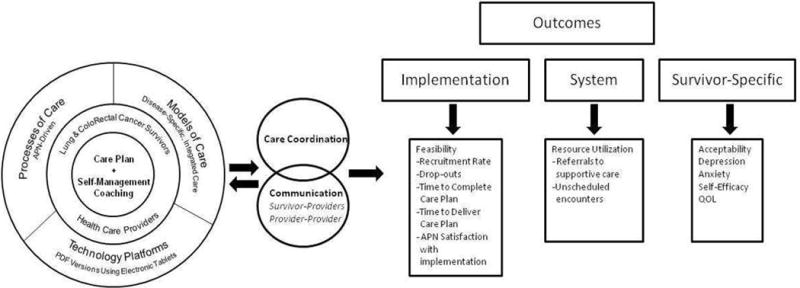
Methods: This is a single-group, pre- and post-mixed methods study of an advance practice nurse-driven survivorship care intervention that integrates a survivorship care plan with self-management skills coaching. Colorectal and lung cancer survivors with stage I-III disease were enrolled at 3-6 months after completing treatments, and the intervention was administered in one in-person or telephone session. Survivor outcome measures included depression, anxiety, self-efficacy, QOL, and satisfaction. Paired t-tests were used for exploratory evaluations of pre-to post-intervention score changes. Content analysis was conducted to analyze the qualitative data to describe survivors' experience with the intervention.
Results: Thirty participants (15 colorectal, 15 lung) enrolled and completed the study (73% retention). It took an average of 40 min to complete the TS/CP and 34.2 min to deliver the intervention. Exploratory analysis revealed significant differences from baseline to post-intervention in depression, anxiety, self-efficacy, physical functioning, role limitations-physical, pain, general health, health transition, physical health summary, and total QOL. Three qualitative themes emerged: 1) Feeling empowered about having a plan; 2) Struggling with psychosocial concerns; and 3) Suggestions for intervention content and delivery.
Conclusions: The SM-SCP intervention was feasible and acceptable for colorectal and lung cancer survivors after treatment completion. Survivorship care interventions have potential to fulfill the unmet needs of colorectal and lung cancer survivors. Their effectiveness might be greater by integrating conceptually-based models of care, such as self-management skills building.
Keywords: Care plans; Colorectal cancer; Lung cancer; Mixed-methods; Self-efficacy; Self-management.
Copyright © 2017 Elsevier Ltd. All rights reserved.
Figures
References
-
- American College of Surgeons. Cancer Program Standards 2012: Ensuring Patient-Centered Care 2012
-
- Baravelli C, Krishnasamy M, Pezaro C, Schofield P, Lotfi-Jam K, Rogers M, Milne D, Aranda S, King D, Shaw B, Grogan S, Jefford M. The views of bowel cancer survivors and health care professionals regarding survivorship care plans and post treatment follow up. Journal of cancer survivorship: research and practice. 2009;3:99–108. - PubMed
-
- Chrischilles EA, McDowell BD, Rubenstein L, Charlton M, Pendergast J, Juarez GY, Arora NK. Survivorship care planning and its influence on long-term patient-reported outcomes among colorectal and lung cancer survivors: the CanCORS disease-free survivor follow-up study. Journal of cancer survivorship: research and practice. 2015;9:269–278. - PMC - PubMed
MeSH terms
Grants and funding
LinkOut - more resources
Full Text Sources
Other Literature Sources
Medical
Miscellaneous
