


Squamous intraepithelial lesions of the anal squamocolumnar junction: Histopathological classification and HPV genotyping
- PMID: 28720443
- PMCID: PMC5883205
- DOI: 10.1016/j.pvr.2016.12.001
Squamous intraepithelial lesions of the anal squamocolumnar junction: Histopathological classification and HPV genotyping
Abstract
Background: Human papillomavirus (HPV)-related anal cancer lesions are often found adjacent to the squamocolumnar junction (SCJ). We have assessed the histopathology and associated HPV genotypes in anal SCJ lesions in surgically excised anal warts in HIV-negative and -positive patients.
Methods: Histopathology identified 47 squamous intraepithelial lesions (SILs) adjacent to the SCJ amongst a total of 145 cases of clinically diagnosed anal condylomata. The anal SCJ lesions were further analyzed with p16, CK7 and p63 immunohistochemistry and HPV genotyping.
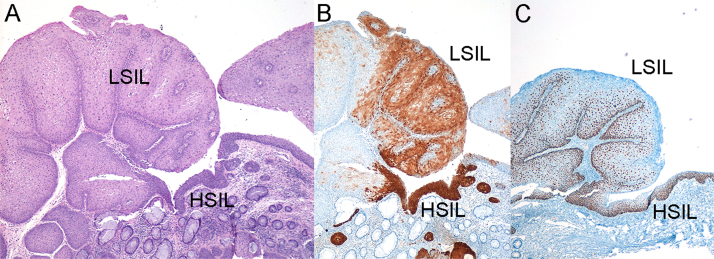
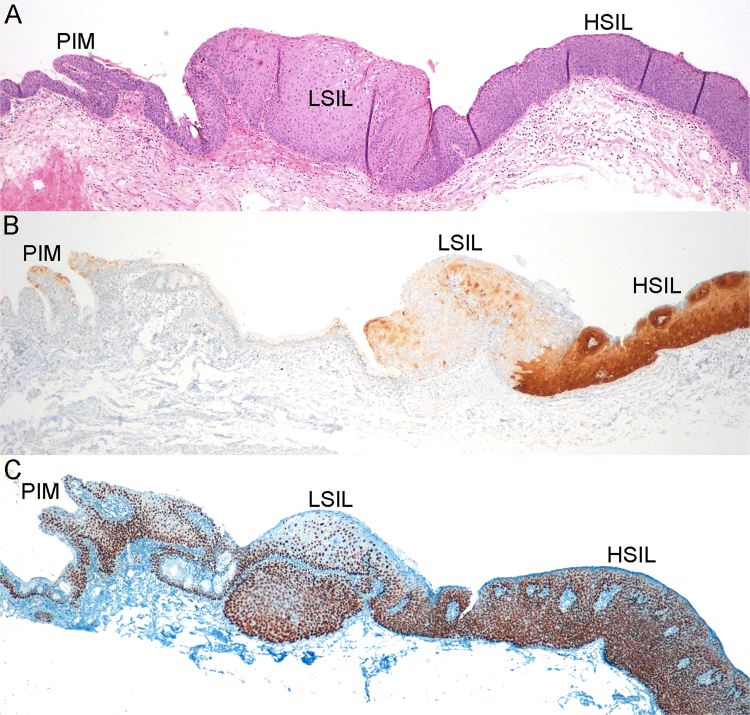
Results: Sixteen (16/47) of the excised anal wart lesions contained HSIL; Three were HSIL and exclusively associated with oncogenic HPVs. A further thirteen (13/47) were mixed lesions. Of these eight were HSILs with LSIL and six were HSILs with papillary immature metaplasia (PIM); Ten of the mixed lesions were associated with one or more oncogenic HPVs, while three cases were exclusively associated with HPV6.
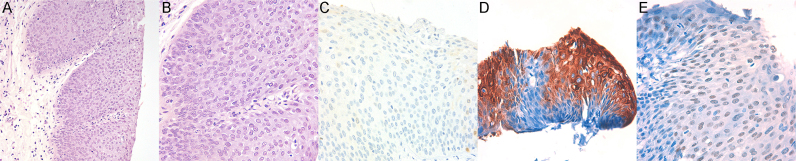
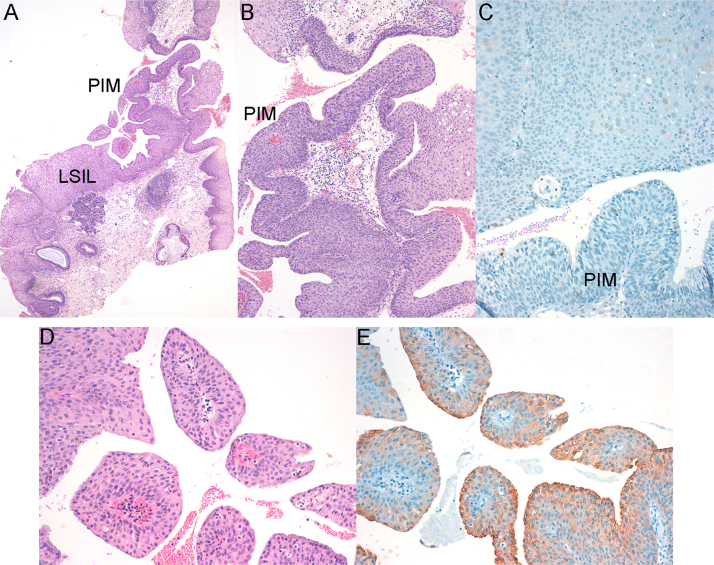
Conclusions: Clinically diagnosed anal warts cannot be assumed to be limited to low-grade lesions as anal warts of the SCJ often show heterogeneous lesions, with coexistence of LSIL, PIM, and HSIL. Lesions showing PIM, however, may mimic HSIL, because they are hypercellular, but lack the nuclear atypia and conspicuous mitotic activity of HSIL; and are p16 negative.
Keywords: Anal squamocolumnar junction; HIV; HPV; High-grade squamous intraepithelial lesion (HSIL); Low-grade squamous intraepithelial lesion (LSIL); Papillary immature metaplasia (PIM).
Copyright © 2016 The Authors. Published by Elsevier B.V. All rights reserved.
Figures

References
-
- J.K. Greenson, ed., Diagnostic Pathology Gastrointestinal, First Ed., Amirsys, Salt Lake City, Utah, 2010.
-
- Johnson L.G., Madeleine M.M., Newcomer L.M., Schwartz S.M., Daling J.R. Anal cancer incidence and survival: the surveillance, epidemiology, and end results experience, 1973–2000. Cancer. 2004;101:281–288. - PubMed
-
- Palefsky J.M., Giuliano A.R., Goldstone S., Moreira E.D., Aranda C., Jessen H., Hillman R., Ferris D., Coutlee F., Stoler M.H., Marshall J.B., Radley D., Vuocolo S., Haupt R.M., Guris D., Garner E.I.O. HPV vaccine against anal HPV infection and anal intraepithelial neoplasia. N. Engl. J. Med. 2011;365:1576–1585. - PubMed
-
- Fenger C., Bichel P. Flow cytometric DNA analysis of anal canal epithelium and ano-rectal tumours. Acta Microbiol. Scand. A. 1981;89:351–355. 〈http://www.ncbi.nlm.nih.gov/pubmed/7315332〉 (accessed 09.09.14) - PubMed
-
- Abramowitz L., Benabderrahmane D., Ravaud P., Walker F., Rioux C., Jestin C., Bouvet E., Soulé J.-C., Leport C., Duval X. Anal squamous intraepithelial lesions and condyloma in HIV-infected heterosexual men, homosexual men and women: prevalence and associated factors. AIDS. 2007;21:1457–1465. - PubMed
LinkOut - more resources
Full Text Sources
Other Literature Sources
Research Materials
