Review
. 2017 Aug 7;214(8):2193-2204.
doi: 10.1084/jem.20170879.

Platelets as autonomous drones for hemostatic and immune surveillance

Affiliations
Review

Platelets as autonomous drones for hemostatic and immune surveillance

Jackson LiangYao Li et al. J Exp Med. .

Abstract

Platelets participate in many important physiological processes, including hemostasis and immunity. However, despite their broad participation in these evolutionarily critical roles, the anucleate platelet is uniquely mammalian. In contrast with the large nucleated equivalents in lower vertebrates, we find that the design template for the evolutionary specialization of platelets shares remarkable similarities with human-engineered unmanned aerial vehicles in terms of overall autonomy, maneuverability, and expendability. Here, we review evidence illustrating how platelets are uniquely suited for surveillance and the manner in which they consequently provide various types of support to other cell types.


Figures

Figure 1.
Figure 1.
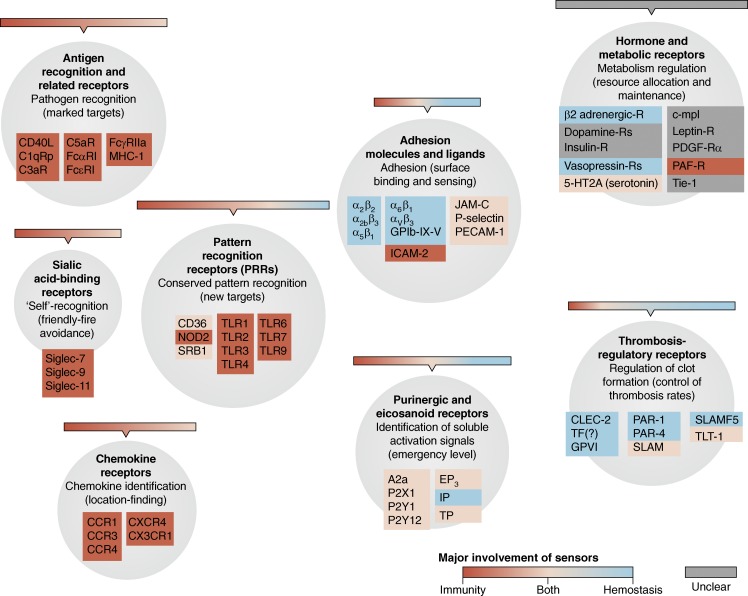
Platelet receptors. List of receptors in human platelets categorized by their major functional types. The areas of circles correspond proportionally to the number of members shown here. The major involvement of each molecule in hemostasis, immunity, or both is color-coded. Receptors of unclear contributions to hemostasis or immunity are shown in gray. Examples of the corresponding ligands of these receptors are listed in Table S1.
Figure 2.
Figure 2.
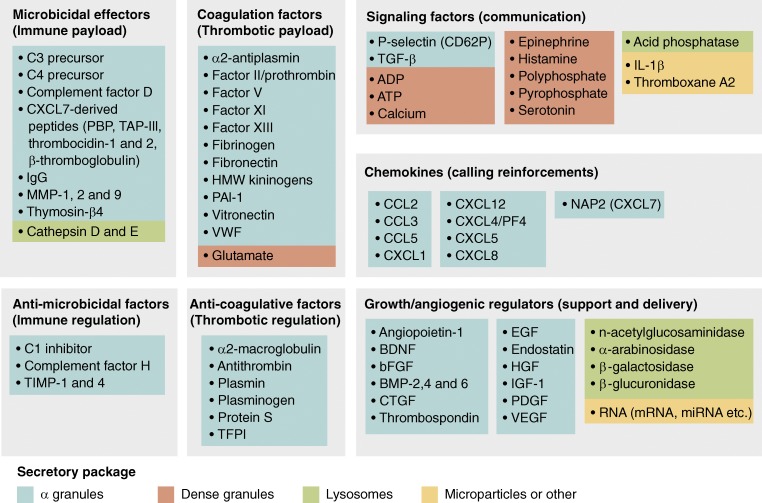
Platelet payloads. List of bioactive mediators released by human platelets categorized by their major functional roles. Many of these mediators play multiple roles but are categorized only once. CXCL7 is unique among chemokines in that it is cleaved into multiple distinct peptides with varying functions.
Figure 3.
Figure 3.
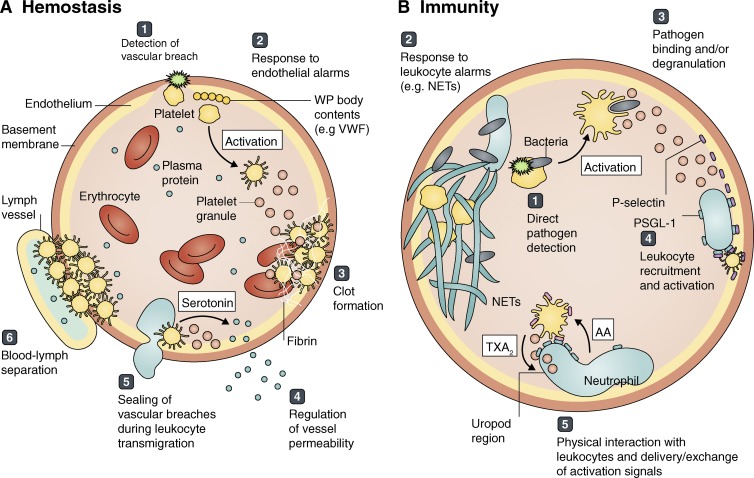
Major platelet tasks in hemostasis and immunity. Platelets circulate in blood, surveying the vasculature for (A) hemostatic and (B) immune threats. (A) Platelets detect vascular breaches using a variety of receptors, such as those binding exposed collagen (1). They respond to danger signals such as ADP or the contents of Weibel-Palade (WP) bodies, released by damaged or activated endothelial cells (2). Upon activation, platelets can initiate thrombosis (3) while regulating vessel permeability (4). They also act as gatekeepers, physically preventing erythrocyte loss during leukocyte transmigration (5), and also at the lymphovenous junction at steady state or during lymphangiogenesis (6). (B) Platelets may recognize immune threats directly using evolutionarily conserved pattern receptors (1) or indirectly via leukocyte signals, such as neutrophil extracellular traps (NETs) or cytokines (2). Platelets can bind and wrap around pathogens, triggering degranulation to effect killing (3) and direct/indirect leukocyte recruitment (4). Additionally, platelets often physically interact with leukocytes to deliver or exchange signals that result in fully active inflammation, for example by taking up arachidonic acid (AA) from neutrophils to synthesize thromboxane A2 (TXA2; 5).

References

    1. Alard J.E., Ortega-Gomez A., Wichapong K., Bongiovanni D., Horckmans M., Megens R.T., Leoni G., Ferraro B., Rossaint J., Paulin N., et al. 2015. Recruitment of classical monocytes can be inhibited by disturbing heteromers of neutrophil HNP1 and platelet CCL5. Sci. Transl. Med. 7:317ra196 10.1126/scitranslmed.aad5330 - DOI - PubMed
    1. Antonioli L., Pacher P., Vizi E.S., and Haskó G.. 2013. CD39 and CD73 in immunity and inflammation. Trends Mol. Med. 19:355–367. 10.1016/j.molmed.2013.03.005 - DOI - PMC - PubMed
    1. Bakocevic N., Claser C., Yoshikawa S., Jones L.A., Chew S., Goh C.C., Malleret B., Larbi A., Ginhoux F., de Lafaille M.C., et al. 2014. CD41 is a reliable identification and activation marker for murine basophils in the steady state and during helminth and malarial infections. Eur. J. Immunol. 44:1823–1834. 10.1002/eji.201344254 - DOI - PubMed
    1. Barteneva N.S., Fasler-Kan E., Bernimoulin M., Stern J.N., Ponomarev E.D., Duckett L., and Vorobjev I.A.. 2013. Circulating microparticles: square the circle. BMC Cell Biol. 14:23 10.1186/1471-2121-14-23 - DOI - PMC - PubMed
    1. Berthet J., Damien P., Hamzeh-Cognasse H., Arthaud C.A., Eyraud M.A., Zéni F., Pozzetto B., McNicol A., Garraud O., and Cognasse F.. 2012. Human platelets can discriminate between various bacterial LPS isoforms via TLR4 signaling and differential cytokine secretion. Clin. Immunol. 145:189–200. 10.1016/j.clim.2012.09.004 - DOI - PubMed