Comparative Study
. 2017 Jul 18;7(1):5697.
doi: 10.1038/s41598-017-05712-3.

Comparison between an African town and a neighbouring village shows delayed, but not decreased, sleep during the early stages of urbanisation

Affiliations
Comparative Study

Comparison between an African town and a neighbouring village shows delayed, but not decreased, sleep during the early stages of urbanisation

Andrew D Beale et al. Sci Rep. .

Abstract

The well-established negative health outcomes of sleep deprivation, and the suggestion that availability of electricity may enable later bed times without compensating sleep extension in the morning, have stimulated interest in studying communities whose sleep pattern may resemble a pre-industrial state. Here, we describe sleep and activity in two neighbouring communities, one urban (Milange) and one rural (Tengua), in a region of Mozambique where urbanisation is an ongoing process. The two communities differ in the amount and timing of daily activity and of light exposure, with later bedtimes (≈1 h) associated with more evening and less daytime light exposure seen in the town of Milange. In contrast to previous reports comparing communities with and without electricity, sleep duration did not differ between Milange (7.28 h) and Tengua (7.23 h). Notably, calculated sleep quality was significantly poorer in rural Tengua than in Milange, and poor sleep quality was associated with a number of attributes more characteristic of rural areas, including more intense physical labour and less comfortable sleeping arrangements. Thus, whilst our data support the hypothesis that access to electricity delays sleep timing, the higher sleep quality in the urban population also suggests that some aspects of industrialisation are beneficial to sleep.


Conflict of interest statement

The authors declare that they have no competing interests.

Figures
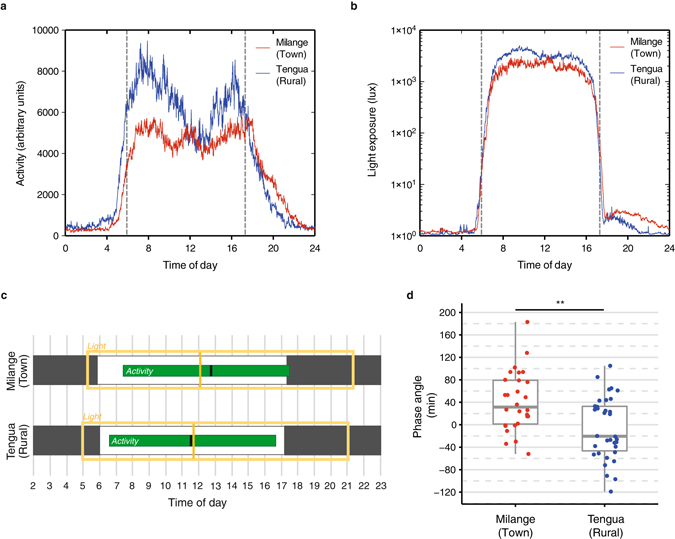
Figure 1
Figure 1
Daily activity and light exposure in rural (Tengua) and town (Milange) settings. Mean 24-h activity (a) and light exposure (b) profiles for all subjects of Tengua (blue) and Milange (red). Activity (arbitrary units) and light (lux) were measured in 60-s epochs by wrist-worn actigraphy devices. Dashed lines represent mean sunrise (05:55) and sunset (17:18) respectively. (c) Representation of the timing of daily activity and daily light exposure in Milange and Tengua based on non-parametric analysis of actigraphy. M10 activity (green bar), centre of gravity of activity (black line), M16 light exposure (yellow box), centre of gravity light exposure (yellow line). Black and white bars represent dark and light periods respectively in the natural environment. (d) The phase angle between the centres of gravity of activity and light exposure was significantly different in the two locations, with activity in Milange delayed relative to the light exposure. **P < 0.01.
Figure 2
Figure 2
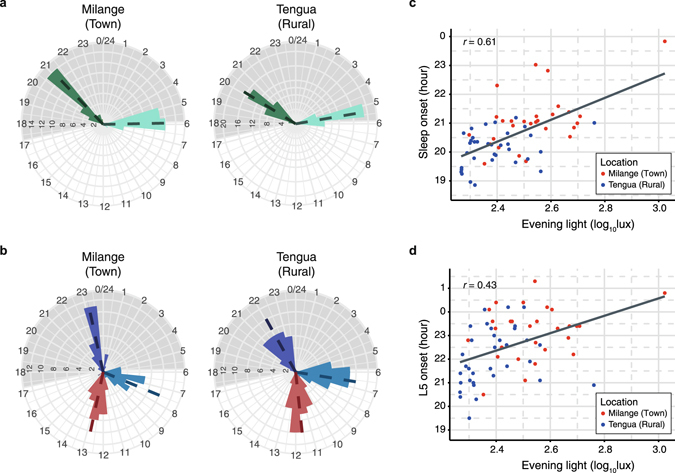
Phase of sleep and activity and amount of evening light exposure. (a,b) are circular histograms shown according to clock time where frequencies of temporal activity distributions are shown as distances from the centre. (a) Residents of Milange displayed a delayed onset of sleep (green) and a delayed wake up time (light green) compared to residents of Tengua. (b) Residents of Milange displayed a delayed M10 activity onset (light blue), a delayed L5 activity onset (purple) and a delayed centre of gravity for activity (red) relative to residents of Tengua. In (a,b) means (dotted lines) and histograms with 45 min bins (bars, counts on circumferences) are shown according to 24-h clock time (hours on radii). Grey shading represents average night duration. Sleep onset time (c) and L5 onset time (d) correlated with total exposure to light after sunset. Evening light exposure is distributed by location (Milange, red; Tengua, blue).
Figure 3
Figure 3
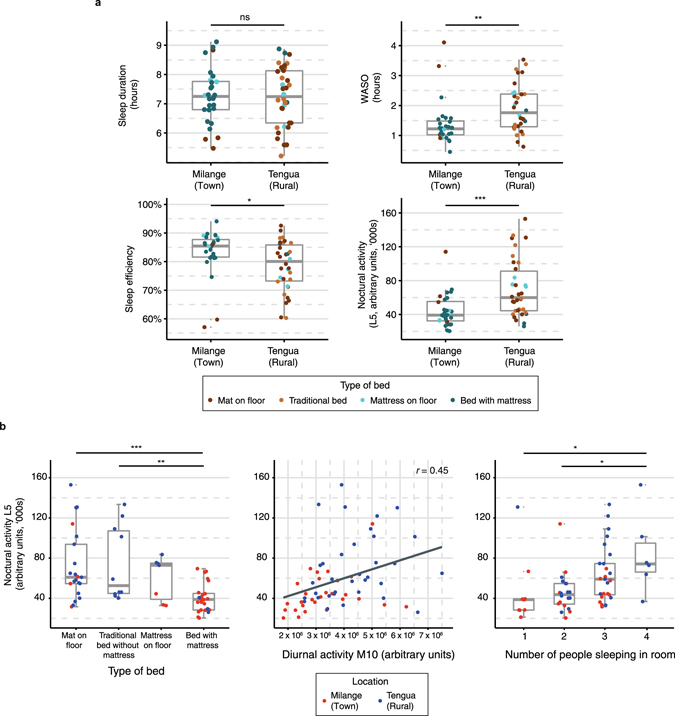
Sleep variables in town and rural settings. (a) Sleep variables by location. WASO, sleep efficiency and nocturnal activity L5 significantly differed between Milange and Tengua, though total sleep duration was not significantly different. Type of bed is represented by colour. ***P < 0.001; **P < 0.01; *P < 0.05, according to Table 1. (b) Environmental variables impact nocturnal activity L5. Type of bed (left), amount of diurnal activity M10 (centre) and number of people sleeping in the same room (right) associated with the amount of nocturnal activity across both locations (Milange, red; Tengua, blue). Significance between groups is denoted by Bonferroni corrected post-hoc tests, ***P < 0.001; **P < 0.01; *P < 0.05. Correlation (r) determined significant association between continuous variables.

References

    1. Knutson KL, Van Cauter E, Rathouz PJ, DeLeire T, Lauderdale DS. Trends in the prevalence of short sleepers in the USA: 1975-2006. Sleep. 2010;33:37–45. doi: 10.1093/sleep/33.1.37. - DOI - PMC - PubMed
    1. Luyster FS, Strollo PJ, Jr., Zee PC, Walsh JK. Sleep: a health imperative. Sleep. 2012;35:727–734. doi: 10.5665/sleep.1846. - DOI - PMC - PubMed
    1. Czeisler CA. Perspective: casting light on sleep deficiency. Nature. 2013;497:S13. doi: 10.1038/497S13a. - DOI - PubMed
    1. Yetish G, et al. Natural sleep and its seasonal variations in three pre-industrial societies. Curr Biol. 2015;25:2862–2868. doi: 10.1016/j.cub.2015.09.046. - DOI - PMC - PubMed
    1. Samson, D. R., Crittenden, A. N., Mabulla, I. A., Mabulla, A. Z. & Nunn, C. L. Hadza sleep biology: Evidence for flexible sleep-wake patterns in hunter-gatherers. Am J Phys Anthropol, doi:10.1002/ajpa.23160 (2017). - PubMed

Publication types

LinkOut - more resources