


Piggyback-the-Winner in host-associated microbial communities
- PMID: 28721247
- PMCID: PMC5515262
- DOI: 10.1038/npjbiofilms.2016.10
Piggyback-the-Winner in host-associated microbial communities
Abstract
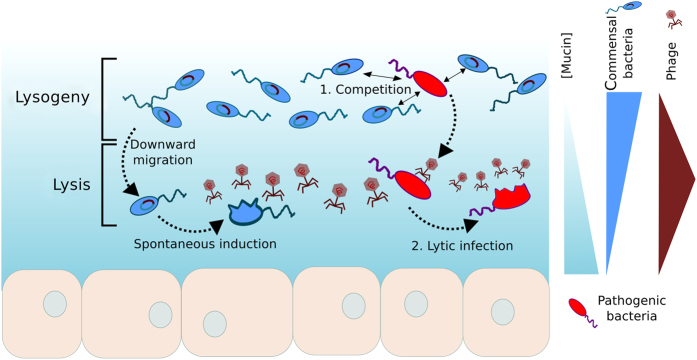
Phages can exploit their bacterial hosts by lytic infection, when many viral particles are released at cell lysis, or by lysogeny, when phages integrate into the host's genome. We recently proposed a new dynamic model of bacteria-phage interactions in which lysogeny predominates at high microbial abundance and growth rates. This model, named Piggyback-the-Winner (PtW), contrasts to current accepted models on the frequency of lysis and lysogeny and predicts that phages integrate into their hosts' genomes as prophages when microbial abundances and growth rates are high. According to PtW, switching to the temperate life cycle reduces phage predation control on bacterial abundance and confers superinfection exclusion, preventing that a closely-related phage infects the same bacterial cell. Here we examine how PtW is important for metazoans. Specifically, we postulate that PtW and the recently described bacteriophage adherence to mucus (BAM) model are strongly interrelated and have an important role in the development of the microbiome. In BAM, phage produced by the microbiome attach to mucins and protect underlying epithelial cells from invading bacteria. Spatial structuring of the mucus creates a gradient of phage replication strategies consistent with PtW. We predict that lysogeny is favored at the top mucosal layer and lytic predation predominates in the bacteria-sparse intermediary layers. The lysogeny confers competitive advantage to commensals against niche invasion and the lytic infection eliminates potential pathogens from deeper mucus layers.
Conflict of interest statement
The authors declare no conflict of interest.
Figures
References
-
- Thingstad, T. F. Elements of a theory for the mechanisms controlling abundance, diversity, and biogeochemical role of lytic bacterial viruses in aquatic systems. Limnol. Oceanogr. 45, 1320–1328 (2000).
-
- Obeng N., Pratama A. A. & van Elsas J. D. The significance of mutualistic phages for bacterial ecology and evolution. Trends Microbiol. 24: 440–449. (2016). - PubMed
-
- Rohwer, F. & Thurber, R. V. Viruses manipulate the marine environment. Nature 459, 207–212 (2009). - PubMed
-
- Paul, J. H. Prophages in marine bacteria: dangerous molecular time bombs or the key to survival in the seas? ISME J. 2, 579–589 (2008). - PubMed
-
- Paul, J. H. & Jiang, S. C. Occurrence of lysogenic bacteria in marine microbial communities as determined by prophage induction. Mar. Ecol. Prog. Ser. 142, 27–38 (1996).
Publication types
LinkOut - more resources
Full Text Sources
Other Literature Sources
Miscellaneous
