Review
. 2016 Aug 18:2:16017.
doi: 10.1038/npjamd.2016.17. eCollection 2016.

It takes two to tango: NAD+ and sirtuins in aging/longevity control

Affiliations
Review

It takes two to tango: NAD+ and sirtuins in aging/longevity control

Shin-Ichiro Imai et al. NPJ Aging Mech Dis. .

Abstract

The coupling of nicotinamide adenine dinucleotide (NAD+) breakdown and protein deacylation is a unique feature of the family of proteins called 'sirtuins.' This intimate connection between NAD+ and sirtuins has an ancient origin and provides a mechanistic foundation that translates the regulation of energy metabolism into aging and longevity control in diverse organisms. Although the field of sirtuin research went through intensive controversies, an increasing number of recent studies have put those controversies to rest and fully established the significance of sirtuins as an evolutionarily conserved aging/longevity regulator. The tight connection between NAD+ and sirtuins is regulated at several different levels, adding further complexity to their coordination in metabolic and aging/longevity control. Interestingly, it has been demonstrated that NAD+ availability decreases over age, reducing sirtuin activities and affecting the communication between the nucleus and mitochondria at a cellular level and also between the hypothalamus and adipose tissue at a systemic level. These dynamic cellular and systemic processes likely contribute to the development of age-associated functional decline and the pathogenesis of diseases of aging. To mitigate these age-associated problems, supplementation of key NAD+ intermediates is currently drawing significant attention. In this review article, we will summarize these important aspects of the intimate connection between NAD+ and sirtuins in aging/longevity control.


Conflict of interest statement

SI is a co-founder of Metro Midwest Biotech. LG is a founder of Elysium Health and consults for GSK, Chronos (Oxford), and Segterra.

Figures
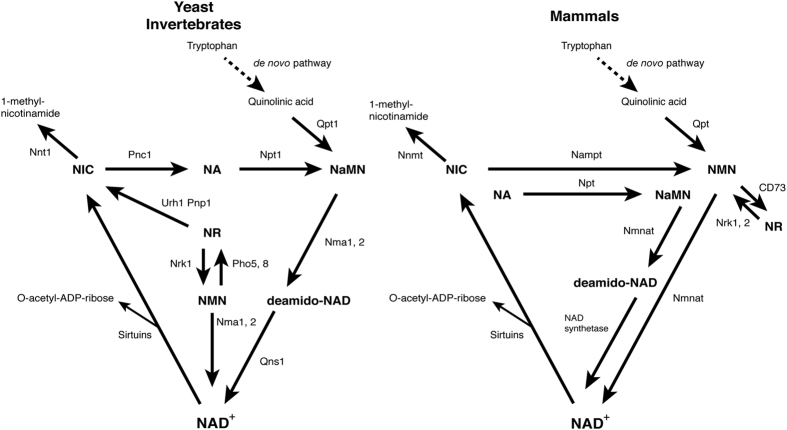
Figure 1
Figure 1
Comparison of NAD+ biosynthetic pathways between yeast/invertebrates and mammals. Left panel: NAD+ biosynthetic pathways in the budding yeast Saccharomyces cerevisiae and invertebrates. The pathways from NIC, NA, and NR and the de novo pathway from tryptophan are shown. Right panel: NAD+ biosynthetic pathways in mammals. In mammals, NIC is a predominant NAD+ precursor. NA, NR, and tryptophan can also be utilized to synthesize NAD+. The de novo pathway and the NAD+ biosynthetic pathway from NA are evolutionarily conserved, whereas the NAD+ biosynthetic pathway from NIC is mediated by NAMPT. In this figure, only sirtuins are shown among multiple NAD+-consuming enzymes that break NAD+ into nicotinamide and ADP-ribose. Mammals have two NR kinases (Nrk1 and 2) and ecto-5′-nucleotidase CD73 to produce NMN and NR, respectively. NA, nicotinic acid; NAD+, nicotinamide adenine dinucleotide; NAMPT, nicotinamide phosphoribosyltransferase; NIC, nicotinamide; NR, nicotinamide riboside; Nrk1, nicotinamide ribose kinase 1; Npt1, nicotinic acid phosphoribosyltransferase; Nma1, 2, nicotinic acid mononucleotide adenylyltransferase 1, 2; Nnt1, nicotinamide-N-methyltransferase; Npt, nicotinic acid phosphoribosyltransferase; NMNAT, NMN adenylyltransferase; NNMT, nicotinamide-N-methyltransferase; NaMN, nicotinic acid mononucleotide; NMN, nicotinamide mononucleotide; Pho5, 8, phosphatase 5, 8; Pnp1, purine nucleoside phosphorylase; Pnc1, nicotinamidase; Qpt, quinolinic acid phosphoribosyltransferase; Qns1, NAD synthetase; Qpt1, quinolinic acid phosphoribosyltransfease; Urh1, uridine hydrolase.
Figure 2
Figure 2
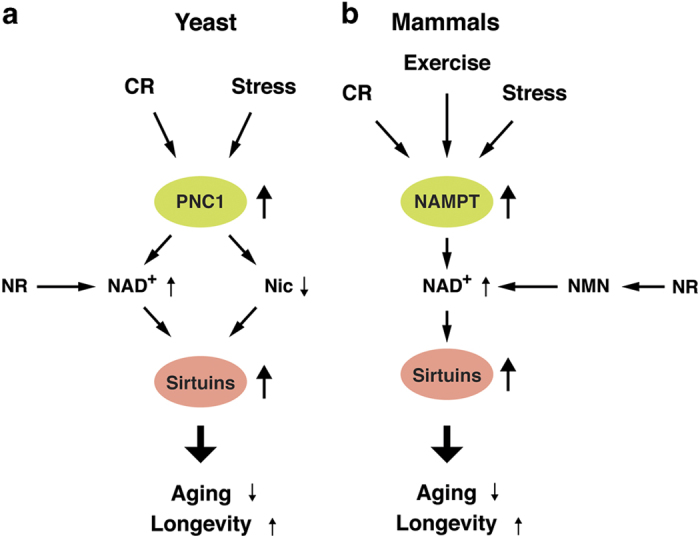
Responses of NAD+ biosynthetic enzymes and sirtuins to nutritional and environmental cues in aging/longevity control. (a) Responses of PNC1 and sirtuins in budding yeast Saccharomyces cerevisiae and invertebrates (worms and flies) to caloric restriction (CR) and stress. When PNC1 levels increase in response to CR or stress in these organisms, the NAD+ biosynthetic flux increases and nicotinamide levels decrease, both contributing to the enhancement of sirtuin activity. (b) Responses of NAMPT and sirtuins in mammals to CR, exercise, and stress. Upregulation of NAMPT activates sirtuins primarily through the increase in NAD+ biosynthesis because nicotinamide levels are normally much lower in mammals, compared to yeast. CR, caloric restriction; NAD+, nicotinamide adenine dinucleotide; NAMPT, nicotinamide phosphoribosyltransferase.
Figure 3
Figure 3
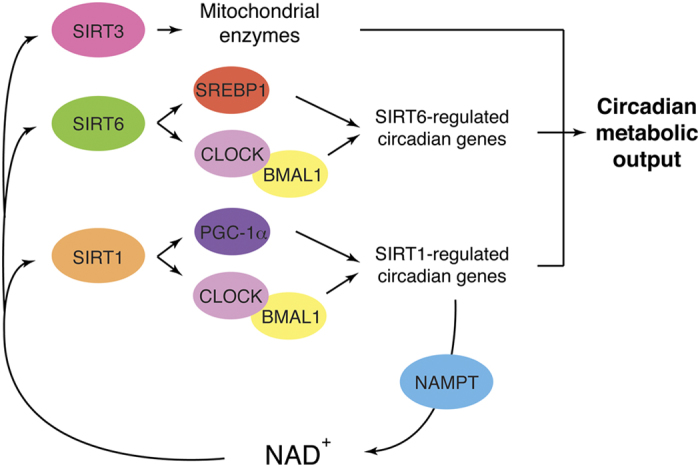
Circadian regulation of NAD+ biosynthesis and metabolism by NAMPT and sirtuins. Nampt is one of the SIRT1/CLOCK/BMAL1-regulated circadian genes, and SIRT1 and NAMPT comprise a novel circadian regulatory feedback loop, producing the circadian oscillation of NAD+. This circadian oscillation of NAD+ drives SIRT1, SIRT3, and SIRT6 activities. SIRT1 feedbacks the key circadian transcription factors CLOCK/BMAL and regulates genes related to peptide and cofactor biosynthesis in the liver. SIRT1 also regulates Bmal1 expression through PGC-1α in the suprachiasmatic nucleus. SIRT6 controls the chromatin recruitment of CLOCK/BMAL1 and SREBP1 and regulates genes related to lipid and carbohydrate metabolism. SIRT3 regulates oxidative metabolism in mitochondria through circadian deacetylation of mitochondrial oxidative enzymes. All these circadian activity changes of sirtuins produce robust metabolic outputs in many different tissues and organs. NAD+, nicotinamide adenine dinucleotide; NAMPT, nicotinamide phosphoribosyltransferase.
Figure 4
Figure 4
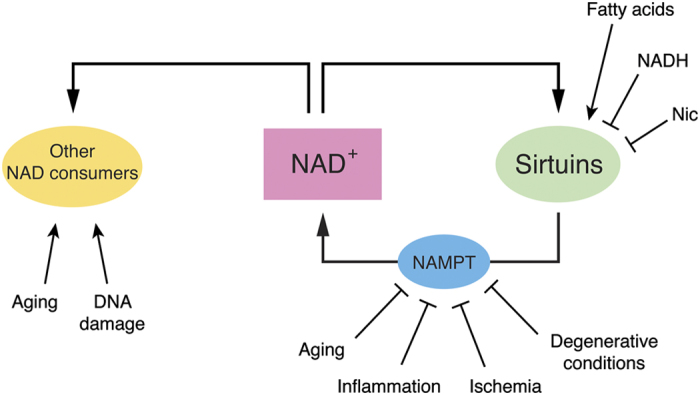
Regulation of the functional connection between NAD+ and sirtuins. There are at least three levels of regulation: (1) regulation of NAD+ biosynthesis, particularly mediated by NAMPT, (2) modulation of sirtuin activity, including inhibition by nicotinamide and NADH and activation of SIRT6 by long-chain fatty acids, and (3) competition with other NAD+-consuming enzymes, such as PARPs and CD38/157 ectoenzymes. See details in text. NAD+, nicotinamide adenine dinucleotide; NAMPT, nicotinamide phosphoribosyltransferase; PARPs, poly-ADP-ribose polymerases.
Figure 5
Figure 5
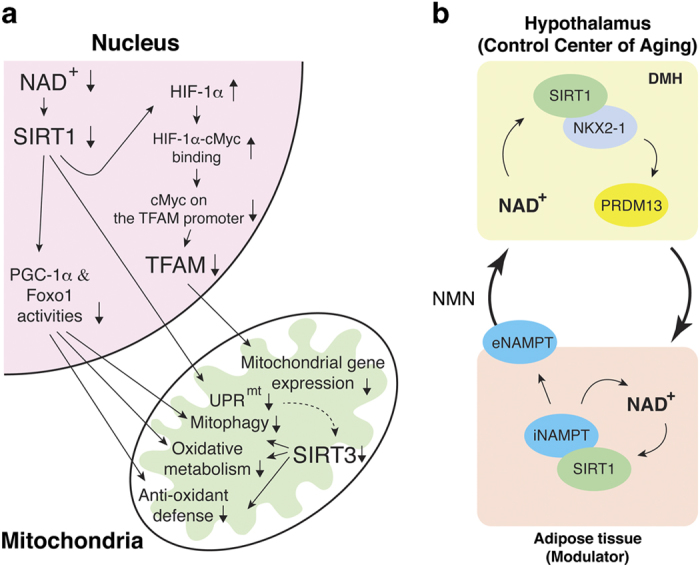
Importance of the communication between the nucleus and mitochondria at a cellular level (a) and between the hypothalamus and adipose tissue at a systemic level (b) in aging/longevity control. See details in text.

References

    1. Imai, S., Armstrong, C. M., Kaeberlein, M. & Guarente, L. Transcriptional silencing and longevity protein Sir2 is an NAD-dependent histone deacetylase. Nature 403, 795–800 (2000). - PubMed
    1. Canto, C., Menzies, K. J. & Auwerx, J. NAD(+) metabolism and the control of energy homeostasis: a balancing act between mitochondria and the nucleus. Cell Metab. 22, 31–53 (2015). - PMC - PubMed
    1. Imai, S. & Guarente, L. NAD+ and sirtuins in aging and disease. Trends Cell Biol. 24, 464–471 (2014). - PMC - PubMed
    1. Choudhary, C., Weinert, B. T., Nishida, Y., Verdin, E. & Mann, M. The growing landscape of lysine acetylation links metabolism and cell signalling. Nat. Rev. Mol. Cell Biol. 15, 536–550 (2014). - PubMed
    1. Wagner, G. R. & Hirschey, M. D. Nonenzymatic protein acylation as a carbon stress regulated by sirtuin deacylases. Mol Cell. 54, 5–16 (2014). - PMC - PubMed

LinkOut - more resources