Review
. 2017 Sep 15:3:343-363.
doi: 10.1146/annurev-vision-102016-061249. Epub 2017 Jul 19.

Visual Perceptual Learning and Models

Affiliations
Review

Visual Perceptual Learning and Models

Barbara Dosher et al. Annu Rev Vis Sci. .

Abstract

Visual perceptual learning through practice or training can significantly improve performance on visual tasks. Originally seen as a manifestation of plasticity in the primary visual cortex, perceptual learning is more readily understood as improvements in the function of brain networks that integrate processes, including sensory representations, decision, attention, and reward, and balance plasticity with system stability. This review considers the primary phenomena of perceptual learning, theories of perceptual learning, and perceptual learning's effect on signal and noise in visual processing and decision. Models, especially computational models, play a key role in behavioral and physiological investigations of the mechanisms of perceptual learning and for understanding, predicting, and optimizing human perceptual processes, learning, and performance. Performance improvements resulting from reweighting or readout of sensory inputs to decision provide a strong theoretical framework for interpreting perceptual learning and transfer that may prove useful in optimizing learning in real-world applications.

Keywords: models; optimization; perceptual learning; plasticity; signal-to-noise; stability.


Figures
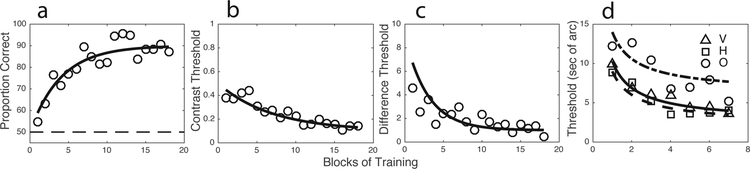
Figure 1.
Figure 1.
Visual perceptual learning improves task performance measured in different ways: improving percent correct discrimination (a), contrast thresholds (b), or feature difference threshold differences (c) (hypothetical data and generating exponential learning curves). (d) Difference thresholds (arcsec) from a line offset hyperacuity task for vertical, horizontal, and oblique layouts (data from McKee & Westheimer, 1981), fitted exponential learning curves added. Reproduced with permission from B. Dosher and Z.L. Lu.
Figure 2.
Figure 2.
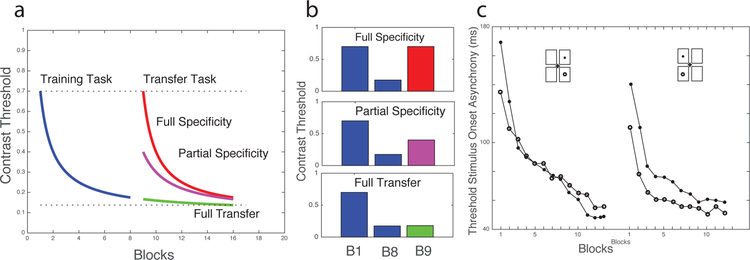
Learning in a training task can express varying benefits for a transfer task. (a) Hypothetical learning curves showing full specificity, partial specificity, and full transfer; (b) corresponding patterns in bar graphs that often summarize these results; and (c) data from an experiment training texture detection in different quadrants of the visual field that shows significant specificity to retinal location and partial transfer (data from Karni & Sagi, 1999, figure 1). (a)-(c) reproduced with permission from B. Dosher and Z.L. Lu. (d) with permission from XXXX
Figure 3.
Figure 3.
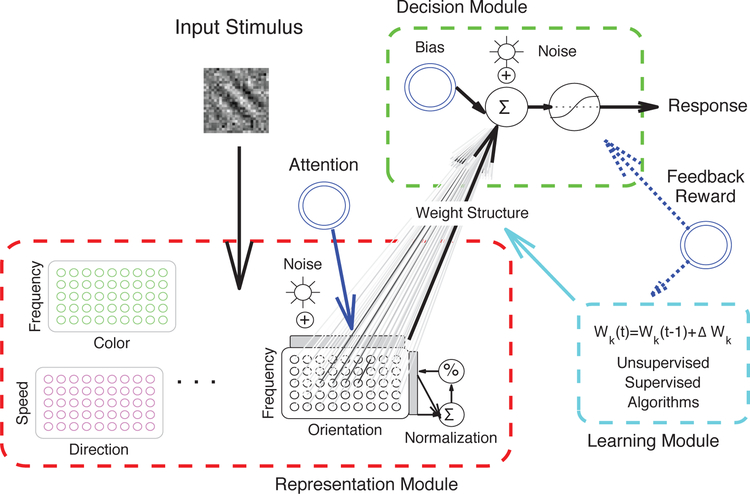
A reweighting framework for visual perceptual learning takes images as input, processes them in task-relevant representations, makes decisions based on the weighted sum of the relevant normalized noisy representation activations, and learns by changing the weights through unsupervised and supervised learning algorithms. As in the observer models, performance depends on normalization and internal noise. Reproduced with permission from B. Dosher and Z.L. Lu.
Figure 4.
Figure 4.
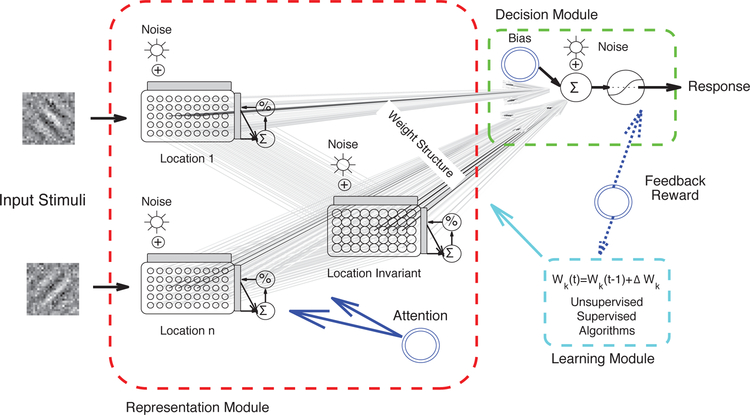
A framework for predicting transfers across and interactions between learning in multiple retinal locations based on a hierarchical architecture of sensory representations including relatively location invariant representations. Perceptual learning in one retinal location trains weights between both location-specific and location-invariant representations and decision. Transfer reflects compatibility of optimized weight structures, while specificity reflects independence or incompatibility of optimized weight structures for the training and transfer tasks. Reproduced with permission from B. Dosher and Z.L. Lu.
Figure 5.
Figure 5.
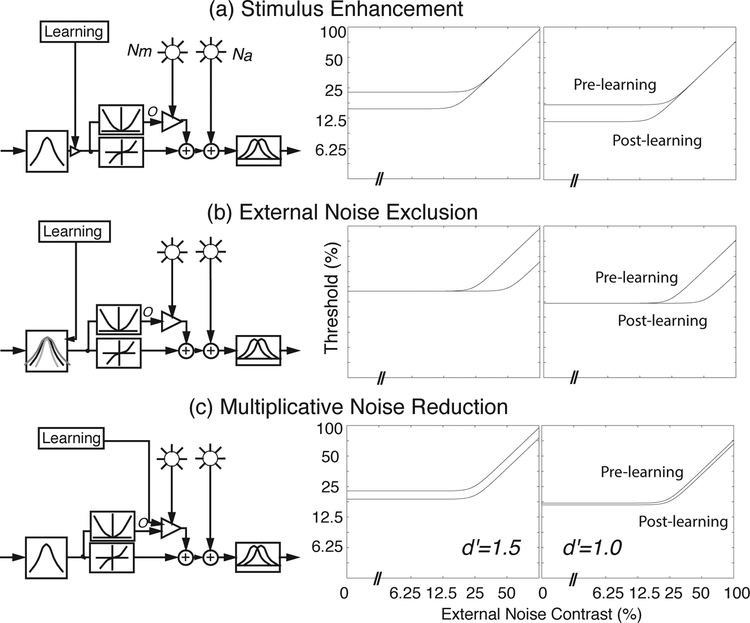
Perceptual template model (PTM) of the observer and signature changes in contrast threshold versus external noise contrast (TvC) functions for three mechanisms of perceptual learning. The observer model includes (from left to right) a template tuned to the target stimulus, point nonlinearity, multiplicative noise, additive noise, and a decision template. Three mechanisms of perceptual learning correspond to stimulus enhancement (or internal additive noise reduction), external noise exclusion (filtering), and changes in multiplicative internal noise or nonlinearity)—or mixtures of these. Modified from Dosher & Lu (1999), figure 3). Reproduced with permission from B. Dosher and Z.L. Lu.

References

    1. Aberg KC, Herzog MH. 2012. Different types of feedback change decision criterion and sensitivity differently in perceptual learning. Journal of vision 12: 3–3 - PubMed
    1. Adab HZ, Vogels R. 2011. Practicing coarse orientation discrimination improves orientation signals in macaque cortical area v4. Current biology 21: 1661–66 - PubMed
    1. Adini Y, Wilkonsky A, Haspel R, Tsodyks M, Sagi D. 2004. Perceptual learning in contrast discrimination: The effect of contrast uncertainty. Journal of Vision 4: 2–2 - PubMed
    1. Ahissar M, Hochstein S. 1993. Attentional control of early perceptual learning. Proceedings of the National Academy of Sciences 90: 5718–22 - PMC - PubMed
    1. Ahissar M, Hochstein S. 2004. The reverse hierarchy theory of visual perceptual learning. Trends in cognitive sciences 8: 457–64 - PubMed

MeSH terms