


Application, technical issues, and interpretation of C1q for graft outcome
- PMID: 28723698
- PMCID: PMC5662152
- DOI: 10.1097/MOT.0000000000000454
Application, technical issues, and interpretation of C1q for graft outcome
Abstract
Purpose of review: Significant interest and controversy surround the use of C1q for determining risk of antibody-mediated rejection (AMR) and graft loss. Alternate models for predicting outcomes have been proposed. This review focuses on the correlation of currently utilized assays for outcome, together with the technical and theoretical limitations, to distill current thinking.
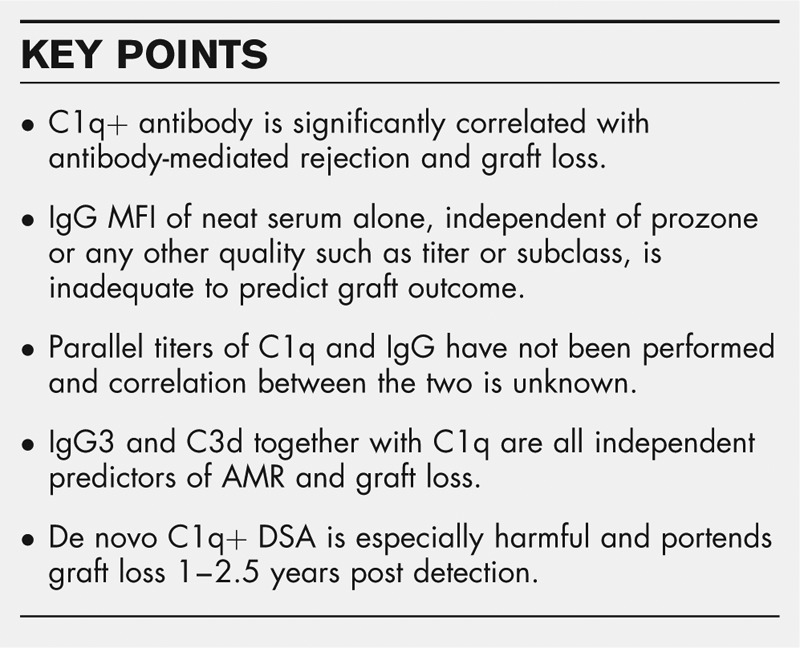
Recent findings: Results demonstrate that C1q status is significantly correlated with AMR and graft loss. There is general consensus that C1q is more clinically relevant for graft outcome than neat IgG MFI. IgG titers, subclass, and other complement assays have now been studied to determine if they are more relevant. Only IgG3 and possibly C3d fixation have shown added value to C1q for outcome correlation. Direct parallel titer comparisons of C1q and IgG are lacking and the correlation is unknown.
Summary: Overall, results confirm the correlation with C1q+ donor-specific antibody (DSA) for AMR and graft loss. The association is stronger posttransplant. C1q+ de novo antibody appears to be especially detrimental portending graft loss in about 1-2.5 years post detection. Recommendations to biopsy and treat at time of de novo C1q+ antibody detection have been suggested by several groups.
Figures
References
-
- Chin C, Chen G, Sequeria F, et al. Clinical usefulness of a novel C1q assay to detect immunoglobulin G antibodies capable of fixing complement in sensitized pediatric heart transplant patients. J Heart Lung Transplant 2011; 30:158–163. - PubMed
-
- Sutherland SM, Chen G, Sequeira FA, et al. Complement-fixing donor-specific antibodies identified by a novel C1q assay are associated with allograft loss. Pediatr Transplant 2012; 16:12–17. - PubMed
-
- Yabu JM, Higgins JP, Chen G, et al. C1q-fixing human leukocyte antigen antibodies are specific for predicting transplant glomerulopathy and late graft failure after kidney transplantation. Transplantation 2011; 91:342–347. - PubMed
-
- Loupy A, Lefaucheur C, Vernerey D, et al. Complement-binding anti-HLA antibodies and kidney-allograft survival. New Engl J Med 2013; 369:1215–1226. - PubMed
-
- Chen G, Sequeira F, Tyan DB. Novel C1q assay reveals a clinically relevant subset of human leukocyte antigen antibodies independent of immunoglobulin G strength on single antigen beads. Hum Immunol 2011; 72:849–858. - PubMed
Publication types
MeSH terms
Substances
LinkOut - more resources
Full Text Sources
Other Literature Sources
Research Materials
