. 2017 Jul 20;2(14):e93433.
doi: 10.1172/jci.insight.93433.

Partially exhausted tumor-infiltrating lymphocytes predict response to combination immunotherapy

Affiliations

Partially exhausted tumor-infiltrating lymphocytes predict response to combination immunotherapy

Kimberly Loo et al. JCI Insight. .

Abstract

Background: Programmed death 1 (PD-1) inhibition activates partially exhausted cytotoxic T lymphocytes (peCTLs) and induces tumor regression. We previously showed that the peCTL fraction predicts response to anti-PD-1 monotherapy. Here, we sought to correlate peCTL and regulatory T lymphocyte (Treg) levels with response to combination immunotherapy, and with demographic/disease characteristics, in metastatic melanoma patients.

Methods: Pretreatment melanoma samples underwent multiparameter flow cytometric analysis. Patients were treated with anti-PD-1 monotherapy or combination therapy, and responses determined by Response Evaluation Criteria in Solid Tumors version 1.1 (RECIST v1.1) criteria. peCTL and Treg levels across demographic/disease variables were compared. Low versus high peCTL (≤20% vs. >20%) were defined from a previous study.

Results: One hundred and two melanoma patients were identified. The peCTL fraction was higher in responders than nonresponders. Low peCTL correlated with female sex and liver metastasis, but not with lactate dehydrogenase (LDH), tumor stage, or age. While overall response rates (ORRs) to anti-PD-1 monotherapy and combination therapy were similar in high-peCTL patients, low-peCTL patients given combination therapy demonstrated higher ORRs than those who received monotherapy. Treg levels were not associated with these factors nor with response.

Conclusion: In melanoma, pretreatment peCTL fraction is reduced in women and in patients with liver metastasis. In low-peCTL patients, anti-PD-1 combination therapy is associated with significantly higher ORR than anti-PD-1 monotherapy. Fewer tumor-infiltrating peCTLs may be required to achieve response to combination immunotherapy.

Trial registration: UCSF IRB Protocol 138510FUNDING. NIH DP2-AR068130, K08-AR062064, AR066821, and Burroughs Wellcome CAMS-1010934 (M.D.R.). Amoroso and Cook Fund, and the Parker Institute for Cancer Immunotherapy (A.I.D.).

Keywords: Cancer immunotherapy; Dermatology; Melanoma; Oncology; T cells.


Conflict of interest statement

Conflict of interest: A.P. Algazi discloses institutional research funding from Novartis, Merck, Bristol-Myers Squibb (BMS), OncoSec, Acerta, AstraZeneca, MedImmune, Tessa, Celldex, Celgene, and Plexxikon. M.F. Krummel discloses ownership of shares in Pionyr Immunotherapeutics, and lab funding from BMS, Amgen, and Abbvie. A.I. Daud discloses ownership of shares in OncoSec Inc.

Figures

Figure 1
Figure 1. Percentage of partially exhausted cytotoxic T lymphocytes (peCTLs, CTLA-4hiPD-1hi) and regulatory T lymphocytes (Tregs, CD25+FoxP3+CD4+) in relation to patient sex and age.
Flow cytometric data from metastatic tumors taken and pregated on live CD45+CD3+CD8+ cells. (A) peCTLs expressed as a percentage of total CD8+ T cells, with sex on the x axis (n = 102). (B) Tregs expressed as a percentage of total CD4+ T cell population, with sex on the x axis (n = 93). (C) peCTLs as a percentage of total CD8+ T cells, with age on the x axis (n = 102). (D) Percentage of Tregs in the total CD4+ T cell population, with age on the x axis (n = 93). Statistical significance was determined by the Mann-Whitney test; P value is shown. NS, not significant.
Figure 2
Figure 2. Percentage of partially exhausted cytotoxic T lymphocytes (peCTLs, CTLA-4hiPD-1hi) and regulatory T lymphocytes (Tregs, CD25+FoxP3+CD4+) in relation to disease stage, liver metastasis, and lactate dehydrogenase (LDH) levels.
Flow cytometric data from metastatic tumors taken and pregated on live CD45+CD3+CD8+ cells. (A) peCTLs as a percentage of total CD8+ T cells, with disease stage on the x axis (n = 102). (B) peCTLs as a percentage of total CD8+ T cells, with disease stage on the x axis (n = 102). (C) Tregs as a percentage of total CD8+ T cells, with presence of liver metastasis on the x axis (n = 93). (D) Percentage of Tregs in the total CD4+ population, with the presence or absence of liver metastasis on the x axis (n = 93). Statistical significance was determined by the Mann-Whitney test; 2-sided P value is shown. NS, not significant. (E) peCTLs as a percentage of total CD8+ T cells, with LDH levels on the x axis (n = 102). (F) Percentage of Tregs in the total CD4+ population, with the presence or absence of LDH elevation on the x axis (n = 93). Statistical significance was determined by the Mann-Whitney test; 2-sided P value is shown.
Figure 3
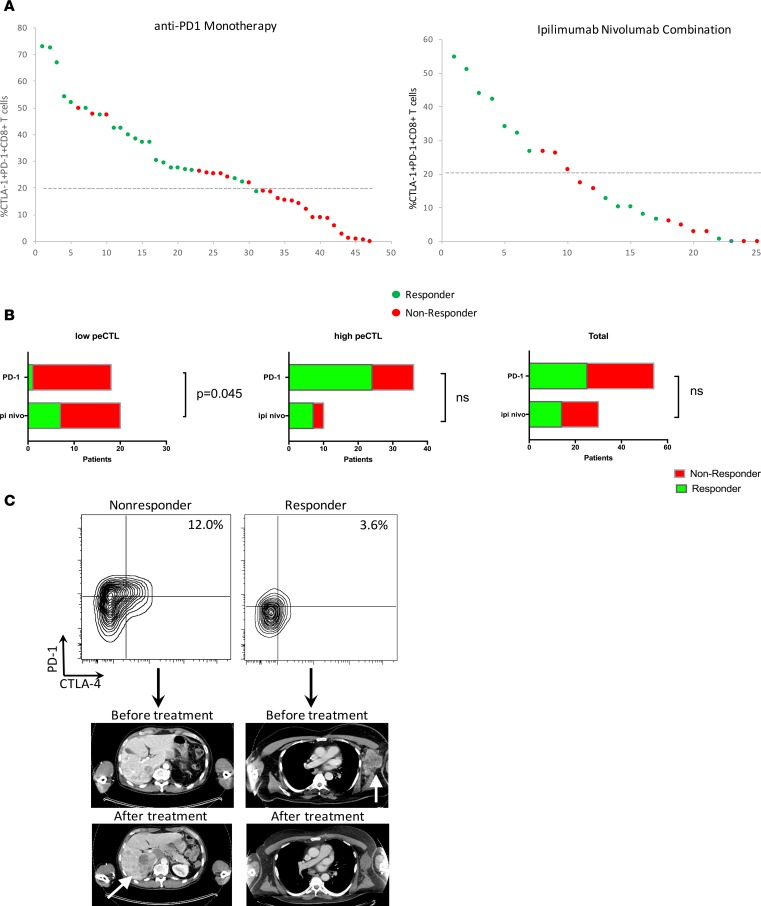
Figure 3. Treatment response to anti–programmed death 1 (PD-1) monotherapy or ipilimumab/nivolumab combination therapy correlated with pretreatment partially exhausted cytotoxic T lymphocytes (peCTLs, CTLA-4hiPD-1hi).
(A) Flow cytometric data from metastatic tumors taken and pregated on live CD45+CD3+CD8+ cells. peCTLs as a percentage of total CD8+ T cells is shown on the y axis, and response to either anti–PD-1 monotherapy (n = 64) or ipilimumab/nivolumab combination (n = 29) is designated by color. Patients with partial or complete responses (PR+CR) by Response Evaluation Criteria in Solid Tumors version 1.1 (RECIST v1.1) are shown in green, and patients with stable or progressive disease (SD+PD) are shown in red. (B) Responders and nonresponders to anti–PD-1 monotherapy and combination therapy relative to pretreatment peCTL count. Low peCTL count is 20% or lower, high peCTL count is greater than 20%. For patients with low peCTLs (left), the difference in objective response rate was 35% for ipilimumab plus nivolumab, while it was 5.6% for anti–PD-1 monotherapy (P = 0.045 by Fisher’s exact test). The difference for patients with high peCTLs (middle) was not significantly different: 70% for ipilimumab plus nivolumab and 66.7% for anti–PD-1 monotherapy. For the overall cohort (right), the difference was also not statistically significant: objective response rate was 46.7% for ipilimumab plus nivolumab versus 46.3% for anti–PD-1 monotherapy. NS, not significant. (C) Illustrative examples for 2 patients. Left: A nonresponder to anti–PD-1 monotherapy with 12% peCTLs with progression in the liver (white arrow). Right: A responder to ipilimumab plus nivolumab combination therapy with 3.6% peCTLs shows a response in a large left axillary mass (white arrow).
Figure 4
Figure 4. Percentage of partially exhausted cytotoxic T lymphocytes (peCTLs, CTLA-4hiPD-1hi) and regulatory T lymphocytes (Tregs, CD25+FoxP3+CD4+) in relation to objective response.
Flow cytometric data from metastatic tumors pregated on live CD45+CD3+CD8+ cells. peCTL (left) shows activated, exhausted peCTLs as a percentage of total CD8+ T cells, with response status on the x axis. Patients with a complete or partial response (CR+PR) were considered to be responders, and those with stable disease or progressive disease (SD+PD) as best response were considered to be nonresponders. Treg (right) shows Tregs as a percentage of total CD4+ T cell population, with response status on the x axis. Statistical significance was determined by the Mann-Whitney test; P value is shown. NS, not significant.

References

    1. Pitt JM, Marabelle A, Eggermont A, Soria JC, Kroemer G, Zitvogel L. Targeting the tumor microenvironment: removing obstruction to anticancer immune responses and immunotherapy. Ann Oncol. 2016;27(8):1482–1492. doi: 10.1093/annonc/mdw168. - DOI - PubMed
    1. Pauken KE, Wherry EJ. Overcoming T cell exhaustion in infection and cancer. Trends Immunol. 2015;36(4):265–276. doi: 10.1016/j.it.2015.02.008. - DOI - PMC - PubMed
    1. Brahmer JR, et al. Phase I study of single-agent anti-programmed death-1 (MDX-1106) in refractory solid tumors: safety, clinical activity, pharmacodynamics, and immunologic correlates. J Clin Oncol. 2010;28(19):3167–3175. doi: 10.1200/JCO.2009.26.7609. - DOI - PMC - PubMed
    1. Hamid O, et al. Safety and tumor responses with lambrolizumab (anti-PD-1) in melanoma. N Engl J Med. 2013;369(2):134–144. doi: 10.1056/NEJMoa1305133. - DOI - PMC - PubMed
    1. Rizvi NA, et al. Activity and safety of nivolumab, an anti-PD-1 immune checkpoint inhibitor, for patients with advanced, refractory squamous non-small-cell lung cancer (CheckMate 063): a phase 2, single-arm trial. Lancet Oncol. 2015;16(3):257–265. doi: 10.1016/S1470-2045(15)70054-9. - DOI - PMC - PubMed