


Pressure-induced anomalous valence crossover in cubic YbCu5-based compounds
- PMID: 28725055
- PMCID: PMC5517414
- DOI: 10.1038/s41598-017-06190-3
Pressure-induced anomalous valence crossover in cubic YbCu5-based compounds
Abstract
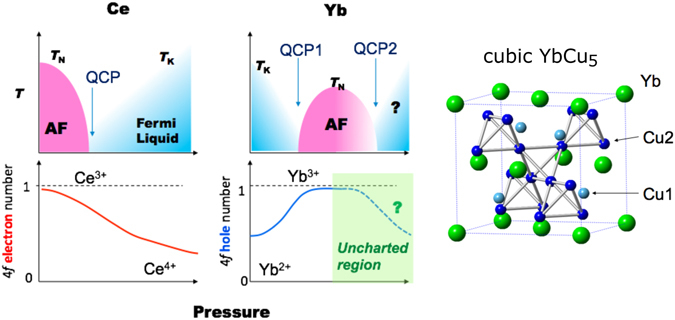
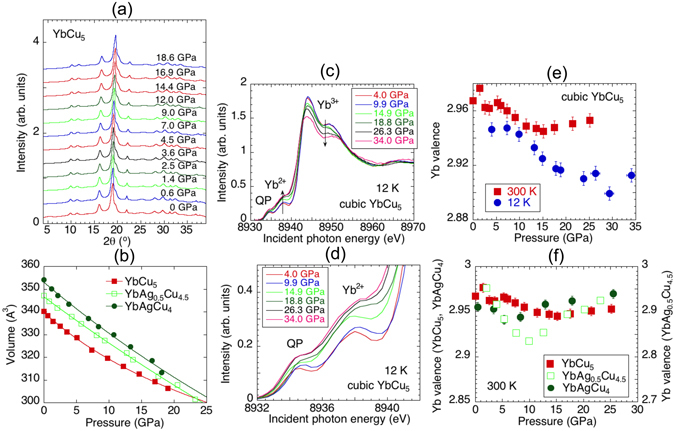
A pressure-induced anomalous valence crossover without structural phase transition is observed in archetypal cubic YbCu5 based heavy Fermion systems. The Yb valence is found to decrease with increasing pressure, indicating a pressure-induced crossover from a localized 4f 13 state to the valence fluctuation regime, which is not expected for Yb systems with conventional c-f hybridization. This result further highlights the remarkable singularity of the valence behavior in compressed YbCu5-based compounds. The intermetallics Yb2Pd2Sn, which shows two quantum critical points (QCP) under pressure and has been proposed as a potential candidate for a reentrant Yb2+ state at high pressure, was also studied for comparison. In this compound, the Yb valence monotonically increases with pressure, disproving a scenario of a reentrant non-magnetic Yb2+ state at the second QCP.
Conflict of interest statement
The authors declare that they have no competing interests.
Figures

References
-
- Lawrence JM, Riseborough PS, Parks RD. Valence fluctuation phenomena. Rep. Prog. Phys. 1981;44:1. doi: 10.1088/0034-4885/44/1/001. - DOI
-
- Löhneysen Hv, Rosch A, Vojta M, Wölfle P. Fermi-liquid instabilities at magnetic quantum phase transitions. Rev. Mod. Phys. 2007;79:1015. doi: 10.1103/RevModPhys.79.1015. - DOI
-
- Herbst JF, Wilkins JW. Pressure-induced 4f occupancy enhancement in the rare-earth metals. Phys. Rev. B. 1984;29:5992. doi: 10.1103/PhysRevB.29.5992. - DOI
-
- Chesnut GN, Vohra YK. Structural and electronic transitions in Ytterbium metal to 202 GPa. Phy. Rev. Lett. 1999;82:1712. doi: 10.1103/PhysRevLett.82.1712. - DOI
-
- Goltsev AV, Abd-Elmeguid MM. Origin of the pressure dependence of the Kondo temperature in Ce- and Yb-based heavy-fermion compounds. J. Phys: Condens. Matter. 2005;17:S813.
Publication types
LinkOut - more resources
Full Text Sources
Other Literature Sources
