Review
. 2017 Aug;53(3):61-77.
doi: 10.1016/j.jdsr.2016.11.001. Epub 2016 Dec 19.

Therapeutic strategies with oral fluoropyrimidine anticancer agent, S-1 against oral cancer

Affiliations
Review

Therapeutic strategies with oral fluoropyrimidine anticancer agent, S-1 against oral cancer

Koji Harada et al. Jpn Dent Sci Rev. 2017 Aug.

Abstract

Oral cancer has been recognized as a tumor with low sensitivity to anticancer agents. However, introduction of S-1, an oral cancer agent is improving treatment outcome for patients with oral cancer. In addition, S-1, as a main drug for oral cancer treatment in Japan can be easily available for outpatients. In fact, S-1 exerts high therapeutic effects with acceptable side effects. Moreover, combined chemotherapy with S-1 shows higher efficacy than S-1 alone, and combined chemo-radiotherapy with S-1 exerts remarkable therapeutic effects. Furthermore, we should consider the combined therapy of S-1 and molecular targeting agents right now as these combinations were reportedly useful for oral cancer treatment. Here, we describe our findings related to S-1 that were obtained experimentally and clinically, and favorable therapeutic strategies with S-1 against oral cancer with bibliographic considerations.

Keywords: Chemo-radiotherapy; Chemotherapy; Oral cancer; S-1.


Figures

Figure 1
Figure 1
Transition of fluoropyrimidine related anticancer agents. Heidelberger et al. discovered 5-FU in 1957, and Giller et al. artificially synthesized tegafur (FT) as the first 5-FU prodrug in 1967. In addition, Fujii et al. developed oral 5-FU prodrug tegafur/uracil (UFT®) by using FT in 1976. Moreover, Shirasaka et al. developed a better agent, S-1 in 1996. As policy of S-1 was based on the theory of biochemical modulation of 5-FU, S-1 can maintain efficacious concentrations of 5-FU in plasma by gimeracil, and can reduce the serious gastrointestinal toxicity associated with 5-FU by oteracil potassium.
Figure 2
Figure 2
The metabolic pathway of 5-FU and the molecular mechanisms of S-1 that exert antitumor effects. One of the metabolic pathways of 5-FU begins with the process of phosphorylation by OPRT and further metabolized into (F)RNA. Then, (F)RNA is recognized as an abnormal RNA metabolism, which causes RNA dysfunction. Another process that causes DNA synthesis inhibition starts with phosphorylation of 5-FU by OPRT, then 5-FU is metabolized to FdUMP that forms ternary complex with TS. Also, 5-FU is phosphorylated to FdUrd by TP, TP reversibly converts FdUrd into 5-FU and is involved in the angiogenesis. In addition, DPD can degrade 5-FU in the liver. OPRT, Orotate phosphoribosyl transferase; FUMP, 5-fluorouridine 5′-monophosphate; FUDP, 5-fluorouridine 5′-diphosphate; FUTP, 5-fluorouridine 5′-triphosphate; FdUDP, 5-fluoro-2′-deoxyuridine 5′-diphosphate; FdUMP, 5-fluoro-2′-deoxyuridine 5′-monophosphate; TS, thymidylate synthase; CH2FH4, 5,10-methylentetrahydrofolate; DPD, dihydropyrimidine dehydrogenase; TP, Thymidine phosphorylase; FdUrd, 5-fluoro-2′-deoxyuridine.
Figure 3
Figure 3
Schedule of cancer chemotherapy. Maximum tolerable dose (MTD) is administered about once a month in conventional chemotherapy. On the other hand, low-dose than MTD is administered at a close regular interval with no prolonged breaks in metronomic chemotherapy in order to inhibit vascular endothelial cells as well as tumor cells. In addition, metronomic chemotherapy can inhibit feeding vessels of tumor mass, and may lead to starve cancer cells into surrender even when we do not think that the chemotherapeutic agent is effective on the tumor cells.
Figure 4
Figure 4
Anti-angiogenic property and suppression of survival signal. (A) Tumor bearing nude mice was treated orally either with 10.0 mg/kg S-1 five times a week for 8 weeks as the treatment group, or with 0.5% sodium hydroxypropylmethylcellulose (HPMC) five times a week for 8 weeks as the control group. The growth inhibition of S-1 treated tumors was statistically significant when compared to that of HPMC administered tumors. (B) The expression level of VEGF was down-regulated in S-1 treated tumors after the first two week of administration, though VEGF expression was high and was fairly constant over time in HPMC administered tumors. In addition, the expression level of Thrombospondin 1 (TSP-1) was enhanced in S-1 treated tumors after the first four week of administration, although time-dependent change of TSP-1 expression was not that much prominent in HPMC administered tumors. Moreover, the expression level of CD34 and p-Akt was reduced in S-1 treated tumors after the first two week of administration, whereas CD34 and p-Akt expressions were high in HPMC administered tumors.
Figure 5
Figure 5
Radiosensitization efficacy of Gimeracil. (A) One of the component of S-1, Gimeracil or CDHP hardly exerts antitumor effects at all. However, CDHP in combination with radiation exerted a pronounced antitumor effect. (B) CDHP may exert radiosensitization effects by suppression of DNA double strand break repair systems (non-homologous end joining and homologous recombination), and exerts little influence on survival signals.
Figure 6
Figure 6
CDDP potentiation by Gimeracil. (A) We treated xenografted oral tumors with CDHP and/or CDDP. (B) CDHP in combination with CDDP exerted remarkable antitumor effect though CDHP alone hardly exerts antitumor effects at all.
Figure 7
Figure 7
Investigation of S-1 regimen. (A) We treated xenografted oral tumors with three different regimens with S-1: the four-week treatment and two-week rest (1 cycle), the two-week treatment and one-week rest (2 cycles), or alternate days treatment (6 weeks). (B) Relative tumor growth inhibition was not significantly different between the treated groups. However, body weights were lower in the mice with the four-week treatment and two-week rest or the two-week treatment and one-week rest, than alternate days treatment group.
Figure 8
Figure 8
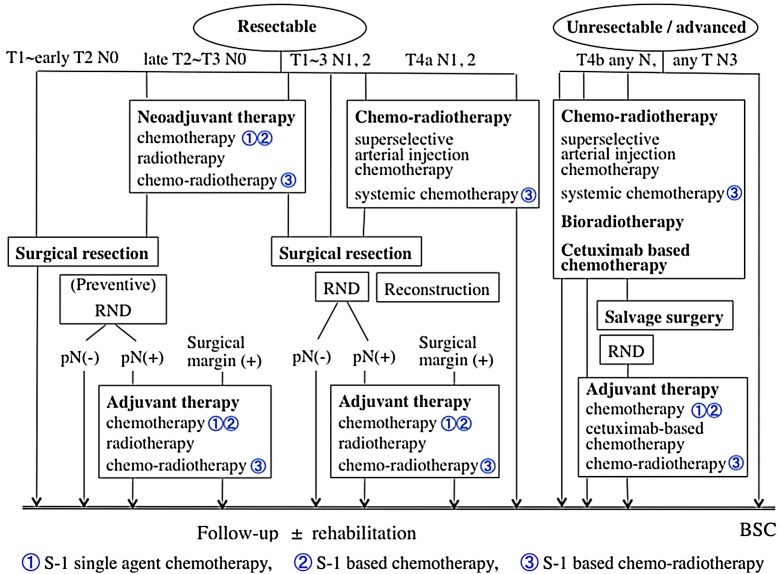
Favorable therapeutic strategies with S-1 against patients with oral cancer. Cetuximab based chemotherapy has been established as the current standard therapy for platinum-resistant recurrent or metastatic oral cancer. Moreover, cetuximab based bio-radiotherapy may be added to the standard therapy for platinum-resistant recurrent or metastatic oral cancer. However, a triplet bio-chemotherapy consisting of cetuximab, 5-FU, and CDDP is not suitable for patients with renal dysfunction. In addition, cetuximab can cause life-threatening infusion reaction. Therefore, S-1 has great potential in unresectable advanced cases as well as high-risk cases that require adjuvant therapy. Also, S-1 based therapy is found to be useful for functional preservation therapy and neoadjuvant therapy. RND, radical neck dissection; BSC, best supportive care.
Figure 9
Figure 9
Mechanisms of S-1 to exert antitumor effects. S-1 has various antitumor effects including antiangiogenic effects, enhacement of apoptosis, suppression of survival signal, radiosensitization efficacy and CDDP potentiation. Briefly, suppression of survival signal such as p-Akt is thought to enhance apoptosis through the activation of caspases. It is thought that inhibition of NF-κB through the IKK suppression may also lead to suppress the expression of angiogenic factors including VEGF and FGF-2 with κB motif in their promoter regions, as well as enhance apoptosis through the activation of caspases. Simultaneously, inhibition of NF-κB can to lead to radiosensitization efficacy and CDDP potentiation. In addition, suppression of DNA double strand break repair systems also may affect radiosensitization efficacy and CDDP potentiation. Moreover, It is thought that enhancement of TSP-1 expression through the MAP kinase and EGR-1 may lead to anti-angiogenesis.

References

    1. Torre L.A., Bray F., Siegel R.L., Ferlay J., Lortet-Tieulent J., Jemal A. Global cancer statistics, 2012. CA Cancer J Clin. 2015;65:87–108. - PubMed
    1. Japan Society for Head and Neck Cancer Registry Committee Report of head and neck cancer registry of Japan. Clinical statistics of registered patients, 2002. Jpn J Head Neck Cancer. 2006;32(Supplement):15–34.
    1. Cancer statistics in Japan—2014. 14th March, 2016. http://ganjoho.jp/reg_stat/statistics/brochure/backnumber/2014_jp.html.
    1. National Comprehensive Cancer Network (NCCN) 2012. NCCN clinical practice guidelines in oncology: head and neck cancers, Ver 1.http://www.nccn.org/clinical.asp 14th March, 2016. - PubMed
    1. Inagi K., Takahashi H., Okamoto M., Nakayama M., Makoshi T., Nagai H. Treatment effects in patients with squamous cell carcinoma of the oral cavity. Acta Otolaryngol Suppl. 2002;547:25–29. - PubMed

LinkOut - more resources