


MINERVA-a platform for visualization and curation of molecular interaction networks
- PMID: 28725475
- PMCID: PMC5516855
- DOI: 10.1038/npjsba.2016.20
MINERVA-a platform for visualization and curation of molecular interaction networks
Abstract
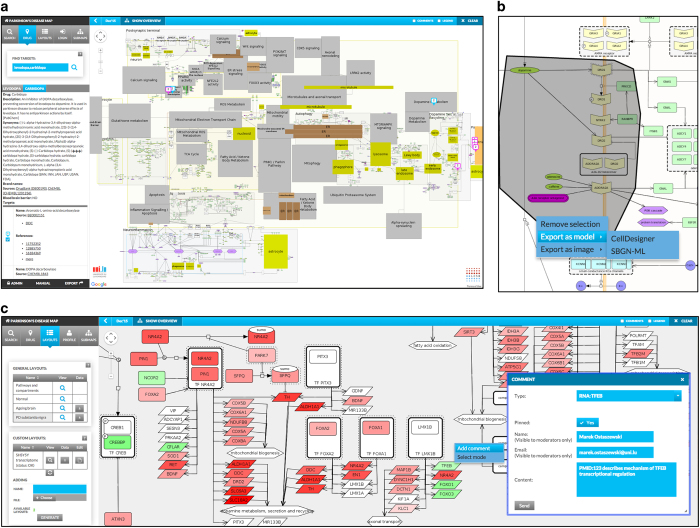
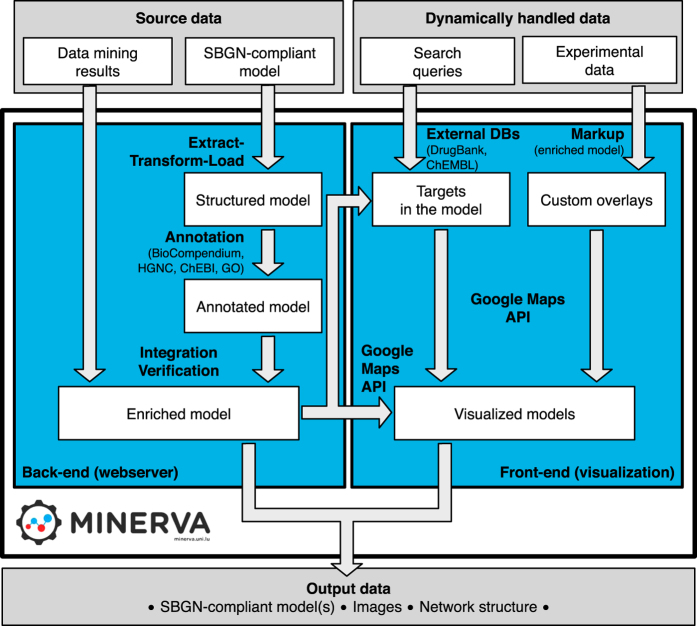
Our growing knowledge about various molecular mechanisms is becoming increasingly more structured and accessible. Different repositories of molecular interactions and available literature enable construction of focused and high-quality molecular interaction networks. Novel tools for curation and exploration of such networks are needed, in order to foster the development of a systems biology environment. In particular, solutions for visualization, annotation and data cross-linking will facilitate usage of network-encoded knowledge in biomedical research. To this end we developed the MINERVA (Molecular Interaction NEtwoRks VisuAlization) platform, a standalone webservice supporting curation, annotation and visualization of molecular interaction networks in Systems Biology Graphical Notation (SBGN)-compliant format. MINERVA provides automated content annotation and verification for improved quality control. The end users can explore and interact with hosted networks, and provide direct feedback to content curators. MINERVA enables mapping drug targets or overlaying experimental data on the visualized networks. Extensive export functions enable downloading areas of the visualized networks as SBGN-compliant models for efficient reuse of hosted networks. The software is available under Affero GPL 3.0 as a Virtual Machine snapshot, Debian package and Docker instance at http://r3lab.uni.lu/web/minerva-website/. We believe that MINERVA is an important contribution to systems biology community, as its architecture enables set-up of locally or globally accessible SBGN-oriented repositories of molecular interaction networks. Its functionalities allow overlay of multiple information layers, facilitating exploration of content and interpretation of data. Moreover, annotation and verification workflows of MINERVA improve the efficiency of curation of networks, allowing life-science researchers to better engage in development and use of biomedical knowledge repositories.
Conflict of interest statement
The authors declare no conflict of interest.
Figures
References
-
- Le Novère, N. et al. The systems biology graphical notation. Nat. Biotechnol. 27, 735–741 (2009). - PubMed
LinkOut - more resources
Full Text Sources
Other Literature Sources
Molecular Biology Databases
Miscellaneous
