


Empathy in the Clinician-Patient Relationship: The Role of Reciprocal Adjustments and Processes of Synchrony
- PMID: 28725863
- PMCID: PMC5513642
- DOI: 10.1177/2374373517699271
Empathy in the Clinician-Patient Relationship: The Role of Reciprocal Adjustments and Processes of Synchrony
Abstract
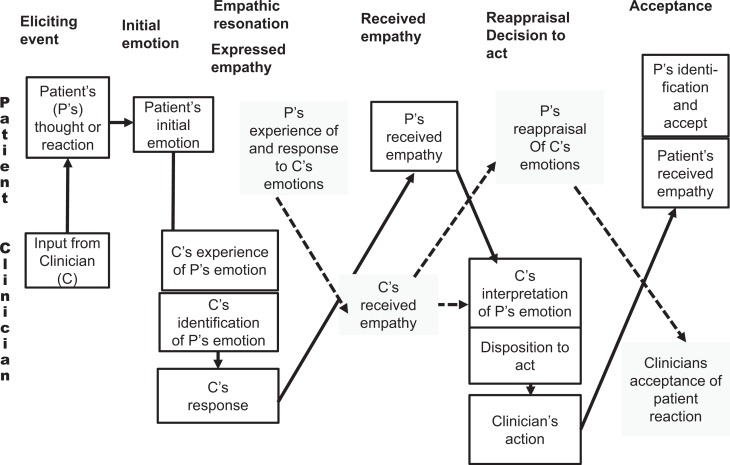
The clinician-patient relationship is asymmetric in the sense that clinicians and patients have different roles in the medical consultation. Yet, there are qualities of reciprocity and mutuality in many clinician-patient encounters, and we suggest that such reciprocity may be related to the phenomenon of empathy. Empathy is often defined as the capacity to place oneself in another's position, but empathy may also be understood as a sequence of reciprocal turns-of talk, starting with the patient's expression of emotion, followed by the perception, vicarious experience, and empathic response by the clinician. These patterns of reciprocity may also include the patient's experience of and response to the clinician's emotions. Researchers in different fields of research have studied how informal human interaction often is characterized by mutuality of lexical alignment and reciprocal adjustments, vocal synchrony, as well as synchrony of movements and psychophysiological processes. A number of studies have linked these measures of reciprocity and synchrony in clinical encounters to the subjective experience of empathy.
Keywords: communication; empathy; linguistic alignment; reciprocal adjustments; synchrony.
Conflict of interest statement
Declaration of Conflicting Interests: The author(s) declared no potential conflicts of interest with respect to the research, authorship, and/or publication of this article.
Figures
References
-
- Matthews DA, Suchman AL, Branch WT., Jr Making ‘connexions’: enhancing the therapeutic potential of patient-clinician relationships. Ann Internal Med. 1993;118:973–7. - PubMed
-
- Hafferty FW. Beyond curriculum reform: confronting medicine’s hidden curriculum. Acad Med. 1998;73:403–7. - PubMed
-
- Shapiro J. Perspective: does medical education promote professional alexithymia? A call for attending to the emotions of patients and self in medical training. Acad Med. 2011;86:326–32. - PubMed
-
- Wynn R, Wynn M. Empathy as an interactionally achieved phenomenon in psychotherapy. Characteristics of some conversational resources. J Pragmatics. 2006;38:1385–97. doi:10.1016/j.pragma.2005.09.008.
LinkOut - more resources
Full Text Sources
Other Literature Sources
